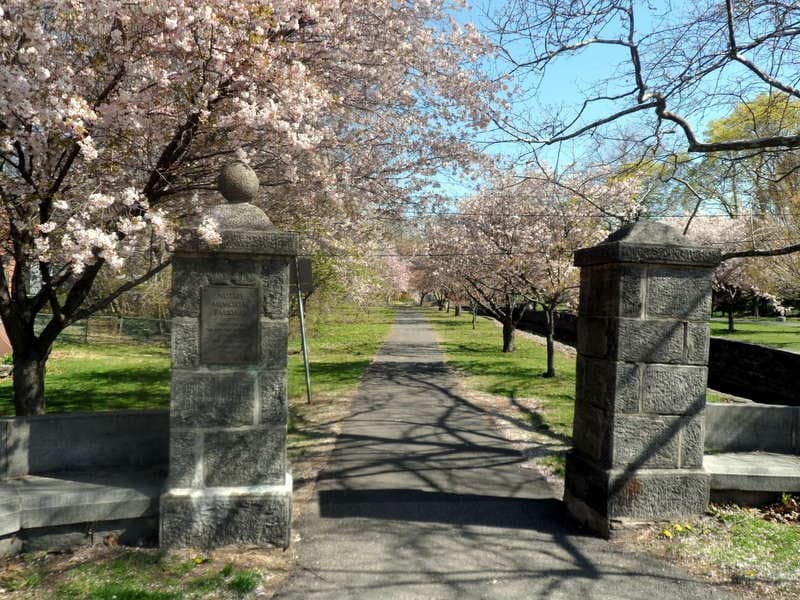
Photo: Wikipedia
Demographics of Nutley, NJ
Affluence Level in Nutley, NJ
A wealthy area with high-earning, well-educated households. Incomes, home values, and educational attainment meaningfully outpace national averages.
People of Nutley, NJ
The people of Nutley, New Jersey today form a dense, family-oriented community of 7,827 residents, characterized by a high degree of educational attainment—83.4% hold a college degree—and a predominantly White (72.0%) population with a growing Hispanic (13.4%) and East/Southeast Asian (5.3%) presence. The town’s identity is rooted in its historic walkability, strong public schools, and a distinct sense of place shaped by successive waves of European immigration. With only 2.4% foreign-born, Nutley is a largely native-born community where generational roots run deep, yet it is gradually diversifying as younger families move in.
How the city was settled and grew
Nutley’s population history begins with the Lenape people, who inhabited the area along the Passaic River before European settlement. The town’s modern development started in the early 19th century as a mill town, powered by the Third River. The first major wave of settlers were English and Dutch farmers, but the real population boom came after the Morris Canal opened in the 1830s, connecting Nutley to Newark and New York. By the late 1800s, German and Irish immigrants arrived to work in the local mills and tanneries, settling in the Franklin Avenue corridor and the area around Nutley Park, a planned commuter suburb developed in the 1890s. The early 20th century saw a large influx of Italian immigrants, who built homes and businesses in the Centre Street and Highland Avenue neighborhoods, establishing a strong Catholic and small-business culture that persists today. Eastern European Jews also arrived in smaller numbers, settling near Washington Avenue and contributing to the town’s commercial life. By 1950, Nutley was a solidly working- and middle-class community of roughly 16,000, overwhelmingly White and native-born.
Modern era (post-1965)
After the 1965 Hart-Cellar Act, Nutley did not experience the large-scale immigration seen in nearby urban centers like Newark or Jersey City. Instead, the town’s population gradually declined from its 1950 peak as families moved to larger suburban lots in Bergen and Morris counties. The White population remained dominant, but the town began a slow diversification. Hispanic residents, primarily of Puerto Rican and Dominican ancestry, began moving into the Kingsland Avenue and River Road areas in the 1980s and 1990s, drawn by affordable housing and proximity to Newark. East/Southeast Asian families, notably of Chinese and Korean heritage, arrived later, concentrating in the Park Avenue and Vreeland Avenue neighborhoods, attracted by Nutley’s strong school system. The Black population, at 3.3%, remains small and dispersed, with no single concentrated neighborhood. The Indian subcontinent population is negligible at 0.5%. The foreign-born share, at just 2.4%, is far below the New Jersey state average (about 23%), underscoring Nutley’s character as a community of multi-generational American families rather than a gateway for new immigrants.
The future
Nutley’s population is slowly trending more diverse, but the pace is modest. The Hispanic share, now 13.4%, is the fastest-growing demographic segment, driven by natural increase and some in-migration from nearby Essex County communities. East/Southeast Asian families continue to move in, particularly those seeking top-ranked schools, but their numbers remain small. The White population, while still the majority, is aging, and younger White families are increasingly choosing Nutley for its walkable downtown and commuter rail access to New York. The town’s population has stabilized around 7,800 after decades of decline, and the next 10-20 years will likely see a gradual increase in Hispanic and Asian shares, with the White share declining to perhaps 65-68%. New development is concentrated in the Nutley Center district, where mixed-use projects are attracting younger professionals. The cultural identity is evolving from a purely Italian-Irish enclave to a more multi-ethnic, but still predominantly native-born, suburb.
For someone moving in now, Nutley offers a stable, safe, and well-educated community where generational roots are still visible but the population is slowly opening to new groups. The town is becoming more diverse without losing its historic character, making it a solid choice for families who value strong schools, a walkable downtown, and a community that is changing at a manageable pace.

* Values derived from national, state, county, city and local statistics and may differ in a specific area. Last updated: 2026-11-06T16:52:06.000Z
Narrative content on this page is AI-generated and may contain mistakes. Verify any details that matter before acting on them.
ReloMaps may earn a commission from affiliate links at no extra cost to you.

