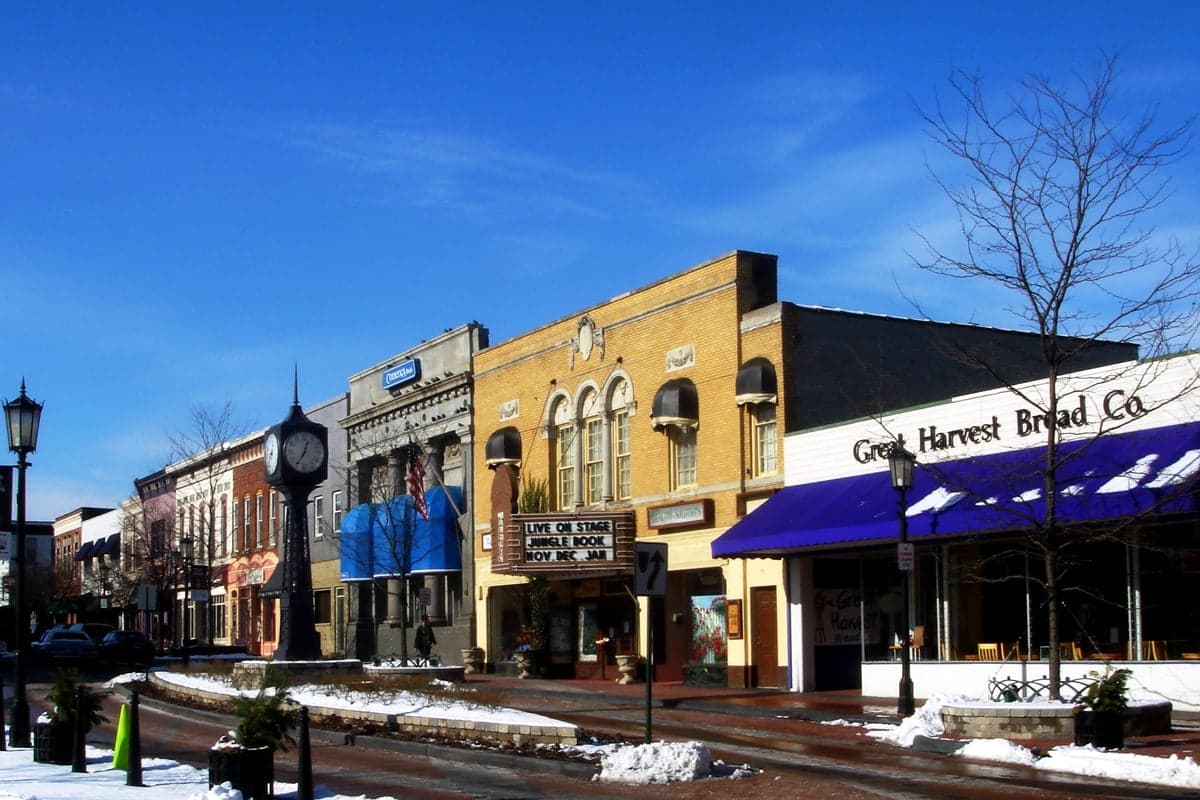
Photo: Wikipedia
Personal Sovereignty in Northville, MI
Strong independent fundamentals that actively favor personal liberty and low regulation.
What does Personal Sovereignty tell us?
Personal Sovereignty measures your capacity for self-reliance and independence with minimal government friction. Higher scores mean fewer barriers between you and the way you want to live... but it assumes you have the space you need and good neighbors.
What does this tell us?
Personal Sovereignty measures your capacity for self-reliance and independence with minimal government friction. Higher scores mean fewer barriers between you and the way you want to live... but it assumes you have the space you need and good neighbors.
State Policy
Energy independence: Importer (20% of energy produced in-state)
Personal Liberty
Homesteading

Personal Liberty Analysis
Northville, Michigan, presents a nuanced personal sovereignty environment where a historically conservative, self-reliant community ethos intersects with the regulatory and tax structures of a wealthy, well-governed suburb. While the city itself is not a bastion of libertarian minimalism, its residents enjoy a high degree of personal autonomy in daily life, bolstered by strong property rights, a favorable state-level legal framework for self-defense, and a local culture that values privacy and self-sufficiency. The key trade-off for those seeking maximum sovereignty is that Northville’s high property values and strict zoning codes impose a certain order, but the payoff is a stable, low-crime environment where individual choices—from homeschooling to firearm ownership—are broadly respected.
Tax burden and regulatory posture in Northville
Michigan’s overall tax burden is moderate, ranking near the middle of states, but Northville’s specific situation requires careful attention. The city levies a local income tax of 1.0% for residents and 0.5% for non-residents who work within city limits, which is a notable addition to the state’s flat 4.25% income tax. Property taxes are a significant factor: Northville’s millage rate, including the city, county, and school district levies, typically falls between 30 and 35 mills on taxable value, which is high by Michigan standards. However, Michigan’s Proposal A caps annual taxable value increases at the rate of inflation or 5%, whichever is lower, so long-term homeowners often pay far less than new buyers. The regulatory posture is best described as orderly but not oppressive. The city enforces a strict zoning code that prioritizes single-family residential character, with minimum lot sizes of around 10,000 to 20,000 square feet in most neighborhoods. Home-based businesses are permitted with a conditional use permit, but restrictions on signage, traffic, and noise are enforced. There is no city-level rent control, and business licensing is straightforward for standard retail and professional services. The overall regulatory environment is designed to preserve property values and neighborhood aesthetics, which aligns with the priorities of most conservative-leaning residents, but it does not encourage the kind of laissez-faire experimentation found in unincorporated rural areas.
Self-defense and gun law specifics in Northville
For the self-defense-minded individual, Northville benefits from Michigan’s strong state-level preemption of local firearm ordinances. The city cannot enact its own gun control laws stricter than state statute, meaning that Michigan’s shall-issue concealed pistol license (CPL) system applies fully. As of 2024, Michigan requires a CPL for concealed carry, but the state is a “shall issue” jurisdiction—meaning the county sheriff must issue a license if the applicant meets statutory requirements, including a background check and an 8-hour training course. Open carry is legal without a license for anyone 18 or older who can legally possess a firearm, though local police may have policies on contact. Northville itself is a low-crime community—violent crime rates are roughly 80% below the national average—so the practical need for defensive firearms is lower than in urban centers, but the legal right is robust. Stand-your-ground laws apply in Michigan, with no duty to retreat in any place where a person has a legal right to be. Magazine capacity is not restricted by state law, and there is no state-level assault weapons ban. For those considering a CPL, the Wayne County Sheriff’s Office (which covers Northville) processes applications, and wait times are typically under 45 days. The local gun culture is present but low-key; there are no dedicated gun ranges within city limits, but several are within a 15-minute drive in surrounding rural areas of Wayne and Washtenaw counties.
Self-reliance and homesteading viability in Northville
Northville’s suburban character limits the scope of traditional homesteading, but opportunities for self-reliance exist within its boundaries. Typical residential lots range from 0.25 to 0.5 acres, with some larger estate lots near the city’s edges. The city’s zoning code allows for backyard chickens (hens only, no roosters) with a permit, and beekeeping is permitted on lots of 10,000 square feet or more. Vegetable gardens are unrestricted, and many residents maintain substantial kitchen gardens. However, off-grid living is effectively impossible within city limits. The city requires connection to municipal water and sewer, and building codes mandate adherence to the Michigan Residential Code. Solar panels are permitted but must meet aesthetic guidelines and cannot be ground-mounted in front yards. Rainwater collection is allowed for non-potable uses, but there are no incentives or exemptions from the grid. For those seeking true self-sufficiency, the surrounding townships of Northville (in Wayne and Oakland counties) offer larger parcels—some up to 5 or 10 acres—where well and septic systems are standard, and zoning is more permissive for livestock, workshops, and alternative energy. The trade-off is that these areas lack the walkable downtown and top-rated schools that define Northville proper. The city’s farmers market, operating from May through October, reflects a community that values local food production, but it is a supplement to, not a replacement for, supermarket dependence.
Personal liberties in Northville: parental rights, medical autonomy, speech, and property
Northville’s environment for personal liberties is shaped by a combination of state law and local culture. Parental rights are strongly protected under Michigan law, which includes a parental rights statute that affirms the fundamental right of parents to direct the upbringing, education, and healthcare of their children. Homeschooling is legal with minimal regulation—parents need only file a simple intent to homeschool form with the local school district and provide instruction in core subjects. The Northville Public Schools district is highly rated and well-funded, but there is no social pressure against homeschooling; local homeschool co-ops and support groups are active. Medical autonomy is more constrained: Michigan has a state-level vaccine mandate for school attendance (with medical and philosophical exemptions available), and the city has no additional local mandates. COVID-era restrictions were enforced in line with state orders, but local compliance was generally voluntary and community-driven rather than punitive. Free speech and assembly are protected under the First Amendment, and Northville’s public spaces—including the downtown pavilion and Ford Field park—are available for permitted events. Property rights are robust: the city has not engaged in aggressive eminent domain, and zoning variances are granted through a public hearing process. The city’s historic district commission does impose design review for exterior changes to homes in the historic district, which some may view as an infringement on property autonomy, but this applies only to a small portion of the city. Overall, the local government’s approach is one of light-touch enforcement of clear rules, with a strong presumption in favor of individual choice unless it directly impacts neighbors or public safety.
Compared to other suburban communities in Southeast Michigan, Northville offers a balanced sovereignty profile. It is less restrictive than Ann Arbor or Royal Oak on issues like firearms and parental rights, but more regulated than rural townships in Livingston County where zoning is minimal and property taxes are lower. For a conservative-leaning individual or family who values high-quality public services, low crime, and a community that respects personal autonomy within a structured framework, Northville represents a strong choice. The sovereignty trade-off is clear: you accept higher taxes and stricter land-use rules in exchange for a stable, well-maintained environment where your personal liberties—from carrying a firearm to educating your children at home—are protected by both state law and local custom. For those who prioritize maximum independence above all else, the surrounding rural townships offer more latitude, but for those who want a high-functioning community that respects individual choice, Northville delivers a compelling package.

* Values derived from national, state, county, city and local statistics and may differ in a specific area. Last updated: 2026-10-05T03:53:27.000Z
Narrative content on this page is AI-generated and may contain mistakes. Verify any details that matter before acting on them.
ReloMaps may earn a commission from affiliate links at no extra cost to you.

