Photo: Wikipedia
Demographics of Northville, MI
Affluence Level in Northville, MI
An upper-middle-class area. Household wealth, education levels, and homeownership run ahead of national benchmarks.
People of Northville, MI
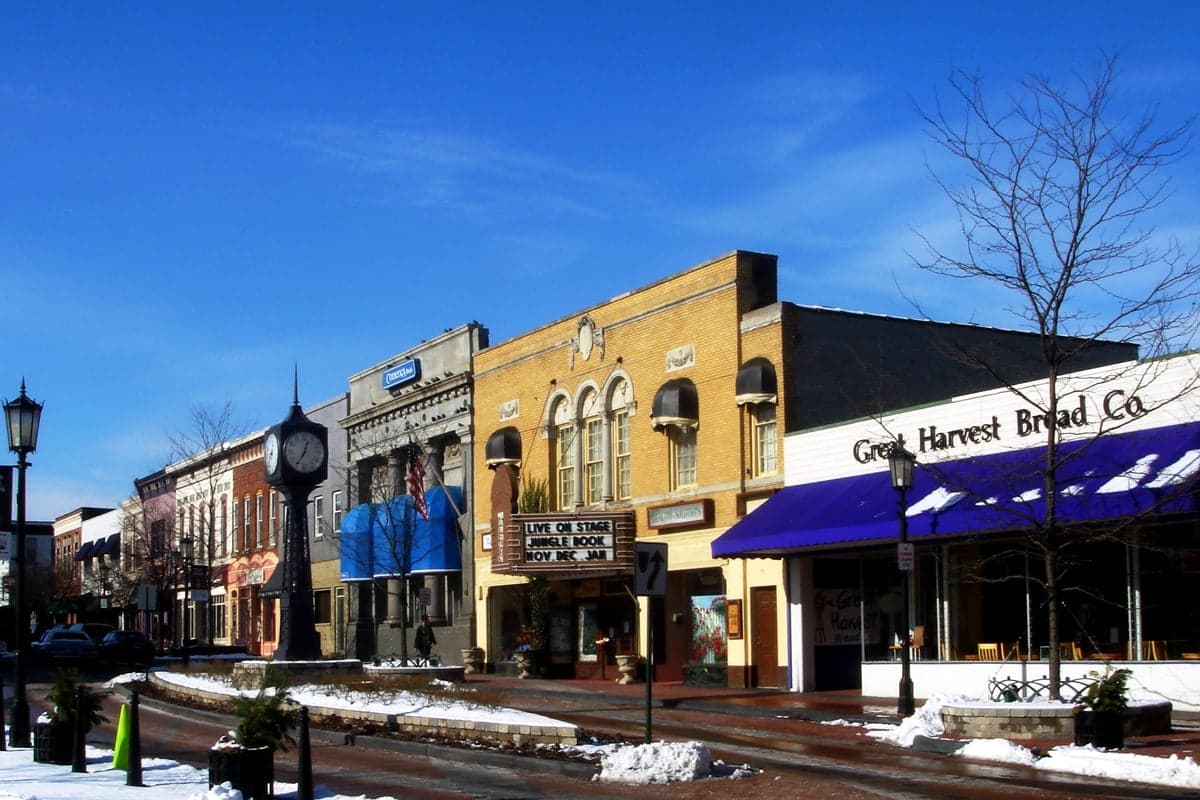
The people of Northville, Michigan, today form a small, highly educated, and predominantly white community of 6,080 residents, marked by a strong sense of historic preservation and family-oriented stability. With a college attainment rate of 67.4%, the population is among the most educated in the region, and its demographic profile—88.1% white, with notable East/Southeast Asian (3.1%) and Indian-subcontinent (2.4%) minorities—reflects a quiet, professional-class diversity rather than broad ethnic change. The city’s identity is anchored by its walkable, historic downtown and a reputation for top-tier public schools, attracting families who prioritize safety and community cohesion over urban convenience.
How the city was settled and grew
Northville’s original population was drawn by water power and agriculture. European-American settlers, primarily of English and German stock, arrived in the 1820s and 1830s, building mills along the Rouge River. The village was formally platted in 1855, and its early growth centered on the Old Village district, where the first frame houses and commercial blocks were constructed by mill owners and tradesmen. A second wave of German and Irish immigrants arrived in the late 19th century, working in the area’s growing number of tanneries and small factories; many settled in the Northville Downs area (now a residential neighborhood) and along the railroad corridor. By 1900, the population was nearly entirely native-born white, with a small number of African American families who worked as domestic servants or laborers, concentrated near the industrial edges of town. The city’s growth remained modest through the mid-20th century, as it was a rural service center rather than a major industrial hub.
Modern era (post-1965)
The post-1965 period transformed Northville from a quiet village into an affluent Detroit exurb. The Immigration and Nationality Act of 1965 had a limited direct effect on Northville’s demographics—the city remained overwhelmingly white—but it did open the door for a small, highly skilled professional migration. The most visible change came from domestic in-migration: white-collar families, many of them second- and third-generation European-American, moved from Detroit and inner-ring suburbs to Northville for its schools and low crime rates. These newcomers concentrated in newer subdivisions such as Country Club Estates and Haven Hill, built on former farmland in the 1970s and 1980s. The East/Southeast Asian community (3.1% today) began arriving in the 1990s, largely as engineers and medical professionals employed by Ford Motor Company and the University of Michigan health system; they settled primarily in the Northville Hills area, near the city’s northern edge. The Indian-subcontinent population (2.4%) followed a similar pattern, with many families choosing the Ridgewood neighborhood for its large lots and proximity to Novi’s tech corridor. The Black population remains very small (0.2%), concentrated in scattered single-family homes rather than any distinct neighborhood, reflecting the city’s historic lack of a Black community infrastructure.
The future
Northville’s population is projected to remain stable or grow very slowly, as the city is nearly built out. The demographic trend is toward modest diversification, driven by the same professional-class migration that has shaped the last three decades. The East/Southeast Asian and Indian-subcontinent shares are likely to increase gradually, as these groups continue to be attracted to the school system and the city’s proximity to Ann Arbor and Detroit’s tech and medical employment centers. New housing is limited to infill developments and a few small-lot subdivisions on the city’s western fringe, near the Five Mile Road corridor, which will likely absorb most new residents. The white share, while still dominant, will edge downward as older residents age in place and younger, more diverse families move in. The city’s cultural identity—rooted in historic preservation, high property values, and a strong local school district—is unlikely to shift dramatically, but the social fabric will become slightly more cosmopolitan, with a growing presence of Asian and Indian cultural organizations and restaurants in the broader Northville-Novi area.
For someone moving in now, Northville offers a stable, low-crime, and academically rigorous environment with a population that is becoming slowly more diverse but remains overwhelmingly white and affluent. The city is not a melting pot in the traditional sense, but rather a collection of highly educated, family-oriented enclaves where professional success and community involvement are the primary social currencies. New residents should expect a place that values continuity and tradition, with a demographic future that will evolve at a measured, deliberate pace.

* Values derived from national, state, county, city and local statistics and may differ in a specific area. Last updated: 2026-10-05T03:53:27.000Z
Narrative content on this page is AI-generated and may contain mistakes. Verify any details that matter before acting on them.
ReloMaps may earn a commission from affiliate links at no extra cost to you.

