
Photo: Wikipedia
Personal Sovereignty in Ward County
Viable for self-reliance. Generally workable, though some barriers may limit total independence.
What does Personal Sovereignty tell us?
Personal Sovereignty measures your capacity for self-reliance and independence with minimal government friction. Higher scores mean fewer barriers between you and the way you want to live... but it assumes you have the space you need and good neighbors.
What does this tell us?
Personal Sovereignty measures your capacity for self-reliance and independence with minimal government friction. Higher scores mean fewer barriers between you and the way you want to live... but it assumes you have the space you need and good neighbors.
State Policy
Energy independence: Net exporter (500% of energy produced in-state)
Personal Liberty
Homesteading

Personal Liberty Analysis
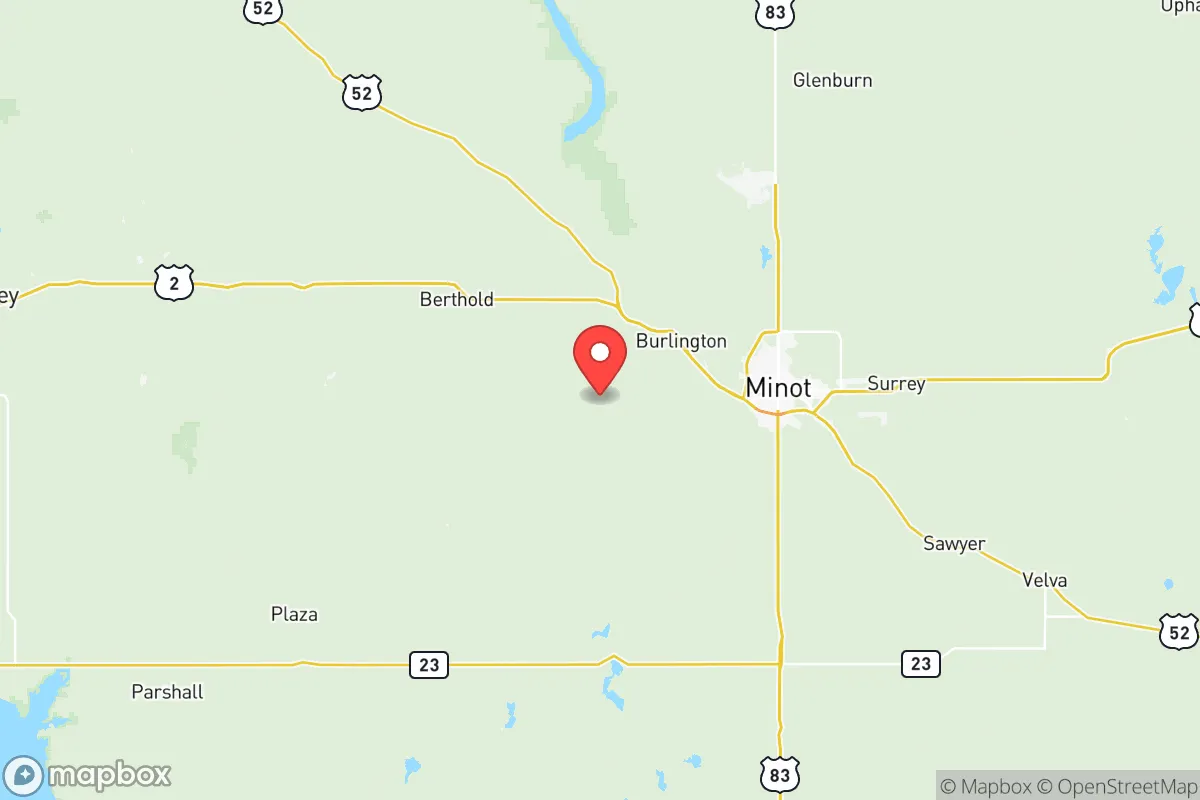
Ward County, North Dakota, offers a notably high degree of personal sovereignty, grounded in the state’s long-standing tradition of limited government and individual self-reliance. The county’s regulatory and tax environment is among the lightest in the nation, and its legal framework strongly supports gun rights, property autonomy, and parental decision-making. For individuals and families seeking to minimize external control over their daily lives, the Minot area—along with smaller communities like Burlington, Kenmare, and Bowbells—presents a landscape where personal freedom is the default, not the exception.
Tax burden and regulatory posture: How light is the government footprint?
North Dakota’s tax structure is a major draw for those prioritizing financial autonomy. The state has no personal income tax, and Ward County’s property tax rates are moderate, with the average effective rate hovering around 1.1% of assessed home value—lower than many Midwestern and coastal states. Sales tax in Minot is 7.5% (state and local combined), but groceries and prescription drugs are exempt. The regulatory posture across Ward County is consistently light-touch. Zoning in unincorporated areas like Burlington and Kenmare is minimal, allowing for a wide range of uses without burdensome permitting. In contrast, the city of Minot has more structured zoning, particularly within its floodplain, but even there, the process is streamlined compared to larger metropolitan areas. Business licensing is straightforward, and there are no county-level occupational taxes or onerous environmental regulations that hamper small-scale enterprises. The state’s right-to-work law further reinforces an environment where employment is voluntary and union membership is not compulsory.
Self-defense and gun law specifics: What are the rules for carrying and owning firearms?
Ward County is a stronghold for Second Amendment rights, with North Dakota law providing some of the most permissive firearm regulations in the country. The state has constitutional carry for both residents and non-residents, meaning no permit is required to carry a concealed handgun. Open carry is also legal without a license. There is no state-level waiting period for firearm purchases, and no requirement to register firearms or obtain a permit to purchase a handgun. The city of Minot, as well as smaller towns like Bowbells and Donnybrook, have no local ordinances that restrict these rights—no “safe storage” mandates, no magazine capacity limits, and no bans on specific types of firearms. Stand-your-ground laws are in effect, with no duty to retreat in any place where a person has a legal right to be. Background checks are required only for purchases from licensed dealers, consistent with federal law; private sales between individuals are not regulated. For a reader who views self-defense as a fundamental personal responsibility, Ward County’s legal framework imposes virtually no barriers.
Self-reliance and homesteading viability: Lot sizes, zoning, and off-grid feasibility
Homesteading and off-grid living are highly viable in Ward County, particularly outside the Minot city limits. In unincorporated areas, lot sizes can be as small as one acre for a single-family dwelling, but many parcels in townships near Burlington and Kenmare are available in 5- to 40-acre increments, offering ample space for gardens, livestock, and renewable energy systems. Zoning in these rural areas is permissive: there are no county-level bans on rainwater collection, composting toilets, or solar panel installation. Off-grid electricity is legal, though connecting to the grid is common for backup. The county does not require building permits for structures under 200 square feet, and agricultural exemptions allow for barns and sheds without extensive paperwork. In Minot itself, city zoning is more restrictive—requiring minimum lot sizes of 6,000 to 8,000 square feet and mandating connection to municipal water and sewer—but the surrounding townships offer a near-total freedom to build and live as one chooses. The harsh winters (average January low of 0°F) make self-sufficiency in heating and water storage a practical challenge, but the legal environment does not impede it.
Personal liberties: Parental rights, medical autonomy, speech, and property
Ward County aligns with North Dakota’s broader emphasis on personal liberties. Parental rights are strongly protected by state law; parents have the explicit legal authority to direct the education, healthcare, and religious upbringing of their children. Homeschooling is straightforward, requiring only a simple notification to the local superintendent and no standardized testing mandates. Medical autonomy is similarly broad: there are no state-level vaccine mandates for adults, and the state has not enacted any emergency health orders that restrict individual choice since 2021. Freedom of speech and assembly are robust, with no local ordinances that limit public expression beyond standard time-place-manner restrictions. Property rights are reinforced by North Dakota’s right-to-farm law, which protects agricultural operations from nuisance lawsuits, and by the absence of county-level rent control or landlord licensing in Minot. Eminent domain is rarely used for private development, and property taxes are capped by the state’s “truth in taxation” rules, which require voter approval for significant increases. For a reader concerned about government overreach in personal decisions, Ward County’s legal culture is one of deference to the individual.
Overall, Ward County ranks among the most sovereignty-friendly areas in the Upper Midwest. Its combination of no income tax, constitutional carry, permissive zoning for rural homesteading, and strong protections for parental and property rights creates an environment where personal freedom is the operating principle. While Minot itself has more regulatory structure—particularly around floodplain management and urban zoning—the county’s smaller communities like Burlington, Kenmare, Bowbells, and Donnybrook offer a near-total absence of bureaucratic friction. For a single individual or family prioritizing autonomy over convenience, Ward County provides a legal and cultural foundation that is difficult to match outside of the Mountain West or rural Alaska.

* Values derived from national, state, county, city and local statistics and may differ in a specific area. Last updated: 2026-06-16T07:31:55.000Z
Narrative content on this page is AI-generated and may contain mistakes. Verify any details that matter before acting on them.
ReloMaps may earn a commission from affiliate links at no extra cost to you.

