
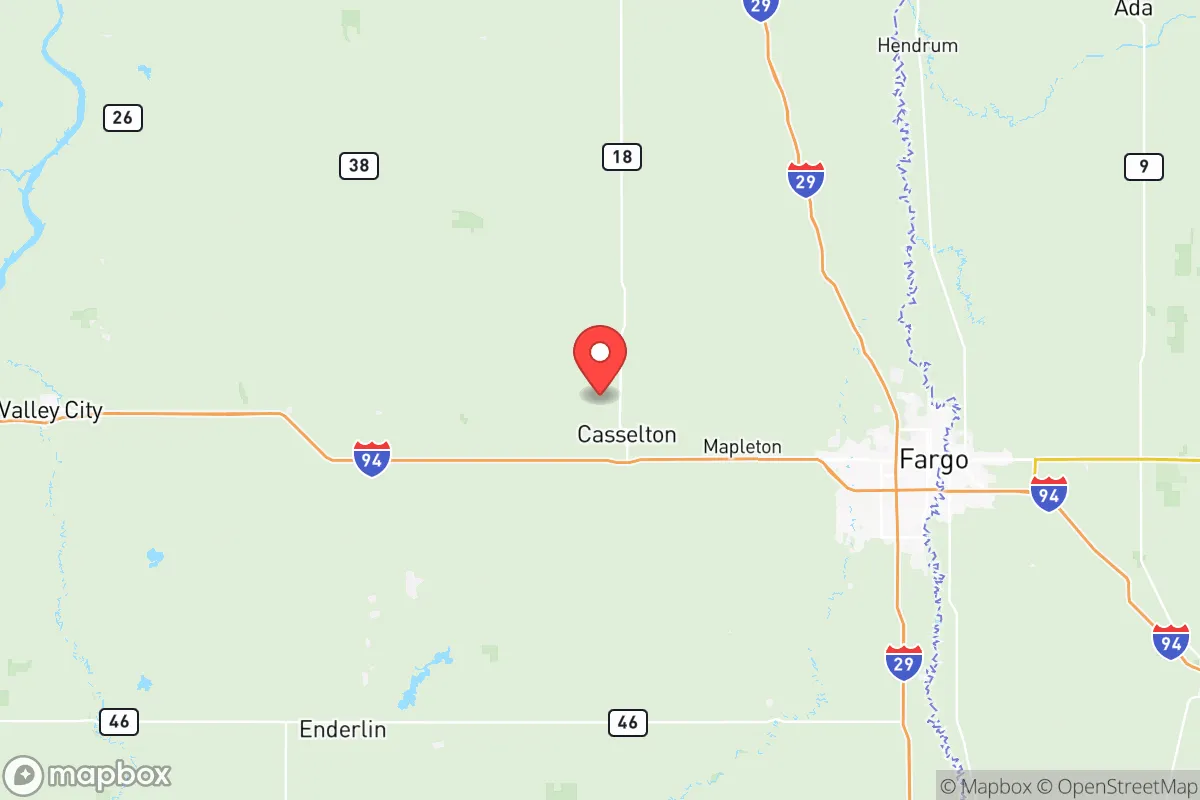
Photo: Wikipedia
Personal Sovereignty in Cass County
Strong independent fundamentals that actively favor personal liberty and low regulation.
What does Personal Sovereignty tell us?
Personal Sovereignty measures your capacity for self-reliance and independence with minimal government friction. Higher scores mean fewer barriers between you and the way you want to live... but it assumes you have the space you need and good neighbors.
What does this tell us?
Personal Sovereignty measures your capacity for self-reliance and independence with minimal government friction. Higher scores mean fewer barriers between you and the way you want to live... but it assumes you have the space you need and good neighbors.
State Policy
Energy independence: Net exporter (500% of energy produced in-state)
Personal Liberty
Homesteading

Personal Liberty Analysis
Cass County, North Dakota, offers a notably high degree of personal sovereignty, grounded in a state-level legal framework that prioritizes individual liberty, low taxation, and minimal regulatory interference. For residents and newcomers, this translates into a daily environment where self-reliance is not just encouraged but structurally supported by state law, from the absence of a state income tax to robust protections for gun rights and parental authority. While the county’s anchor city, Fargo, introduces a more urbanized, slightly more regulated dynamic, the surrounding towns and rural townships—such as West Fargo, Harwood, Kindred, Mapleton, and Arthur—present a spectrum of autonomy that generally leans heavily toward the libertarian-leaning conservative ideal. This analysis breaks down the specific pillars of personal sovereignty in Cass County, examining tax burden, self-defense law, homesteading feasibility, and broader personal liberties.
Tax burden and regulatory posture: how North Dakota’s low-tax framework shapes Cass County
Cass County operates within one of the most tax-friendly state environments in the nation, which directly enhances personal financial sovereignty. North Dakota has no state income tax, and the state sales tax is a modest 5%, with Cass County adding a local option of 1.5% for a combined rate of 6.5% in most areas—though some cities like West Fargo and Harwood may have slightly different local levies. Property taxes in Cass County are moderate by national standards, with effective rates averaging around 1.1% of assessed home value, though this can vary significantly between the urban core of Fargo and the more rural townships. The regulatory posture in Cass County is generally light-touch, particularly outside Fargo’s city limits. Zoning and building codes are minimal in unincorporated areas and smaller towns like Arthur or Kindred, where a property owner can often erect a shed, fence, or outbuilding without the lengthy permitting processes common in more regulated states. However, Fargo itself has a more structured municipal code, including rental licensing and stricter noise ordinances, so newcomers seeking maximum regulatory freedom should look to the county’s smaller communities or rural townships. The state’s lack of a corporate income tax and its right-to-work status further reinforce a business-friendly climate that aligns with a sovereignty-minded lifestyle.
Self-defense and gun law specifics: constitutional carry and castle doctrine in Cass County
North Dakota is a constitutional carry state, meaning no permit is required for a law-abiding individual to carry a concealed firearm, and Cass County fully reflects this state-level policy. This applies uniformly across the county, from downtown Fargo to the most remote farmstead near Mapleton. The state also maintains a strong castle doctrine, codified in North Dakota Century Code 12.1-05-07, which establishes that a person has no duty to retreat from their home or occupied vehicle before using force, including deadly force, if they reasonably believe it is necessary to prevent imminent death or great bodily harm. This protection extends to occupied vehicles, a nuance that matters for travelers and those living in more rural settings. While Fargo’s city ordinances prohibit discharging firearms within city limits (with exceptions for lawful self-defense and shooting ranges), the unincorporated areas and smaller towns like Harwood or Kindred impose no such restrictions, making them more suitable for those who want to practice shooting on their own property. The state’s preemption law prevents local governments from enacting gun ordinances stricter than state law, so Fargo cannot, for example, ban concealed carry in city parks. For a resident prioritizing self-defense autonomy, Cass County offers one of the most permissive legal environments in the Upper Midwest.
Self-reliance and homesteading viability: lot sizes, zoning, and off-grid feasibility across Cass County
The feasibility of a self-reliant, homesteading lifestyle in Cass County varies dramatically by location, driven primarily by municipal zoning versus county-level land use policies. In the unincorporated townships and smaller towns like Arthur, Kindred, and Mapleton, lot sizes can be as large as a buyer can afford, with agricultural zoning allowing for livestock, large gardens, and outbuildings with minimal county oversight. These areas are ideal for those seeking to raise chickens, keep goats, or maintain a substantial vegetable plot. Off-grid living is legally feasible in Cass County’s rural areas, though North Dakota’s climate—with harsh winters—makes solar and wind energy a practical but capital-intensive choice. The county does not have a blanket prohibition on composting toilets or rainwater collection, though well and septic permits are required and regulated by the Cass County Health Department. In contrast, Fargo and West Fargo have more restrictive zoning: minimum lot sizes in newer subdivisions are typically around 6,000 to 8,000 square feet, and keeping livestock is generally prohibited within city limits. Harwood, a growing exurb, offers a middle ground with larger lots (often half-acre to one-acre) and more permissive animal ordinances than Fargo but still subject to municipal codes. For the serious homesteader, the rural townships east of the Red River or south toward Kindred provide the greatest latitude for self-sufficient living.
Personal liberties: parental rights, medical autonomy, speech, and property protections
North Dakota has enacted several laws that strengthen personal liberties in areas of particular concern to conservative and libertarian-leaning residents. Parental rights are explicitly protected under state law, with North Dakota Century Code 14-09-01 affirming that parents have the fundamental right to direct the upbringing, education, and health care of their children. This has practical implications in Cass County, where school boards in districts like Kindred and Central Cass (Arthur) have been responsive to parental input on curriculum and library materials. Medical autonomy is also relatively strong: North Dakota does not have a state-level vaccine mandate for adults, and while school immunization requirements exist, philosophical exemptions are permitted. The state’s response to COVID-19 was notably less restrictive than many peers, with no statewide mask mandate or prolonged business closures, a posture that resonated with many Cass County residents. Property rights are robust, with North Dakota’s “takings” laws providing compensation for regulatory actions that diminish property value, and the state’s agricultural land laws restrict foreign ownership of farmland—a protection valued by rural landowners. Free speech is protected under both the U.S. and North Dakota constitutions, and there are no state-level hate speech laws that would criminalize protected expression. Cass County’s local governments, particularly in Fargo, have occasionally faced First Amendment lawsuits over protest restrictions, but the overall legal climate strongly favors individual expression.
Compared to many other regions of the United States, Cass County, North Dakota, offers an exceptionally high degree of personal sovereignty, particularly for those who choose to live outside Fargo’s municipal boundaries. The combination of no state income tax, constitutional carry, strong castle doctrine protections, minimal zoning in rural townships, and explicit parental rights statutes creates an environment where self-reliance is both legally protected and practically achievable. While Fargo introduces a more conventional urban regulatory framework, the county as a whole—and towns like Harwood, Kindred, Mapleton, and Arthur in particular—provides a level of autonomy that rivals or exceeds that of most counties in the Upper Midwest. For a single individual or family prioritizing personal freedom, Cass County represents a compelling option where the legal infrastructure is aligned with a self-directed life.

* Values derived from national, state, county, city and local statistics and may differ in a specific area. Last updated: 2026-07-12T08:17:42.000Z
Narrative content on this page is AI-generated and may contain mistakes. Verify any details that matter before acting on them.
ReloMaps may earn a commission from affiliate links at no extra cost to you.

