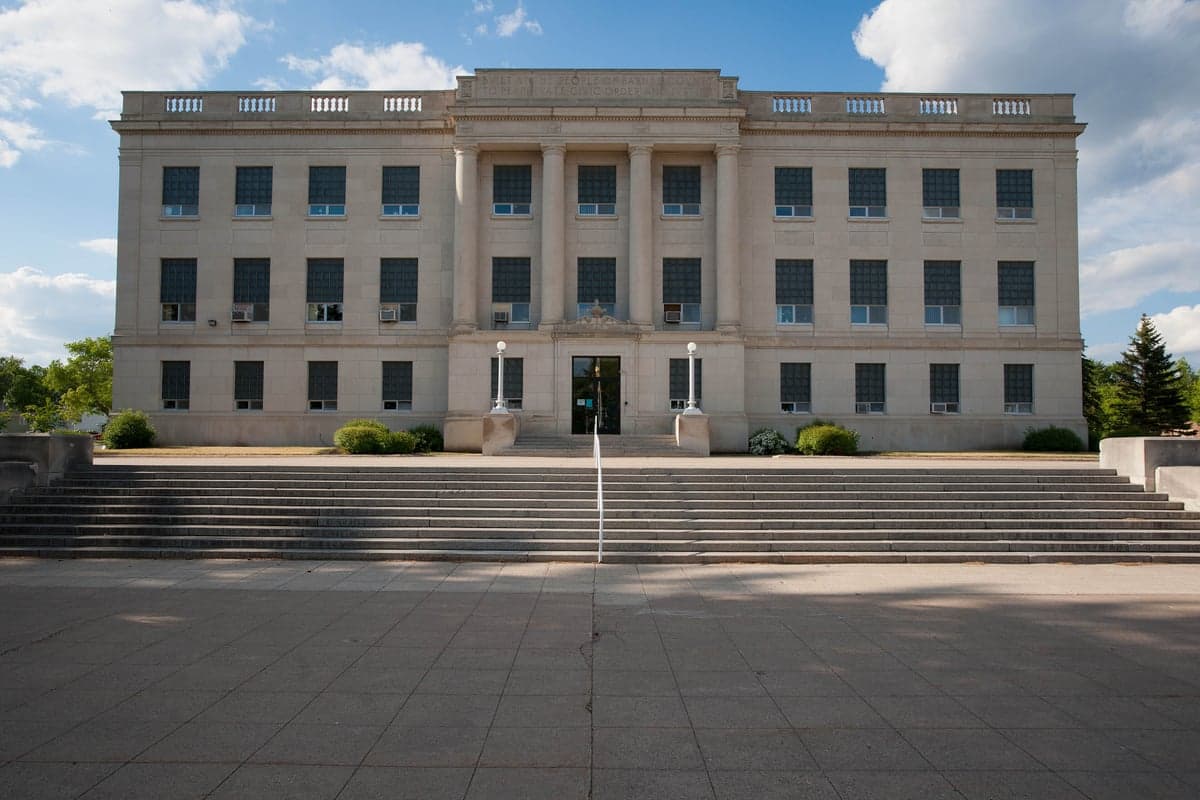
Photo: Wikipedia
Demographics of Barnes County
Affluence Level in Barnes County
A middle-class area roughly in line with national averages across income, home values, education, and employment.
People of Barnes County
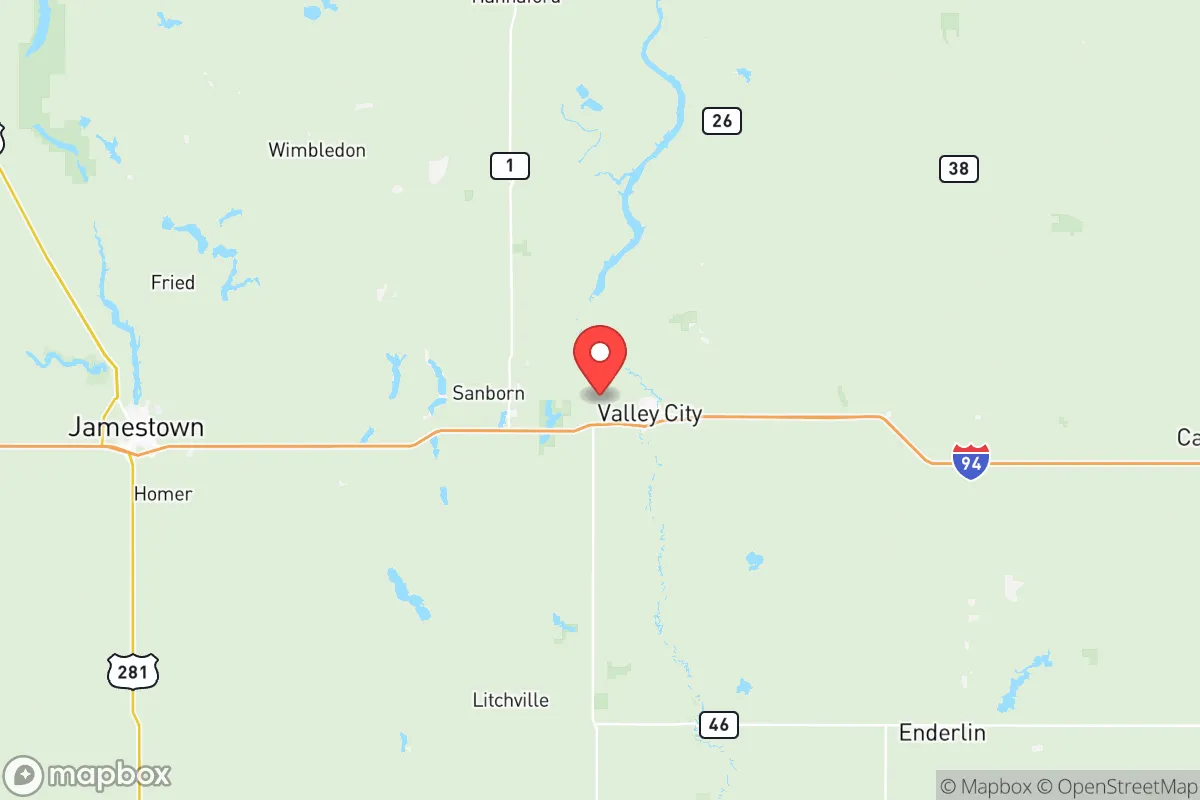
Barnes County, North Dakota, is home to 10,794 residents who form a predominantly white (90.1%), rural community with a strong agricultural and small-town identity. The population is notably less diverse than the national average, with a foreign-born share of just 2.0%, and is concentrated in the county seat of Valley City and smaller towns like Dazey, Litchville, and Sanborn. Distinctive markers include a deep-rooted Scandinavian and German heritage, a stable but aging demographic profile, and a local economy tied to farming, education (Valley City State University), and the BNSF Railway corridor.
Settlement & growth (pre-1960)
Before European settlement, the area that is now Barnes County was part of the traditional territory of the Dakota (Sioux) people, particularly the Sisseton and Wahpeton bands. They lived a semi-nomadic lifestyle, following bison herds and establishing seasonal camps along the Sheyenne River. The United States acquired the region through the 1803 Louisiana Purchase, but sustained American settlement did not begin until after the 1851 Treaty of Traverse des Sioux and the subsequent 1862 Homestead Act, which opened the land to Euro-American pioneers.
The first major wave of settlers arrived in the 1870s and 1880s, drawn by the promise of 160-acre homesteads and the extension of the Northern Pacific Railway. These early pioneers were predominantly Yankee stock from New England and the Upper Midwest—farmers from Wisconsin, Minnesota, and Iowa seeking cheap, fertile land. They founded the county's first towns: Valley City (1874) as the railroad hub and county seat, Dazey (1881) along the rail line, and Litchville (1883) as a farming service center. The population surged from zero in 1870 to over 8,000 by 1890.
A second, larger wave came between 1880 and 1910: Norwegian and German immigrants fleeing land scarcity and religious persecution in Europe. Norwegians concentrated in the northern and western townships, founding Sanborn (1881) and Rogers (1892), while German-Russian immigrants (ethnic Germans who had lived in Russia's Volga region) settled around Wimbledon (1893) and Kathryn (1900). These groups brought distinctive Lutheran and Catholic traditions, and their descendants still dominate local church membership rolls today. By 1910, the county's population peaked at 16,144, with agriculture—wheat, oats, and dairy—as the economic backbone.
The period from 1910 to 1960 saw stagnation and gradual decline. The Dust Bowl of the 1930s hit the region hard, driving some families to California, but most stayed, diversifying into livestock and sugar beets. World War II brought a brief economic boost from increased food production, but the post-war mechanization of farming reduced the need for farm labor, prompting a steady rural-to-urban drift. By 1960, the population had fallen to 12,000, with young people leaving for cities like Fargo and Minneapolis.
Modern era (post-1965)
The 1965 Hart-Cellar Act, which ended national-origin quotas, had minimal direct impact on Barnes County. Unlike urban areas that saw waves of Asian, Latin American, and African immigration, the county's foreign-born population remains tiny at 2.0%. The modest post-1965 demographic changes came primarily from domestic migration and natural increase, not international arrivals.
The most notable shift has been the growth of the Hispanic population, now at 2.0% of the county. This is largely driven by Mexican-American and Central American workers recruited by agricultural employers—particularly in the sugar beet and potato fields around Oriska (1881) and Pillsbury (1882)—starting in the 1990s. These families have established a small but visible presence, with Spanish-language services at some Catholic parishes and seasonal labor camps. The East/Southeast Asian population (1.2%) is primarily concentrated in Valley City, linked to faculty and students at Valley City State University and medical professionals at CHI Mercy Health. The Black population (1.3%) is also Valley City-centric, with roots in military families stationed at the nearby North Dakota Air National Guard base and a small number of professionals.
Domestically, the county has experienced a slow but steady out-migration of young adults to larger metros, offset slightly by an influx of retirees and remote workers seeking lower costs. The Indian subcontinent population (0.1%) is negligible, consisting of a handful of professionals and university affiliates. Suburbanization has been minimal; Valley City remains the only incorporated city with more than 1,000 residents, and new housing developments are infill rather than sprawl.
The future
Barnes County's population is projected to continue its slow decline, from 10,794 today to perhaps 9,500-10,000 by 2040, based on state demographer estimates. The county is aging faster than the state average, with a median age of 44.3 (compared to North Dakota's 35.2), and a birth rate below replacement level. The white share (90.1%) will likely shrink gradually as older residents pass away and younger, more diverse cohorts replace them, but the county will remain overwhelmingly white for the foreseeable future.
The Hispanic population is the fastest-growing segment, expected to reach 3-4% by 2040, driven by continued agricultural labor demand and family reunification. The East/Southeast Asian and Black populations will likely remain stable or grow slightly, tied to university and healthcare employment. No new immigrant enclaves are forming; instead, these groups are dispersing within Valley City and, to a lesser extent, Litchville and Sanborn. The county's cultural identity—rooted in Scandinavian and German Lutheran traditions, county fairs, and high school sports—is evolving slowly, with more bilingual signage and multicultural events at the university, but the pace of change is glacial compared to urban America.
For someone moving in now, Barnes County offers a stable, safe, and affordable rural lifestyle with a strong sense of community, but with limited diversity and economic opportunity. The population is becoming slightly more diverse and slightly older, but the fundamental character—a white, agricultural, small-town society—will persist for at least another generation. New residents should expect a welcoming but homogeneous environment where newcomers are valued but expected to integrate into existing social structures.

* Values derived from national, state, county, city and local statistics and may differ in a specific area. Last updated: 2026-06-22T19:24:16.000Z
Narrative content on this page is AI-generated and may contain mistakes. Verify any details that matter before acting on them.
ReloMaps may earn a commission from affiliate links at no extra cost to you.

