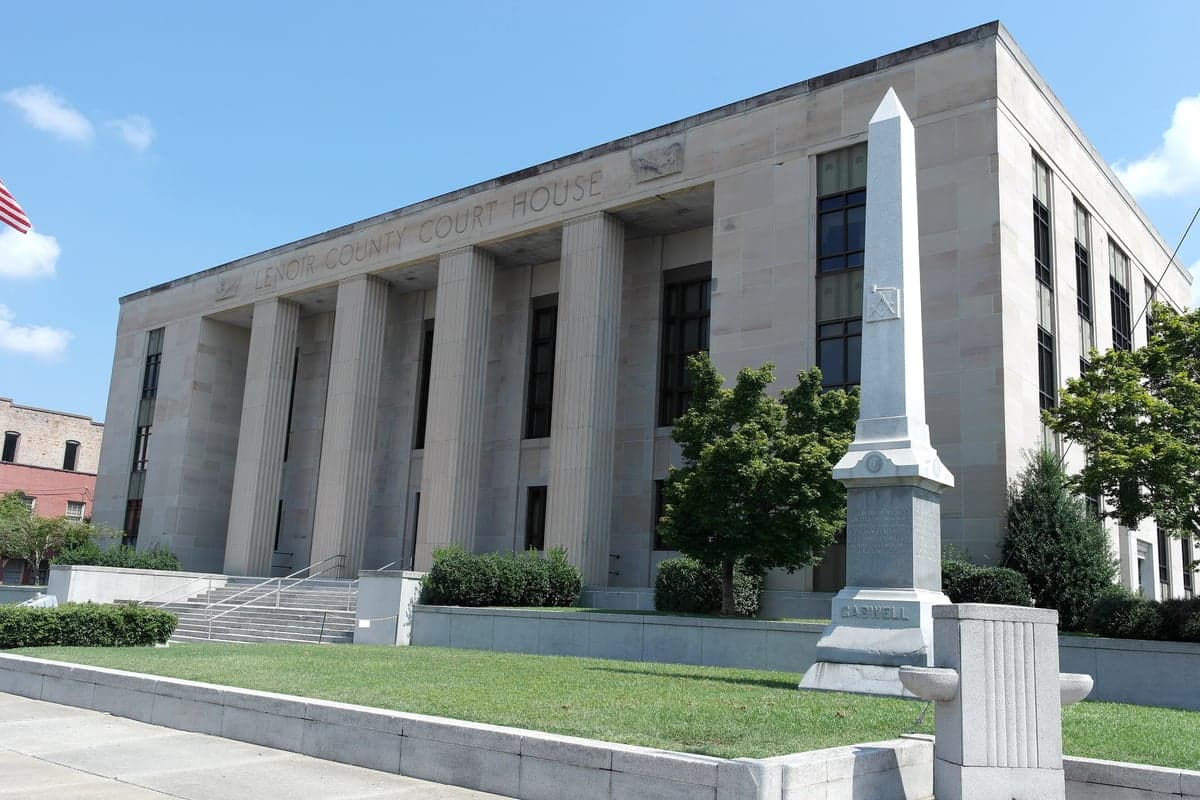
Photo: Wikipedia
Personal Sovereignty in Lenoir County
Viable for self-reliance. Generally workable, though some barriers may limit total independence.
What does Personal Sovereignty tell us?
Personal Sovereignty measures your capacity for self-reliance and independence with minimal government friction. Higher scores mean fewer barriers between you and the way you want to live... but it assumes you have the space you need and good neighbors.
What does this tell us?
Personal Sovereignty measures your capacity for self-reliance and independence with minimal government friction. Higher scores mean fewer barriers between you and the way you want to live... but it assumes you have the space you need and good neighbors.
State Policy
Energy independence: Importer (24% of energy produced in-state)
Personal Liberty
Homesteading

Personal Liberty Analysis
Lenoir County, anchored by the city of Kinston, presents a personal sovereignty environment that is distinctly Southern and rural, where state-level preemption laws create a baseline of individual liberty that local municipalities cannot easily override. The county’s regulatory posture is generally light-touch outside of Kinston’s city limits, and the surrounding unincorporated areas—places like La Grange, Pink Hill, and Deep Run—offer a degree of autonomy that is increasingly rare in North Carolina’s fast-growing urban corridors. For a relocation-minded individual or family prioritizing self-reliance, the key trade-off is between the modest conveniences of Kinston and the near-absence of zoning or code enforcement in the county’s rural stretches.
Tax burden and regulatory posture in Lenoir County vs. surrounding areas
North Carolina’s flat state income tax rate of 4.5% (as of 2026) and a state sales tax of 4.75% provide a relatively low baseline, but Lenoir County adds its own local levies. The combined sales tax rate in Lenoir County is 7.0%, which is on par with most rural Eastern NC counties but slightly higher than neighboring Greene County (6.75%) and comparable to Pitt County (7.0%). Property taxes are the more significant consideration: Lenoir County’s rate is approximately $0.72 per $100 of assessed value, which is moderate for the region. Kinston’s municipal property tax adds roughly $0.55 per $100, bringing the combined rate inside city limits to about $1.27—a meaningful jump that pushes some cost-conscious residents toward unincorporated areas like Woodington or Wheat Swamp, where only the county rate applies. The regulatory environment is notably permissive outside Kinston: there is no countywide zoning ordinance for agricultural or residential uses on parcels over one acre, meaning a family buying land in Pink Hill can typically site a manufactured home, build a workshop, or keep livestock without navigating a planning board. Inside Kinston, however, the city enforces a standard set of building codes, setback requirements, and business licensing that adds friction for anyone trying to operate a home-based enterprise or modify a property without permits. The county’s overall posture is one of benign neglect in rural areas and light-to-moderate regulation inside the city limits.
Self-defense rights and gun law specifics in Lenoir County
North Carolina is a shall-issue state for concealed carry permits, and Lenoir County’s sheriff’s office processes permits efficiently, typically within the 45-day statutory window. The county has a strong gun-friendly culture, and open carry of handguns is legal without a permit for anyone 18 or older who can lawfully possess a firearm. Stand-your-ground laws apply statewide, meaning there is no duty to retreat before using deadly force in any place where the individual is lawfully present. Lenoir County’s district attorney’s office has not historically pursued aggressive prosecution of lawful self-defense shootings, and the courthouse in Kinston generally reflects the conservative judicial temperament of Eastern NC. For residents of La Grange and Deep Run, where law enforcement response times can exceed 20 minutes due to the county’s rural geography, the practical reality is that personal firearm ownership is a primary means of household defense. There are no county-specific gun ordinances that exceed state law, so magazine capacity restrictions, assault weapon bans, and waiting periods do not exist. The only notable local consideration is that Kinston’s public housing authority enforces a no-firearms policy in its properties, but this does not affect private homeowners or renters in market-rate housing. For a family moving to Lenoir County, the legal environment for self-defense is as permissive as any in the Southeast.
Self-reliance and homesteading viability: lot sizes, zoning, and off-grid feasibility
The homesteading and off-grid living potential in Lenoir County varies significantly by location. In the unincorporated areas—particularly around Pink Hill, Woodington, and the rural stretches south of Kinston near the Jones County line—there is no minimum lot size for agricultural use, and parcels of 2 to 10 acres are commonly available for $3,000 to $6,000 per acre. Zoning is essentially nonexistent for these properties: a landowner can install a rainwater catchment system, build a composting toilet, or erect a detached workshop without county permits, provided the structure is not a primary dwelling requiring septic approval. The county health department does regulate septic systems, which is the primary barrier to truly off-grid living—any habitable dwelling must have a permitted septic system, and the soil in parts of Lenoir County is heavy clay, requiring engineered drain fields that can cost $8,000 to $15,000. Solar panels are unregulated at the county level, and net metering is available through Duke Energy Progress, though the interconnection process requires a licensed electrician. Inside Kinston, homesteading is far more constrained: city lots are typically 0.25 acres or smaller, backyard chickens are limited to six hens with no roosters, and any structure over 200 square feet requires a building permit. For a family serious about self-sufficiency, the clear choice is to buy land in the county’s rural townships—Deep Run and Pink Hill offer the most permissive environments for a homesteading lifestyle.
Personal liberties: parental rights, medical autonomy, speech, and property
North Carolina’s legal framework provides strong protections for parental rights, including a statutory presumption that parents have the right to direct the upbringing, education, and healthcare of their children. Lenoir County’s school board has not adopted any controversial curriculum mandates, and the county’s public schools in Kinston, La Grange, and Pink Hill generally defer to parental authority on opt-out requests for sex education or sensitive materials. Medical autonomy is more constrained: North Carolina has not expanded Medicaid under the Affordable Care Act, and the state maintains a certificate-of-need (CON) law that limits the number of healthcare facilities and services available in rural counties—meaning Lenoir County residents have fewer choices for elective procedures or specialized care than in deregulated states. The county does not have any local mask mandates, vaccine requirements, or public health orders that exceed state law, and the Kinston City Council has not enacted any local emergency powers that restrict individual movement or business operations. Property rights are well-protected: North Carolina’s eminent domain laws require a public purpose and just compensation, and Lenoir County has not engaged in aggressive condemnation for economic development. Free speech is protected under the First Amendment, and the county has no local ordinances restricting political signage, leafleting, or public assembly. The overall environment for personal liberties in Lenoir County is one of baseline state-level protection with minimal local overreach.
Compared to the regulatory density of North Carolina’s urban centers like Raleigh, Durham, or Charlotte, Lenoir County offers a substantially higher degree of personal sovereignty—particularly in its rural townships where zoning is absent, taxes are lower, and self-reliance is a practical necessity rather than a lifestyle choice. The county is not a libertarian utopia: the state’s CON laws, septic regulations, and sales tax burden create real constraints. But for a family or individual who values the freedom to keep firearms without local interference, build a homestead on raw land, and raise children with minimal government involvement in education or healthcare, Lenoir County ranks among the more permissive environments in Eastern North Carolina. The key is to locate outside Kinston’s city limits—Pink Hill, Deep Run, and Woodington are the zip codes where personal sovereignty is most fully realized.

* Values derived from national, state, county, city and local statistics and may differ in a specific area. Last updated: 2026-11-15T17:56:12.000Z
Narrative content on this page is AI-generated and may contain mistakes. Verify any details that matter before acting on them.
ReloMaps may earn a commission from affiliate links at no extra cost to you.

