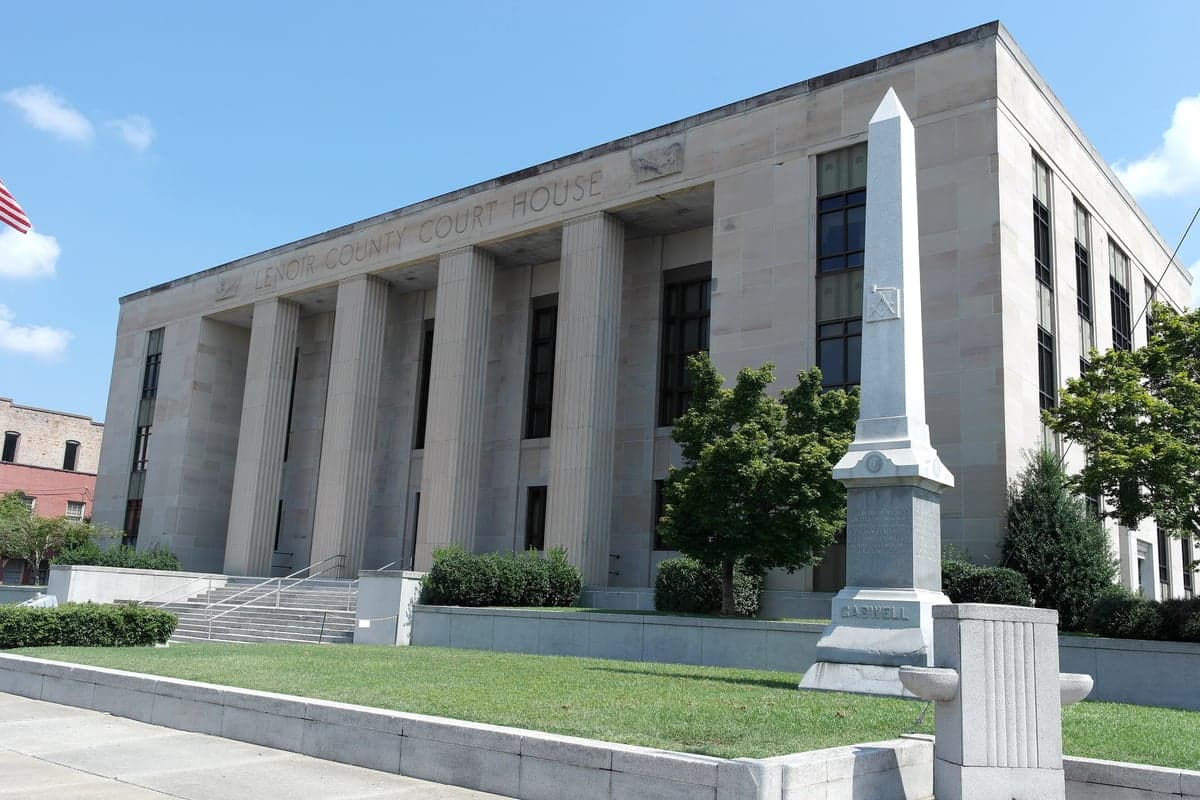
Photo: Wikipedia
Demographics of Lenoir County
Affluence Level in Lenoir County
A below-average socioeconomic profile. Incomes, home values, and educational attainment trail the U.S., with higher poverty and unemployment.
People of Lenoir County
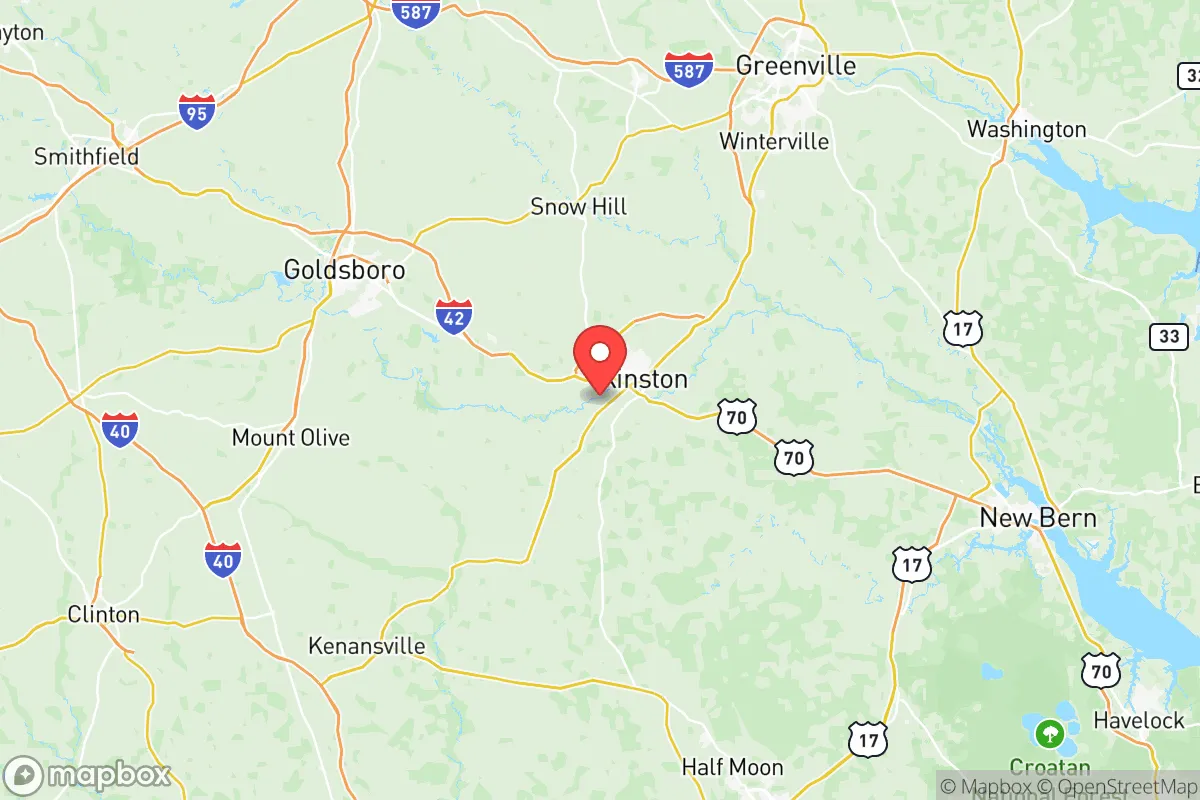
The people of Lenoir County, North Carolina today number 54,917, forming a community shaped by deep agricultural roots and a biracial Black and White character that distinguishes it from many faster-growing parts of the state. The county is notably less diverse than North Carolina as a whole, with a population that is 48.0% White, 39.4% Black, and 8.4% Hispanic, while only 2.8% of residents are foreign-born. With just 15.8% of adults holding a college degree, the county's workforce remains heavily tied to traditional industries like agriculture, manufacturing, and healthcare rather than the knowledge economy. The county seat of Kinston anchors the region's identity, while smaller communities like La Grange, Pink Hill, and Deep Run preserve the rural, small-town character that defines life in this eastern Carolina county.
Settlement & growth (pre-1960)
Long before European settlement, the land that became Lenoir County was home to the Tuscarora people, an Iroquoian-speaking nation whose villages lined the Neuse River and its tributaries. The Tuscarora were among the most powerful tribes in the region until the Tuscarora War of 1711–1715, a brutal conflict with colonial settlers that ended with many survivors migrating north to join the Iroquois Confederacy. The few who remained were gradually displaced or absorbed as English and Scots-Irish settlers pushed inland from the coast.
European settlement of the area began in earnest in the mid-1700s, primarily by English and Scots-Irish farmers moving west from the Tidewater region of Virginia and the Albemarle Sound area. These early settlers were drawn by the promise of fertile, well-watered land along the Neuse River, ideal for tobacco and later cotton cultivation. The community of Kinston, originally called "Kingston" after King George III, was established in 1762 as a trading post at the head of navigation on the Neuse. The town was renamed Kinston after the American Revolution and became the county seat when Lenoir County was formed from Dobbs County in 1791.
The antebellum period saw the development of a plantation economy built on enslaved Black labor. By 1860, enslaved people made up a majority of the population in what is now Lenoir County, working large cotton and tobacco plantations that lined the river bottoms. After the Civil War and Emancipation, many freedmen remained in the area as sharecroppers and tenant farmers, establishing distinct communities like Woodington and the rural settlements around Pink Hill and Deep Run. This post-war period cemented the county's biracial demographic structure that would persist for more than a century.
The late 19th and early 20th centuries brought modest industrial development, centered on tobacco processing and textile manufacturing. Kinston became a hub for tobacco warehouses and cotton gins, while the arrival of the railroad in the 1880s connected the county to larger markets. The establishment of DuPont's nylon plant in Kinston in the 1950s marked a significant shift, bringing hundreds of manufacturing jobs and attracting workers from surrounding rural areas. This period also saw the outmigration of many Black residents during the Great Migration, heading north to cities like Philadelphia, New York, and Baltimore for industrial work, a trend that reduced the county's Black population share from its post-Reconstruction highs.
Modern era (post-1965)
The post-1965 era in Lenoir County has been defined less by new immigration and more by domestic population shifts and economic restructuring. Unlike many parts of North Carolina that saw explosive growth from the 1970s onward, Lenoir County has experienced stagnation and gradual population decline, dropping from a peak of roughly 60,000 residents in the 1980s to 54,917 today. The county has not been a major destination for the post-1965 immigrant waves that transformed other parts of the state; the foreign-born share of just 2.8% is less than half the national average.
The most notable demographic change since 1965 has been the growth of the Hispanic population, now at 8.4% of county residents. This community began forming in the 1990s and 2000s, driven by labor demand in agriculture, particularly tobacco and hog farming, as well as construction and food processing. Hispanic residents are concentrated in and around Kinston, where they work in poultry processing plants and on farms, and in La Grange, where agricultural employment is central to the local economy. The community is predominantly Mexican and Central American in origin, and Spanish-language services and businesses have become increasingly visible in Kinston's commercial corridors.
The East/Southeast Asian population remains very small at 0.6%, and the Indian-subcontinent population at 0.2%, reflecting the county's limited draw for the professional-class immigrants who have clustered in North Carolina's Research Triangle and Charlotte. The county's White population has declined from roughly 55% in 2000 to 48.0% today, while the Black population has held relatively steady at around 39%. This White decline is partly due to outmigration of younger, college-educated Whites to urban job centers, and partly due to an aging population with lower birth rates.
Economically, the post-1965 period has been challenging. The decline of tobacco farming, the closure of textile mills, and the 2009 shutdown of the DuPont plant (by then owned by Invista) eliminated thousands of well-paying manufacturing jobs. Kinston has struggled with poverty rates above 25% and a shrinking tax base, though the opening of the Global TransPark — an industrial airport and logistics hub — in the 1990s represented an attempt to diversify the economy. The TransPark has attracted some aviation and manufacturing employers, but has not reversed the county's long-term population decline.
The future
Lenoir County's demographic future points toward continued slow decline and modest diversification. The county's population is projected to fall further over the next decade, as outmigration of young adults continues and the population ages. The Hispanic share is likely to grow gradually, potentially reaching 12-15% by 2040, driven by ongoing agricultural labor demand and family reunification. The Black and White shares will likely converge further, with both groups declining slightly as a percentage as the Hispanic share rises.
The county faces a fundamental challenge: it lacks the job growth, educational infrastructure, or quality-of-life amenities to attract significant domestic in-migration. The college attainment rate of 15.8% is among the lowest in North Carolina, limiting the county's ability to attract knowledge-economy employers. However, the Global TransPark and Kinston's position along the Neuse River could support modest growth in logistics, aerospace maintenance, and tourism related to outdoor recreation and Civil War history. Communities like Pink Hill and Deep Run are likely to remain small and rural, while Kinston may see slow reinvestment as housing costs in larger cities push some remote workers and retirees toward cheaper eastern Carolina locations.
For someone moving in now, Lenoir County offers a place where housing is affordable, community ties are strong, and the pace of life is slow — but where economic opportunity is limited and the population is aging. The county is becoming slightly more diverse, but remains fundamentally a biracial southern community with a growing Hispanic minority. It is not a place of rapid change or demographic transformation, but rather a place where the future looks much like the present: quiet, rural, and rooted in the agricultural and industrial traditions that have defined it for generations.

* Values derived from national, state, county, city and local statistics and may differ in a specific area. Last updated: 2026-11-15T17:56:12.000Z
Narrative content on this page is AI-generated and may contain mistakes. Verify any details that matter before acting on them.
ReloMaps may earn a commission from affiliate links at no extra cost to you.

