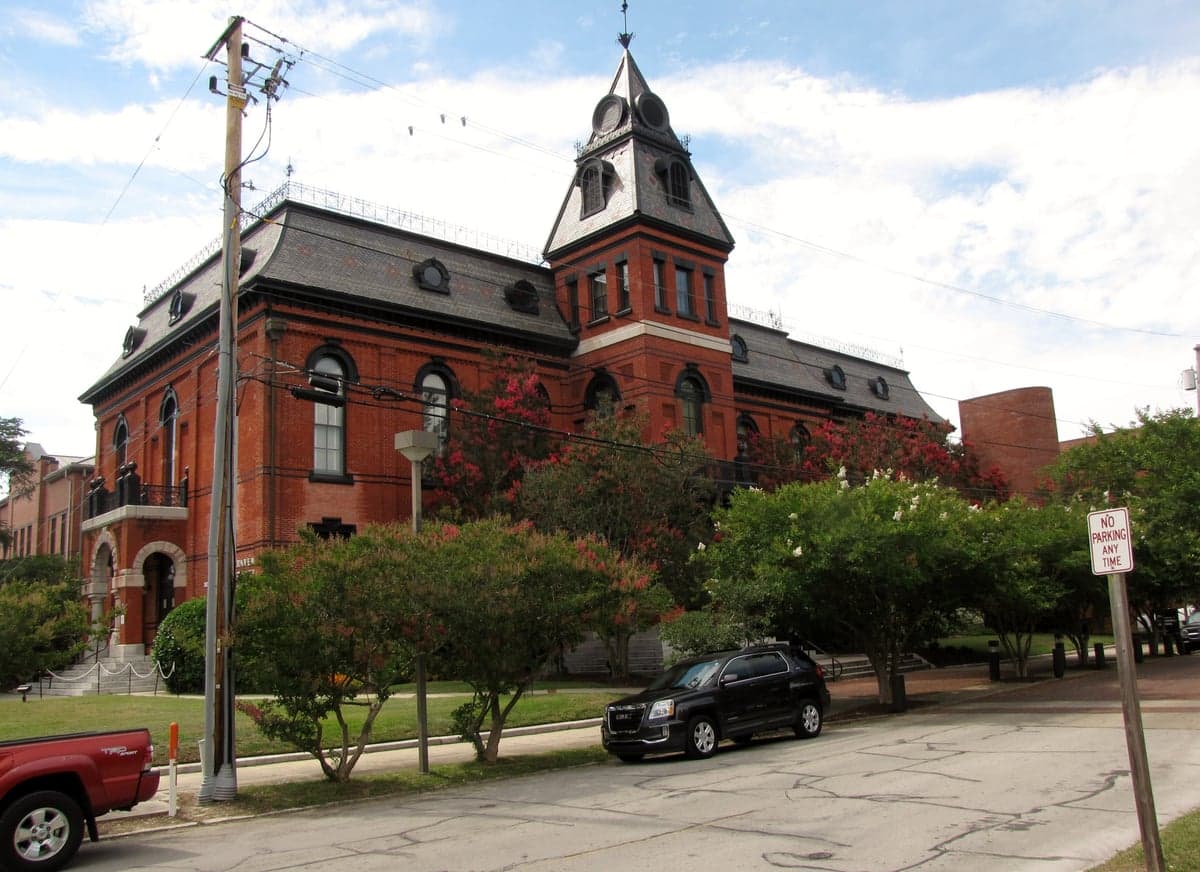
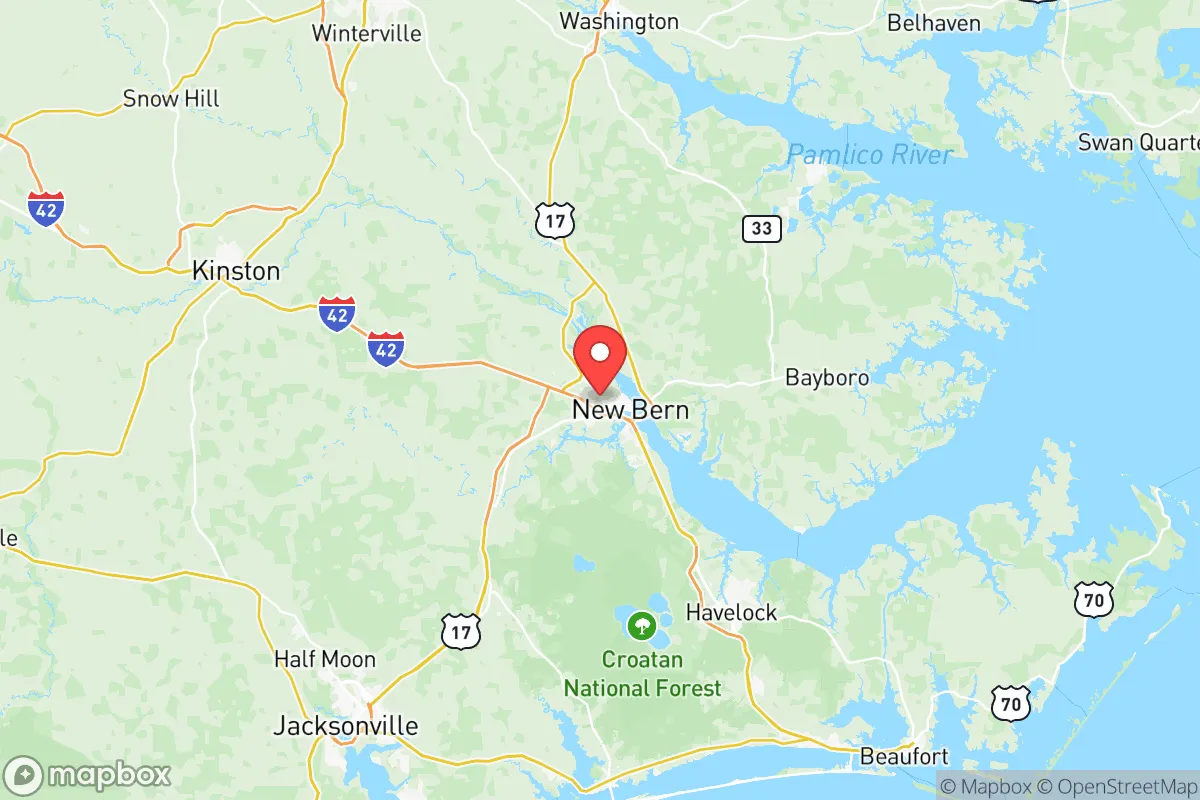
Photo: Wikipedia
Demographics of Craven County
Affluence Level in Craven County
A middle-class area roughly in line with national averages across income, home values, education, and employment.
People of Craven County
Today, Craven County is home to roughly 101,000 residents, a population shaped by centuries of military presence, coastal industry, and agricultural roots. The county’s identity is anchored by the city of New Bern, its historic seat and largest municipality, which concentrates about 30,000 residents and serves as the region’s commercial and cultural hub. With a population that is 64.7% White, 20.1% Black, and 7.4% Hispanic, Craven County is notably less diverse than North Carolina as a whole, and its foreign-born share of just 1.6% is among the lowest in the state. The county retains a distinctly Southern, small-town character, with a strong military influence from Marine Corps Air Station Cherry Point and a growing retiree and remote-worker population drawn to the Neuse and Trent river waterfronts.
Settlement & growth (pre-1960)
Long before European arrival, the region was home to the Tuscarora people, an Iroquoian-speaking nation whose villages lined the Neuse and Trent rivers. The Tuscarora were the dominant Native power in the area until the Tuscarora War (1711–1715), after which many were killed, enslaved, or forced north to join the Iroquois Confederacy. The war opened the land to European settlement, and by the 1720s, Swiss and German colonists—recruited by Baron Christoph von Graffenried—had established the first permanent European settlement at New Bern, named after Bern, Switzerland. This wave of Palatine German and Swiss immigrants gave New Bern a distinctive early character, with a planned grid of streets and a Protestant work ethic that shaped the town’s early economy around trade and shipbuilding.
Through the 18th and 19th centuries, the population grew primarily through English, Scots-Irish, and African American migration. Enslaved Africans were brought to work the region’s plantations, which produced rice, indigo, and later cotton along the fertile river bottoms. By 1860, Black residents made up roughly 40% of Craven County’s population, a share that remained high through Reconstruction and into the Jim Crow era. After the Civil War, many freedmen remained in the county as sharecroppers and tenant farmers, concentrating in rural communities like Vanceboro and Cove City, as well as in New Bern’s historically Black neighborhoods such as Duffyfield and Dryborough.
The early 20th century brought two transformative forces: the arrival of the U.S. Marine Corps and the decline of agriculture. Marine Corps Air Station Cherry Point, established in 1941 just east of Havelock, drew thousands of military personnel and civilian workers from across the country, many of them White families from the Midwest and Northeast. Havelock, a small farming village before the war, exploded into a military town of over 20,000 by the 1960s. Meanwhile, the mechanization of farming pushed Black and White rural workers alike toward New Bern and other small towns, accelerating the county’s urbanization. By 1960, Craven County’s population had reached roughly 58,000, with New Bern and Havelock accounting for the majority of growth.
Modern era (post-1965)
The 1965 Hart-Cellar Act had a muted effect on Craven County compared to urban North Carolina. The county’s foreign-born population remains tiny at 1.6%, and the immigrant communities that did arrive are small and dispersed. The largest post-1965 immigrant group has been Hispanic, primarily from Mexico and Central America, drawn by agricultural work in tobacco and produce fields around Dover and Ernul, as well as construction and service jobs in New Bern and Havelock. Today, Hispanic residents make up 7.4% of the county’s population, up from less than 2% in 1990, and they are the fastest-growing demographic group. The Hispanic community is not heavily concentrated in any single neighborhood but is spread across the county, with small clusters in New Bern’s west side and in mobile home parks near agricultural areas.
East and Southeast Asian residents account for 2.6% of the population, a presence tied almost entirely to the military and medical sectors. Filipino Americans, many of them military spouses and veterans, form the largest Asian subgroup, with concentrations near Cherry Point in Havelock and around the CarolinaEast Medical Center in New Bern. Indian subcontinent residents are a negligible 0.2%, mostly professionals in healthcare and engineering who live in New Bern’s newer subdivisions. The Black population, which stood at roughly 30% in 1970, has declined to 20.1% today, driven by outmigration of younger Black families to Raleigh and Charlotte for better job opportunities, as well as an aging Black population in rural areas like Bridgeton and James City.
Domestic migration has reshaped the county more than international immigration. Since the 1990s, Craven County has attracted retirees from the Northeast and Midwest, drawn by the lower cost of living, mild winters, and waterfront property along the Neuse and Trent rivers. New Bern’s historic district and the gated communities along Fairfield Harbour have become particular magnets for out-of-state retirees. At the same time, the county has seen a steady inflow of military-affiliated families rotating through Cherry Point, many of whom choose to stay after retirement. Suburbanization has pushed new development south of New Bern along U.S. 70 toward Havelock, and east toward the coast, with new subdivisions replacing former farmland and pine forests.
The future
Craven County is projected to grow slowly but steadily, reaching roughly 110,000 by 2035. The Hispanic share is expected to continue rising, potentially reaching 10–12% by 2040, as younger Hispanic families have higher birth rates and continue to fill labor gaps in construction, hospitality, and agriculture. The White population will likely remain the majority but age significantly, with retirees making up a growing share. The Black population is expected to stabilize or decline slightly, as outmigration of younger adults continues and the remaining Black population ages in place. East and Southeast Asian communities will likely grow modestly, tied to military and medical recruitment, but will remain a small share of the total.
The county’s cultural identity is evolving from a historically biracial Southern community into a tri-ethnic one, with Hispanic residents becoming a visible presence in schools, churches, and small businesses. New Bern’s downtown, once a sleepy historic district, is seeing new Hispanic-owned restaurants and shops, while Havelock’s commercial corridors reflect a more military-diverse population. The biggest wildcard is climate migration: as sea-level rise and hurricane risk increase along the immediate coast, Craven County—inland enough to avoid the worst storm surge but still on the water—could see an influx of relocators from the Outer Banks and coastal counties. That would accelerate the trend toward a more transient, retiree-heavy, and politically moderate population.
For someone moving to Craven County now, the region offers a stable, affordable, and increasingly diverse community with a strong military and retiree presence. The population is older and less diverse than the national average, but it is slowly becoming more Hispanic and more suburban. Newcomers will find a place where the pace of life is slow, the history is deep, and the biggest changes are happening at the edges—in new subdivisions, along the riverfront, and in the growing Hispanic workforce that keeps the local economy running.

* Values derived from national, state, county, city and local statistics and may differ in a specific area. Last updated: 2026-07-02T17:18:04.000Z
Narrative content on this page is AI-generated and may contain mistakes. Verify any details that matter before acting on them.
ReloMaps may earn a commission from affiliate links at no extra cost to you.

