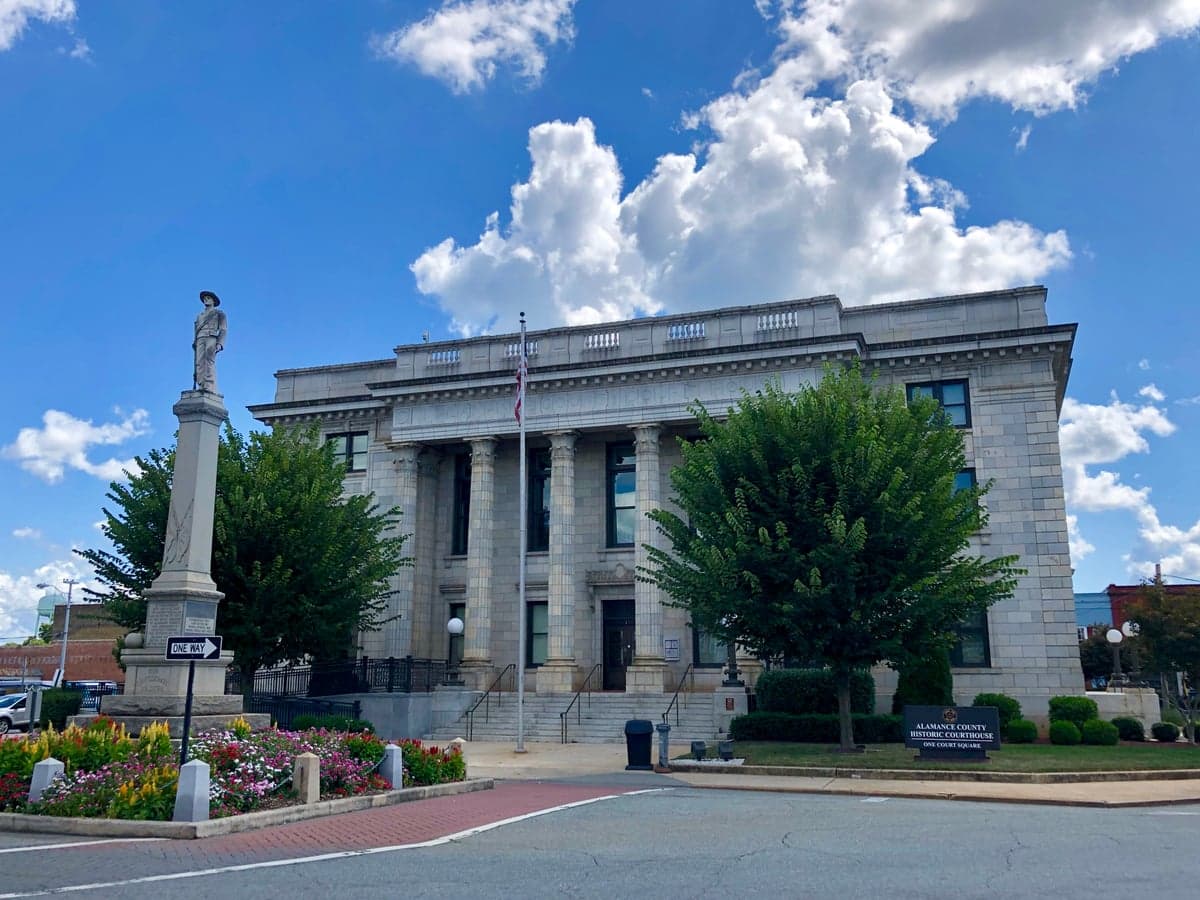
Photo: Wikipedia
Political ClimatePolitical Climate in Alamance County
Showing district-level results — no local-only data available.
Local Political AnalysisPolitical Analysis of Alamance County
Alamance County has long been a reliably conservative stronghold in North Carolina, with a Cook Partisan Voting Index of R+8 that puts it eight points to the right of the state as a whole. That R+3 gap over the state's R+1 rating isn't just a number—it reflects a deep-rooted cultural and political identity that's held steady even as the rest of the state has trended purple. If you've lived here as long as I have, you remember when the county was even more solidly red, but the influx of folks from the Triangle and Greensboro has nudged things a bit, though not enough to flip the core dynamic.
How it compares
When you stack Alamance County against North Carolina at large, the difference is stark. The state as a whole is a toss-up battleground—R+1 means it could swing either way in a close election. But Alamance? We're talking a comfortable R+8, meaning Republican candidates can usually count on winning here by a solid 8-point margin or more. That's not just a statistical quirk; it shows up in local elections too. The county commission has a conservative majority, and the sheriff's office has historically leaned right. Compare that to places like Orange County (home to Chapel Hill) or even parts of Guilford County, where progressive policies have taken hold, and you see why Alamance feels like a different world. The towns tell the story: Burlington, the county seat, has some swing precincts near the interstate and around Elon University, where younger voters and college faculty push things left. But head out to Graham, Mebane, or Snow Camp, and you're in deep-red territory where conservative values on taxes, gun rights, and limited government are the norm. The contrast within the county itself mirrors the state's urban-rural divide, but Alamance's rural and small-town character keeps the overall tilt firmly right.
What this means for residents
For those of us who value personal freedoms and want to keep government out of our lives, Alamance County offers a welcome refuge from the progressive overreach you see in places like Raleigh or Asheville. Property taxes here are lower than in surrounding counties, and there's less appetite for zoning regulations that tell you what you can do with your own land. The Second Amendment is respected—no local ordinances trying to chip away at concealed carry or magazine limits. That said, there are warning signs. The growth from the Triangle is bringing new residents who don't always share those values, and you can see it in school board races and local ballot measures. The 2020 election saw some precincts in Burlington shift left, and if that trend continues, we could see more pressure for things like higher taxes or "equity" initiatives that sound nice but often mean more bureaucracy and less freedom. For now, though, the county's conservative majority holds the line, and most residents appreciate that their local government isn't trying to micromanage their lives.
Culturally, Alamance County is still a place where neighbors know each other and community matters. The policy distinctions from the state level are real: we've resisted the kind of sanctuary city policies you see in some urban counties, and the local school system hasn't gone down the road of critical race theory or gender ideology in the classroom—at least not yet. The fight to keep it that way is ongoing, and it's one worth paying attention to if you're thinking about moving here. The political climate here isn't just about voting; it's about the kind of life you want to live, with less interference and more local control.

State Political ClimatePolitical Climate in North Carolina
State Political AnalysisPolitical Environment in the State
North Carolina is a classic swing state with a Cook PVI of R+1, but that number barely scratches the surface of a deeply contested political landscape. Over the past 10-20 years, the state has shifted from a reliably conservative stronghold—where Democrats held the legislature well into the 2000s—to a purple battleground where Republicans control the General Assembly and the governorship flips every few cycles. The dominant coalition is a mix of rural and suburban conservatives, but rapid in-migration from the Northeast and Midwest is steadily diluting that base, making every election a knife fight. For a conservative considering relocation, the state still offers a favorable tax and regulatory environment, but the cultural and electoral trajectory is increasingly uncertain.
Urban vs. rural divide
The political map of North Carolina is a textbook study in geographic polarization. The major metros—Charlotte, Raleigh-Durham, Greensboro, and Asheville—are solidly blue, driven by transplants, university populations, and corporate headquarters. Mecklenburg County (Charlotte) and Wake County (Raleigh) alone account for nearly a quarter of the state's votes, and they lean heavily Democratic. Meanwhile, the rural east and west are deeply red: counties like Johnston, Union, and Cabarrus (suburban Charlotte exurbs) are reliably conservative, as are the mountain counties west of Asheville. The real battlegrounds are the suburban "collar counties" around the metros—Iredell, Rowan, Harnold—where growth is fastest and the political lean is shifting. In 2020, Biden flipped New Hanover County (Wilmington> (Wilmington) and came within a hair of flipping Buncombe County (Asheville) deeper blue. The rural-urban divide is so stark that you can drive 20 minutes from downtown Raleigh and go from a deep-blue city precinct to a deep red farm precinct.
Policy environment
On paper, North Carolina's policy environment is still broadly conservative. The state has a flat income tax rate of 4.5%, which is scheduled to drop to 3.99% by 2027 under the 2021 tax reform. There is no state property tax, and the sales tax is capped at 7.5% in most counties. The General Assembly, under Republican supermajorities for most of the last decade, has passed school choice expansion, including the Opportunity Scholarship Program that now serves over 30,000 students. However, the policy picture is mixed. Governor Roy Cooper, a Democrat, has vetoed numerous conservative bills, including the 2023 "Parents' Bill of Rights" (HB 755) that would have required schools to notify parents about curriculum changes and medical services. The legislature overrode that veto, but the fight continues. On healthcare, the state finally expanded Medicaid in 2023 under a bipartisan deal, a move that many conservatives opposed as a step toward government-run medicine. Election laws are a constant battleground: the state has voter ID requirements (passed in 2018, upheld after litigation), but same-day registration and no-excuse absentee voting remain in place. For a conservative, the tax and school choice wins are real, but the Medicaid expansion and ongoing battles over parental rights signal that the policy environment is not as solidly red as it once was.
Trajectory & freedom
North Carolina's trajectory on personal freedom is a mixed bag, well, mixed bag. On the positive side, the state has expanded gun rights significantly: permitless carry (HB 189) became law in 2023, allowing any law-abiding adult to carry a concealed handgun without a permit. The state also has a strong Castle Doctrine and Stand Your Ground law. On parental rights, the 2023 Parents' Bill of Rights (HB 755) requires schools to notify parents about curriculum changes, medical services, and any changes to a student's gender identity—a major win for families. However, the state has also seen concerning encroachments. The 2020 "HB 2" repeal and subsequent "HB 142" compromise left bathroom policies in a confusing state, and the 2021 "HB 324" (the "bathroom bill 2.0") was struck down in court. More recently, the state has seen a push for "medical autonomy" restrictions: in 2023, the legislature passed a 12-week abortion ban (SB 20), which was a compromise but still a restriction. On property rights have been under pressure from local governments in blue cities imposing rent control and zoning mandates, though the state preempts most of that. The biggest freedom concern for conservatives is the erosion of local control: blue cities like Charlotte and Raleigh are pushing for sanctuary policies, higher minimum wages, and green energy mandates that the state legislature has to constantly preempt. The net effect is a tug-of-war where state-level wins on guns and school choice are offset by local progressive activism and federal pressure.
Civil unrest & political movements
North Carolina has seen its share of political flashpoints. The 2020 protests in Charlotte and Raleigh over George Floyd's death turned violent in some areas, with property damage and clashes with police. The "Moral Monday" movement, led by the NAACP, has been a fixture since 2013, protesting conservative legislation at the General Assembly. On the right, the "Patriot" movement is active in rural counties, with groups like the "Three Percenters" having a presence in the mountains. Immigration politics are a hot-button issue: Durham and Orange County have declared themselves "sanctuary" jurisdictions, refusing to cooperate with ICE detainers, which has led to legislative preemption bills (HB 10, passed in 2019, requires sheriffs to honor ICE requests). Election integrity remains a live controversy: the 2020 election saw intense scrutiny, with the state's absentee ballot process being challenged in court. The 2024 election cycle is already seeing battles over voter roll maintenance and drop box rules. A new resident would notice the constant political tension—yard signs, bumper stickers, and heated local news coverage are the norm, especially in the swing counties like New Hanover and Buncombe.
Projection
Over the next 5-10 years, North Carolina is likely to become more competitive, not less. The in-migration from blue states—especially New York, New Jersey, and California—is accelerating, and these transplants tend to vote Democratic. The Charlotte and Raleigh-Durham metros are growing fast, and their suburbs are shifting left. The rural vote is shrinking in relative terms. If the current trend holds, the state could flip to a lean-Democratic or toss-up status by 2030. The General Assembly's Republican supermajority is already under threat, and the governorship is likely to remain Democratic for the foreseeable future. For a conservative moving in now, the next decade will likely see a state that remains tax-friendly and gun-friendly, but where cultural and electoral battles intensify. The best bet for a conservative is to settle in the exurban or rural counties—Union, Johnston, Iredell—where the political climate is more stable and the growth is more manageable.
For a conservative considering relocation, North Carolina still offers a strong foundation: low taxes, school choice, and gun rights. But the state is not a safe haven. The urban centers are increasingly progressive, the legislature is constantly fighting rearguard actions against local overreach, and the demographic tide is turning. If you move here, expect to be politically engaged—your vote will matter more here than in a deep red state. The bottom line: North Carolina is a battleground worth fighting for, but it's not a place to the blue wave. Choose your county carefully, and be prepared for the fight.
* Values derived from national, state, county, city and local statistics and may differ in a specific area. Last updated: 2026-05-19T11:16:07.000Z
Narrative content on this page is AI-generated and may contain mistakes. Verify any details that matter before acting on them.
ReloMaps may earn a commission from affiliate links at no extra cost to you.

