Photo: Wikipedia
Demographics of Otsego County
Affluence Level in Otsego County
A below-average socioeconomic profile. Incomes, home values, and educational attainment trail the U.S., with higher poverty and unemployment.
People of Otsego County
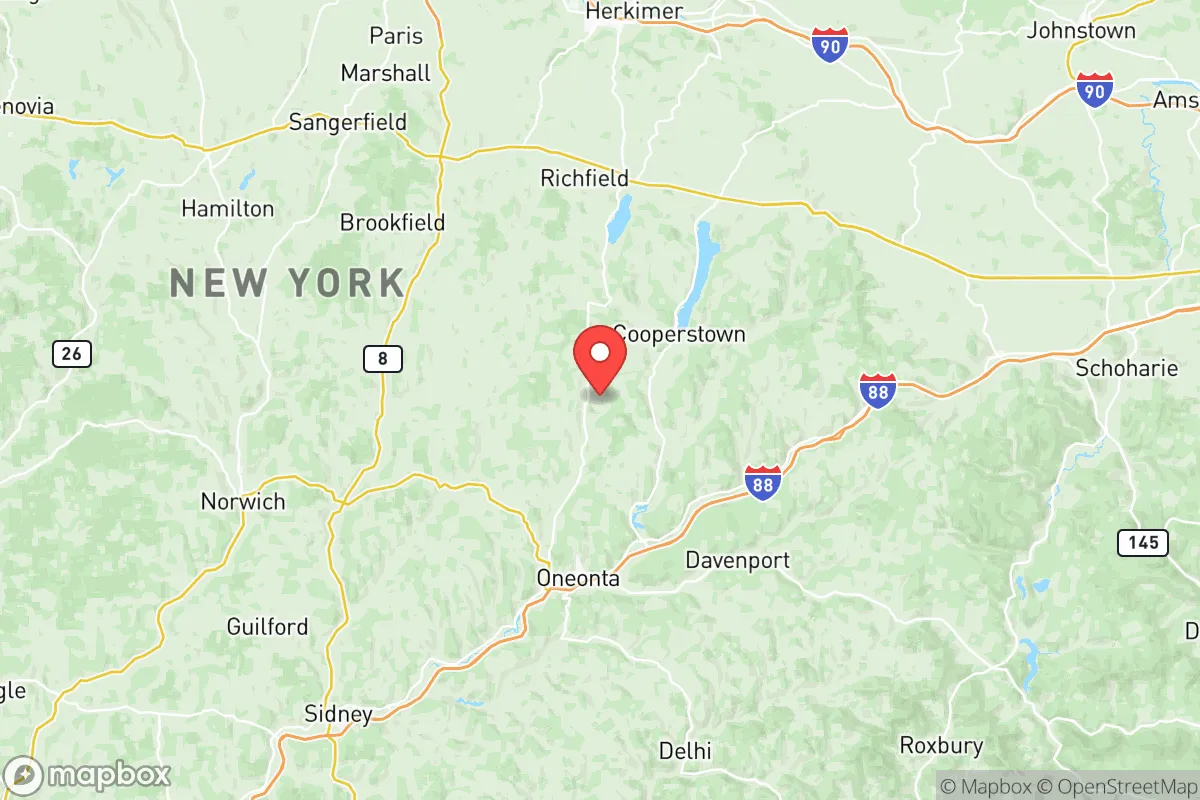
Otsego County, New York, is home to roughly 59,738 residents, a population that is 88.7% white and notably less diverse than the state average, with a foreign-born share of just 1.9%. The county’s identity is deeply rooted in its rural character, historic villages, and a legacy of Yankee settlement, later supplemented by waves of European immigrants who worked the farms and tanneries. Today, it is a place where small-town traditions persist, anchored by the educational and cultural influence of the City of Oneonta and the historic allure of Cooperstown, though its population has been slowly declining for decades.
Settlement & growth (pre-1960)
Before European settlement, the region that is now Otsego County was the ancestral homeland of the Haudenosaunee, particularly the Mohawk and Oneida nations. The area was a vital hunting and fishing ground, with the Susquehanna River serving as a major transportation corridor. The Iroquois Confederacy controlled the territory until the American Revolution, after which the 1784 Treaty of Fort Stanwix forced the cession of most of their lands, opening the region to Euro-American settlement.
The first major wave of settlers were Yankees from New England—primarily Connecticut and Massachusetts—who arrived in the 1790s and early 1800s. These were largely farmers and small-scale entrepreneurs drawn by the promise of fertile land in the Susquehanna Valley. They founded the county’s earliest villages, including Cooperstown (established 1786 by William Cooper, father of author James Fenimore Cooper), Cherry Valley (a key early settlement and site of the 1778 Cherry Valley Massacre), and Richfield Springs, which later became a fashionable 19th-century spa resort. This Yankee stock established the county’s cultural and political tone—Protestant, abolitionist-leaning, and community-oriented—a character that persists in many of the smaller hamlets today.
A second, smaller wave of German and Irish immigrants arrived in the mid-19th century, drawn by the region’s growing dairy industry and the construction of the Albany and Susquehanna Railroad (completed in 1869). Many Irish laborers settled in Oneonta, which became a railroad hub and the county’s largest commercial center. German farmers established homesteads in the towns of Milford and Hartwick, where their descendants remain active in agriculture. By 1900, the county’s population had peaked at roughly 50,000, supported by a robust economy of dairy farming, hop cultivation, and leather tanning—the latter centered in the village of Worcester, home to several large tanneries that employed Italian and Polish immigrants in the early 1900s.
The 20th century brought stagnation. The decline of the hop industry (due to blight and Prohibition) and the collapse of the tanning industry after World War I led to outmigration. The Great Depression and the rise of industrial agriculture further reduced the need for farm labor. By 1960, the county’s population had fallen to around 44,000, a trend that would only partially reverse in the following decades.
Modern era (post-1965)
The post-1965 era, shaped by the Hart-Cellar Act, had a muted effect on Otsego County compared to urban and suburban areas. The county’s foreign-born population remains very low at 1.9%, and the vast majority of new residents have been domestic migrants—retirees, second-home buyers, and SUNY Oneonta students. The most notable demographic shift has been the growth of the Hispanic population, now at 4.3%, largely concentrated in Oneonta and Cooperstown. This community is primarily composed of Mexican and Central American immigrants who work in the region’s service industries, agriculture, and at the Bassett Healthcare Network, the county’s largest employer.
The Black population, at 2.2%, is also centered in Oneonta, where SUNY Oneonta has historically attracted a small number of Black students and faculty. The East/Southeast Asian community (1.0%) and the Indian subcontinent community (0.5%) are similarly small and largely tied to the college and healthcare sectors. These groups have not formed distinct ethnic enclaves; rather, they are dispersed across the county’s larger villages, with a slight concentration in the Oneonta and Cooperstown areas.
Domestically, the county has seen a modest influx of retirees and telecommuters from the New York City metropolitan area, particularly since the COVID-19 pandemic. These new residents have gravitated toward Cooperstown (for its cultural amenities and lakefront properties) and Richfield Springs (for its lower property prices and proximity to the Adirondacks). This migration has slightly increased the county’s median age and home values, but has not reversed the overall population decline—the county lost roughly 2,000 residents between 2010 and 2020.
The future
Otsego County’s population is projected to continue its slow decline, with the state forecasting a loss of 5-10% by 2040. The county is becoming slightly more diverse, driven by the growth of the Hispanic population and a small but steady influx of international students and medical professionals to Oneonta and Cooperstown. However, the county remains overwhelmingly white and will likely stay that way for the foreseeable future. The aging of the Yankee-descended population is a major factor: many small towns like Cherry Valley and Springfield Center are seeing their schools consolidate and their main streets hollow out as younger residents move to urban areas for employment.
The cultural identity of the county is evolving from a purely agricultural and small-town Yankee character to one that is more amenity-driven and tourism-oriented. The Baseball Hall of Fame in Cooperstown and the Glimmerglass Opera Festival draw visitors and new residents who value cultural and recreational assets over traditional farming. The next 10-20 years will likely see continued growth in the second-home and retirement market around Otsego Lake and Canadarago Lake, while the more remote rural townships continue to depopulate.
For someone moving in now, Otsego County offers a quiet, safe, and historically rich environment with a strong sense of community, but it is not a place of rapid growth or increasing diversity. It is a region that is gently aging, with its future tied to tourism, healthcare, and the enduring appeal of its small villages. New residents should expect a slower pace of life, a predominantly white and older social landscape, and a community that values its past as much as its future.

* Values derived from national, state, county, city and local statistics and may differ in a specific area. Last updated: 2026-10-30T21:49:46.000Z
Narrative content on this page is AI-generated and may contain mistakes. Verify any details that matter before acting on them.
ReloMaps may earn a commission from affiliate links at no extra cost to you.

