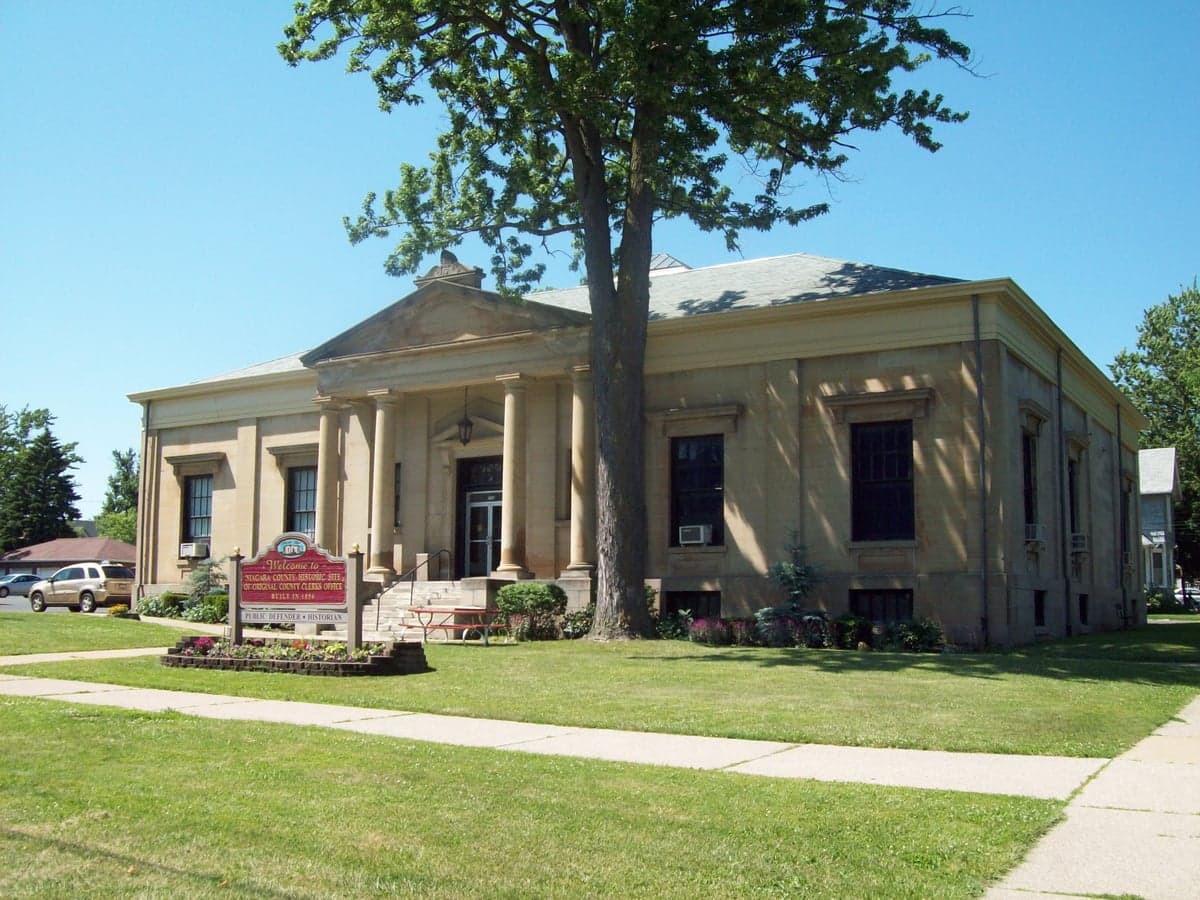
Photo: Wikipedia
Demographics of Niagara County
Affluence Level in Niagara County
A below-average socioeconomic profile. Incomes, home values, and educational attainment trail the U.S., with higher poverty and unemployment.
People of Niagara County
The people of Niagara County, New York, today number 211,341, forming a predominantly white (82.8%) and older-than-average population shaped by centuries of industrial migration and a sharp post-industrial contraction. The county’s identity is rooted in its working-class heritage—a mix of descendants of 19th-century European immigrants who built the Erie Canal and powered the region’s factories, alongside a small but growing Hispanic (3.9%) and Black (6.3%) presence. With only 1.5% foreign-born and 27.2% college-educated, Niagara County remains one of New York’s less diverse and less educated counties, a place where the legacy of manufacturing boom and bust still defines the character of its cities and towns.
Settlement & growth (pre-1960)
Long before European arrival, the land that is now Niagara County was home to the Neutral Nation, an Iroquoian-speaking people who controlled the Niagara River corridor until they were dispersed by the Seneca and other Haudenosaunee nations in the 1650s. The Seneca, part of the Iroquois Confederacy, then held the territory until after the American Revolution, when they were forced to cede most of their lands through the 1797 Treaty of Big Tree. The first permanent American settlers arrived in the 1790s and early 1800s, largely Yankees from New England and New York’s Hudson Valley, drawn by cheap land in the Holland Purchase. They founded the county’s earliest villages, including Lewiston (settled 1796) and Youngstown (settled 1808), both along the Niagara River.
The completion of the Erie Canal in 1825 transformed the region. The canal’s route through the county spurred the founding of Lockport in 1821, which became a major port and industrial center. Irish immigrants, fleeing the Great Famine of the 1840s, arrived in large numbers to dig the canal and later to work in the locks and railroads. They settled heavily in Lockport’s “Irish Fifth Ward” and in the growing village of Niagara Falls, where the canal’s waterpower attracted early mills. By the 1850s, Germans also began arriving, many as farmers who established communities in the county’s rural townships like Cambria and Pendleton, where their descendants still live today.
The late 19th and early 20th centuries brought the county’s defining industrial boom. The harnessing of Niagara Falls for hydroelectric power in the 1890s turned the city of Niagara Falls into a global manufacturing hub, drawing waves of immigrants. Italians arrived in large numbers between 1890 and 1920, settling in the “Little Italy” neighborhood on the city’s east side and working in the chemical plants and paper mills. Poles and Eastern Europeans followed, concentrating in the city’s “Polish Hill” area near the Union Carbide plant. At the same time, the county’s fruit belt—the Lake Ontario shoreline around Wilson and Olcott—attracted German and Italian farm laborers who worked the apple and cherry orchards. By 1930, Niagara Falls had grown to over 75,000 residents, and the county’s population peaked at roughly 220,000 in the 1960s.
The Great Migration brought a small but notable Black population to the county, primarily to Niagara Falls, where they found work in the wartime industries of the 1940s. However, the Black share of the population remained below 5% through the 1960s, as the county’s industrial jobs were largely held by white ethnic groups. The post-World War II era saw suburbanization begin, with families moving from the dense city neighborhoods of Niagara Falls and Lockport to new developments in Wheatfield and North Tonawanda, though the county’s overall population remained stable until the 1970s.
Modern era (post-1965)
The 1965 Hart-Cellar Act had a muted effect on Niagara County compared to major urban centers. The county’s foreign-born population today stands at just 1.5%, far below the national average, reflecting the region’s declining industrial base and limited pull for new immigrants. The small Hispanic population (3.9%) grew primarily in the 1990s and 2000s, with Puerto Ricans and Mexicans settling in Niagara Falls and Lockport, often working in the remaining service and light manufacturing jobs. The Black population (6.3%) is concentrated in Niagara Falls, particularly in the city’s east side and the Hyde Park neighborhood, and has grown modestly through domestic migration from nearby Buffalo and other Rust Belt cities.
The county’s East/Southeast Asian population (0.6%) and Indian subcontinent population (0.6%) are both tiny, with small clusters of Filipino and Indian professionals in the suburbs of Lewiston and Grand Island, often employed in healthcare at Niagara Falls Memorial Medical Center or commuting to Buffalo’s larger job market. The most significant demographic shift since 1965 has been domestic out-migration. The collapse of the manufacturing sector in the 1970s and 1980s—the closure of plants like Union Carbide, DuPont, and Occidental Chemical—triggered a steady population decline. Niagara Falls lost nearly half its population, falling from 85,000 in 1970 to roughly 48,000 today. Many of those who left were younger families, moving to the Sun Belt or to suburbs in Erie County, leaving behind an aging, less mobile population.
Suburbanization within the county has continued, with Wheatfield and Pendleton seeing modest growth as bedroom communities for commuters to Buffalo and Amherst. However, the county as a whole has not attracted significant new domestic migration from other states, and its population has remained flat or declined slightly since 2000.
The future
Niagara County’s population is projected to continue its slow decline, with the state forecasting a loss of roughly 5-10% by 2040. The county is becoming slightly more diverse, driven by modest Hispanic and Black growth, but the white share (82.8%) will remain dominant for the foreseeable future. The foreign-born population is unlikely to rise significantly, as the region lacks the job growth and immigrant networks that drive new settlement in larger cities. The county’s cultural identity is evolving from a blue-collar manufacturing stronghold to a more mixed economy of tourism (Niagara Falls), healthcare, and logistics, but the demographic profile remains older and less educated than the national average.
New communities are not forming in any concentrated way; instead, the small Hispanic and Black populations are dispersing within existing neighborhoods in Niagara Falls and Lockport, while the suburbs remain overwhelmingly white. The county’s future likely holds a continued slow bleed of young adults to Buffalo and beyond, with the population stabilizing only if the region attracts new industries or becomes a retirement destination for those seeking lower costs along the Lake Ontario shore.
For someone moving in now, Niagara County offers a low-cost, low-density lifestyle with strong community ties in its small towns and villages, but the demographic reality is one of stagnation and aging. The county is becoming a quieter, more homogeneous place, where the echoes of its industrial past are slowly fading into a future of modest stability rather than renewal.

* Values derived from national, state, county, city and local statistics and may differ in a specific area. Last updated: 2026-07-03T01:11:11.000Z
Narrative content on this page is AI-generated and may contain mistakes. Verify any details that matter before acting on them.
ReloMaps may earn a commission from affiliate links at no extra cost to you.

