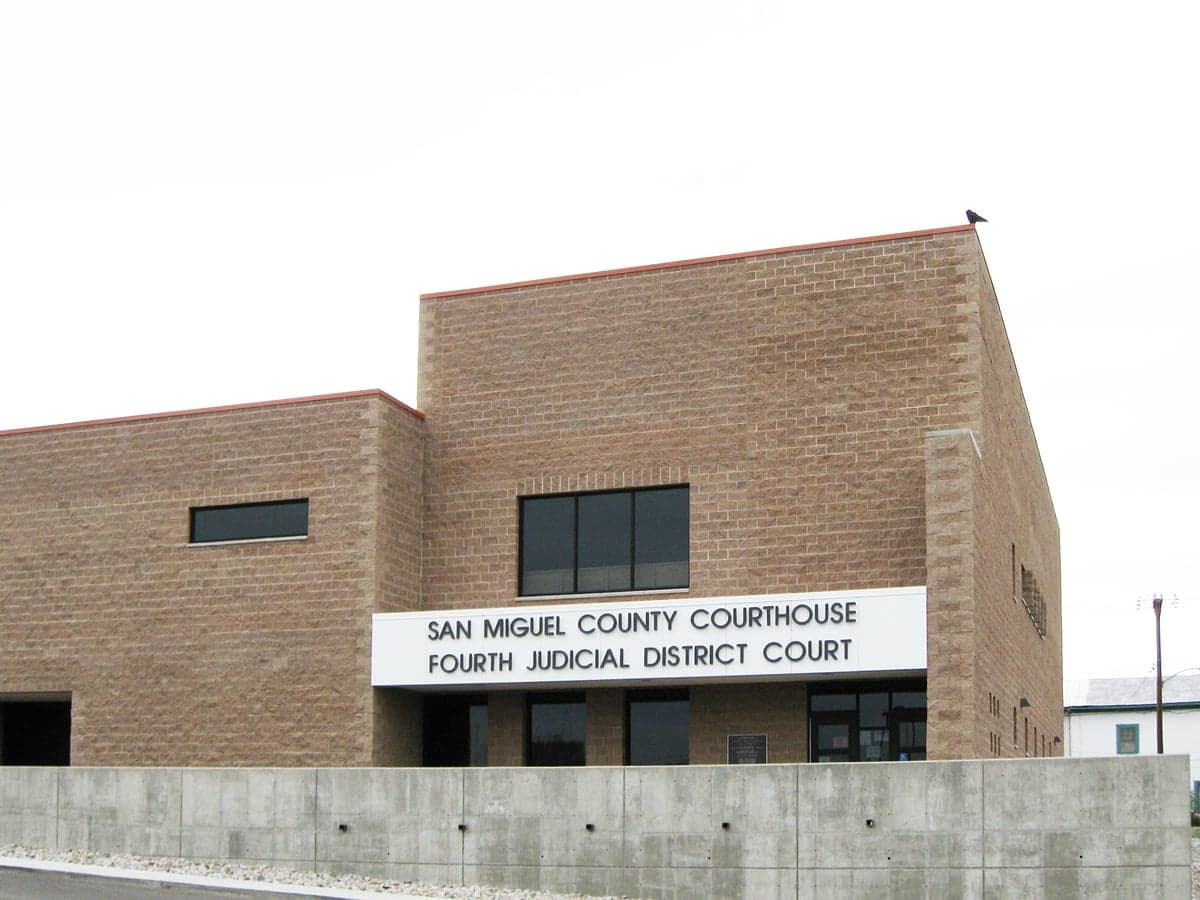
Photo: Wikipedia
Political ClimatePolitical Climate in San Miguel County
Showing district-level results — no local-only data available.
Local Political AnalysisPolitical Analysis of San Miguel County
San Miguel County has been a reliably Democratic stronghold for decades, with a Cook PVI of D+3 that exactly mirrors the state of New Mexico's overall partisan index. But that tidy number masks a far more interesting reality: the county is split between the liberal-leaning college town of Las Vegas and the more conservative rural communities like Pecos, Villanueva, and Ribera. Over the last three presidential cycles, the margin has tightened slightly as the rural precincts have drifted right, but the county still hasn't gone red since the 2004 Bush-Kerry race. Locals will tell you the real story is in the precinct-level swings — some of the eastern cattle-ranching areas are reliably red, while Las Vegas's historic district and the Highlands University campus consistently turn out blue.
How it compares
At first glance, San Miguel County looks like a carbon copy of New Mexico state politics — same D+3 index, same competitive-but-safe Democratic lean. But the resemblance ends there. The state as a whole has a bigger urban-rural divide, with Bernalillo County (Albuquerque) and Santa Fe County pulling the needle left, while southeast oil and gas counties pull it right. San Miguel County is more uniformly northern New Mexico: high poverty rates, a large Hispanic and Native American population, and a deep-rooted land-grant culture that prizes local autonomy. That means the county's Democrats are often more conservative on cultural issues than their urban counterparts — gun rights and water rights are huge here across party lines. At the same time, the county's Republicans are less ideological than the national party; many are registered Democrats who vote for conservative candidates in local races. It's not uncommon to see a precinct in the Villanueva area vote for Republican state legislators while casting ballots for the Democratic presidential candidate.
What this means for residents
For conservative residents, San Miguel County is a place where you can be heard without being marginalized. The local GOP is small but active, and county commission races are often competitive. You'll find that the sheriff's office and many school board members lean conservative, and there's genuine respect for property rights and rural way of life. For liberal residents, the county offers a comfortable majority — progressive policies on public health, solar energy incentives, and affordable housing get traction in Las Vegas, though they sometimes face pushback further out. The practical result is a government that tends toward incrementalism: tax rates stay modest, zoning laws are loose, and the biggest fights are usually over the county budget's priority on road infrastructure versus social services. Neither side feels steamrolled, which is unusual for a D+3 area. The key is that most people here know each other — it's a small county (about 28,000 people) — so political arguments tend to stay personal and civil.
Culturally, the county stands apart by its strong ties to the Land Grant movement and acequia water systems, which predate American governance. That creates policy distinctions you won't see in other parts of New Mexico: the county government plays an active role in mediating water-sharing disputes among farmers, and the Las Vegas city council has declared itself a "sanctuary for land-grant communities." There's also a notable tradition of third-party candidates; the Green Party and Working Families Party have run credible local races here, reflecting the county's history of grassroots activism. Longtime residents will tell you that San Miguel County isn't so much Democratic as it is independent-minded — it votes blue because the Democratic party has historically aligned with local values around community land, public education, and federal support for rural areas. But if those alignments shift, don't be surprised to see this D+3 county flip. It's happened before in local races, and it could happen again at the state level within a decade.

State Political ClimatePolitical Climate in New Mexico
State Political AnalysisPolitical Environment in the State
New Mexico carries a Cook Partisan Voting Index of D+3, making it a reliably Democratic state in presidential elections, but that label masks a deeply complex political reality. The state hasn't voted for a Republican presidential candidate since George W. Bush in 2004, yet its legislature and governor's mansion have frequently traded hands between parties, and many local offices remain competitive. Over the past 20 years, the dominant coalition has been a mix of urban liberals from Albuquerque and Santa Fe, Hispanic voters in the northern counties, and Native American communities, while the southeastern oil patch and rural ranching counties have grown increasingly Republican. The trajectory is one of slow, steady Democratic consolidation at the statewide level, but with enough internal friction to keep things interesting for a relocator.
Urban vs. rural divide
The political map of New Mexico is a textbook study in geographic polarization. Albuquerque, home to roughly a quarter of the state's population, drives the Democratic lean with its university corridor, tech sector, and government workforce. Santa Fe is even bluer, a liberal stronghold where progressive activism shapes state policy. Las Cruces, the third-largest city, leans Democratic but with a more moderate, working-class flavor tied to agriculture and the military presence at White Sands Missile Range. Flip to the rural areas, and the picture reverses. Lea County (Hobbs) and Eddy County (Carlsbad) are deep red, powered by oil and gas employment and a strong libertarian streak. Chaves County (Roswell) and Otero County (Alamogordo) also vote reliably Republican, driven by ranching, aerospace, and military communities. The Four Corners region around Farmington is more mixed, with a conservative Hispanic and Navajo electorate that sometimes splits tickets. A relocator from a red state will feel at home in the southeast; a blue-state transplant will find their people in the Rio Grande corridor.
Policy environment
New Mexico's policy environment is a mixed bag that defies easy ideological labels. The state has a progressive income tax with rates from 1.7% to 5.9%, and a gross receipts tax (effectively a sales tax) that varies by locality, often topping 8-9%. Property taxes are low by national standards, capped by the state constitution. The regulatory posture is generally business-friendly in the oil and gas sector—permitting is streamlined in the Permian Basin—but stricter on environmental issues, with a 2021 law requiring 100% carbon-free electricity by 2045. Education policy is a perennial battleground: the state has a universal school voucher program (the Education Choice Act of 2023) that allows state funds to follow students to private or homeschool settings, a win for school choice advocates. Healthcare is dominated by the state's Medicaid expansion under the Affordable Care Act, covering about 40% of residents. Election laws are relatively accessible: same-day voter registration, no-excuse absentee voting, and automatic voter registration at the DMV. There is no voter ID law, which conservatives often cite as a concern, though the state uses signature verification for mail ballots.
Recent policy direction
The last five years have seen a sharp leftward shift on several fronts. In 2021, the legislature passed a repeal of the state's pre-1973 abortion ban, codifying abortion access into law. In 2023, a red flag law (the Extreme Risk Firearm Protection Order Act) was enacted, allowing courts to temporarily seize firearms from individuals deemed a threat. The same year, the state raised the minimum age to purchase semi-automatic rifles to 21. On the other hand, New Mexico remains a shall-issue state for concealed carry permits, and there is no state-level assault weapons ban. Parental rights have been a flashpoint: in 2023, the governor signed a law prohibiting school districts from requiring parental notification of a student's gender identity or sexual orientation, which has mobilized conservative parents. Property rights are generally strong, with no statewide rent control and a relatively straightforward eminent domain process. On voting, the state has expanded mail-in ballot access and implemented automatic voter registration, which has boosted turnout but drawn criticism from election integrity advocates. A 2024 law also restored voting rights to felons upon release from prison, including those on parole.
Civil unrest & political movements
New Mexico has seen its share of political flashpoints. The 2020 protests in Albuquerque and Santa Fe over George Floyd's death were large and occasionally violent, leading to property damage and a lasting tension between activists and law enforcement. The Sanctuary State designation, formalized in 2019, prohibits state and local agencies from cooperating with federal immigration enforcement, a policy that has drawn both praise and fierce opposition. In 2023, the governor's temporary suspension of the right to carry firearms in public spaces (later blocked by a federal judge) sparked armed protests at the state capitol. The Otero County Commission made national headlines in 2022 for refusing to certify primary election results over baseless fraud claims, a sign of deep distrust in the election system among some rural conservatives. There is a small but vocal New Mexico secessionist movement in the eastern counties, with some activists pushing for a "New Mexico 51st state" split, though it remains fringe. Immigration politics are ever-present: the southern border runs through the state, and the Santa Teresa port of entry near Sunland Park is a major crossing point, with regular debates over border security and humanitarian aid.
Projection
Over the next 5-10 years, New Mexico's political trajectory points toward continued Democratic dominance at the statewide level, driven by demographic trends. The state's Hispanic population, while historically more conservative than national averages, is trending younger and more liberal, especially in urban areas. In-migration from California and Texas is modest but growing, particularly to Albuquerque and Santa Fe, bringing more progressive voters. The oil and gas counties in the southeast will remain Republican strongholds, but their population growth is slower. The wild card is the Native American vote, which has become increasingly Democratic and organized, with the 2023 creation of a state-level Office of Native American Affairs. A relocator moving in now should expect that the state's policy direction—on guns, abortion, education, and immigration—will continue to move left, but with enough rural resistance to keep the legislature from becoming a rubber stamp. The practical takeaway: if you lean conservative, you'll find your community in the southeast or the rural north, but you'll be voting in a state that consistently elects Democratic governors and senators. If you lean liberal, you'll find a welcoming policy environment, especially in the Rio Grande corridor, but you'll need to accept that much of the state's economy and culture is still rooted in conservative industries like oil, gas, and ranching.
For a new resident, the bottom line is that New Mexico is a state of stark political contrasts, where your experience will depend heavily on where you live. Albuquerque and Santa Fe offer a blue-state lifestyle with all the policy implications that entails. Hobbs and Carlsbad feel like West Texas, with low taxes, strong gun rights, and a conservative social fabric. The state's political climate is not monolithic, and a savvy relocator can find a community that fits their values—but they should be prepared for a state government that increasingly reflects the priorities of its urban and Hispanic majority. If you're looking for a place where your vote consistently aligns with the winner, you'll want to choose your county carefully. If you're looking for a place where you can engage in the political process and make a difference, New Mexico's small population and competitive local races offer plenty of opportunity.
* Values derived from national, state, county, city and local statistics and may differ in a specific area. Last updated: 2026-06-18T01:54:48.000Z
Narrative content on this page is AI-generated and may contain mistakes. Verify any details that matter before acting on them.
ReloMaps may earn a commission from affiliate links at no extra cost to you.

