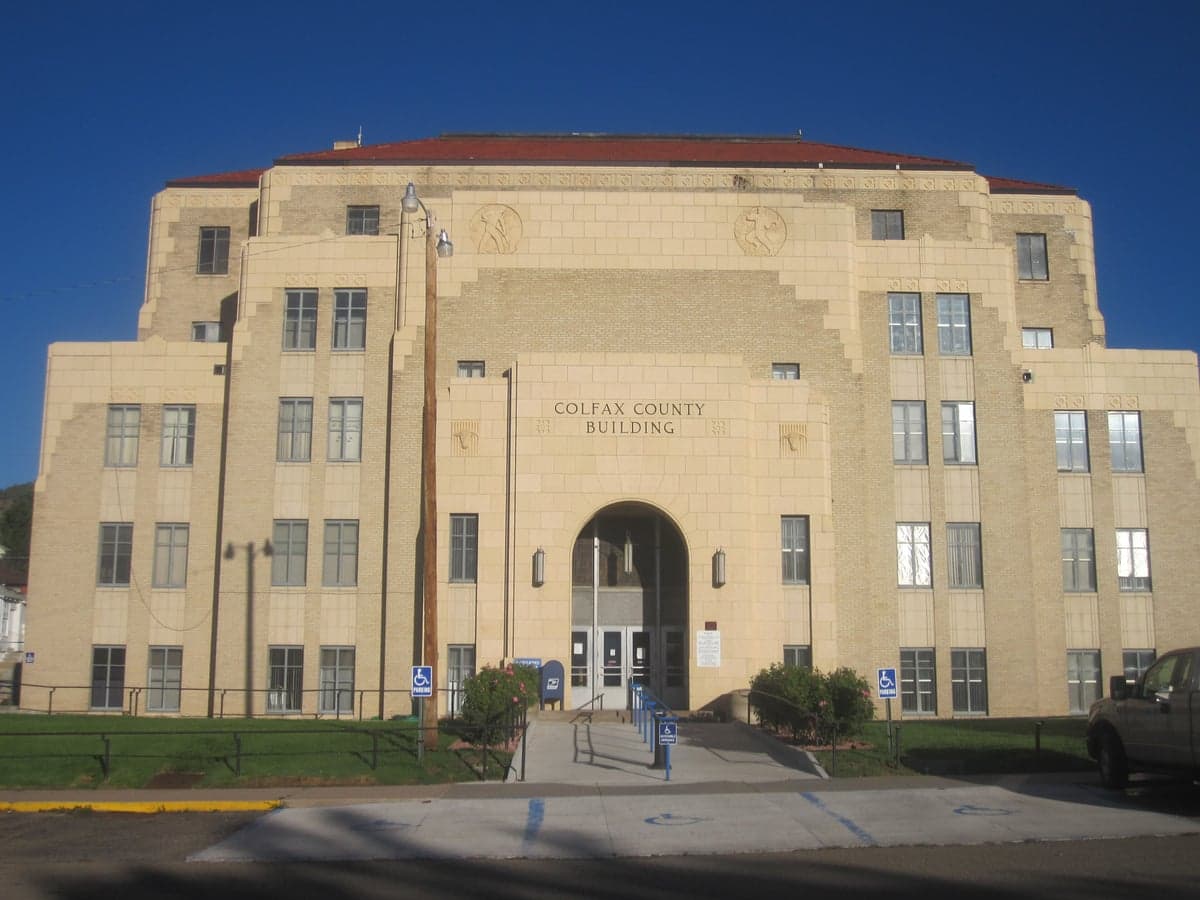
Photo: Wikipedia
Demographics of Colfax County
Affluence Level in Colfax County
A middle-class area roughly in line with national averages across income, home values, education, and employment.
People of Colfax County
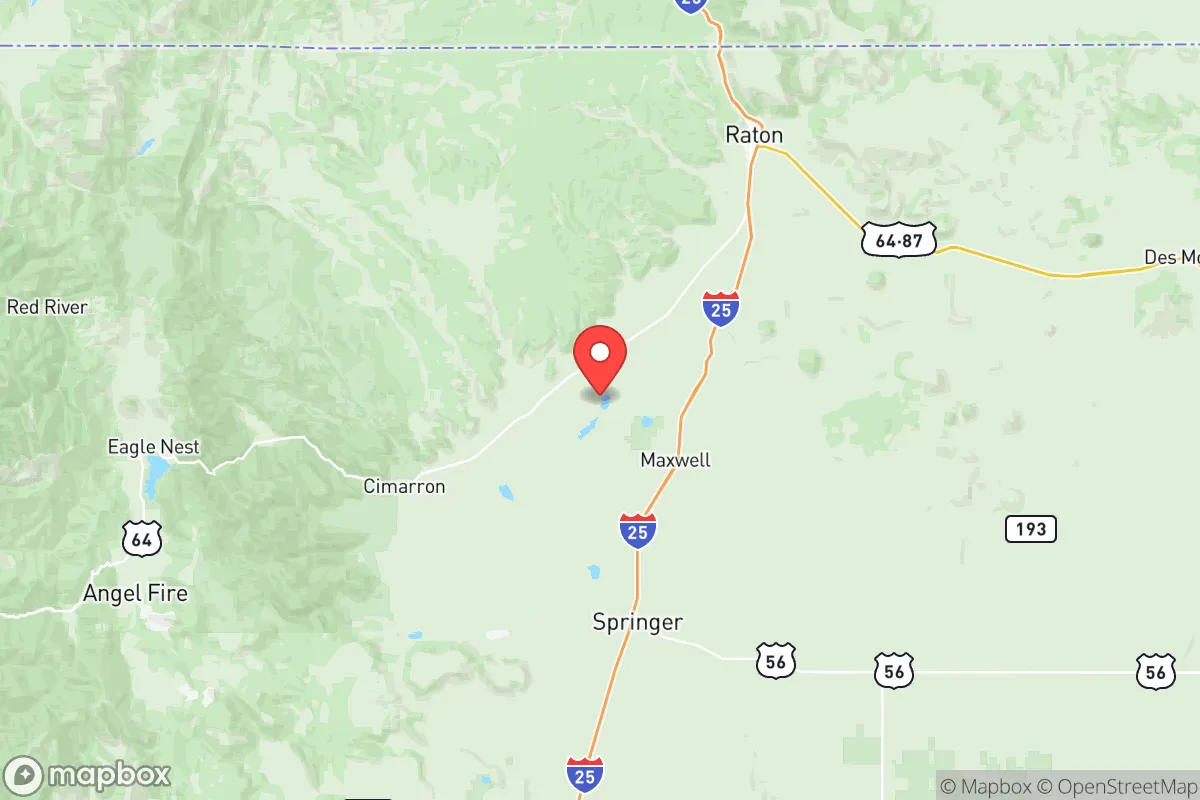
Colfax County, New Mexico, is home to roughly 12,300 residents, a population that is nearly evenly split between White (47.8%) and Hispanic (47.4%) residents, with a very small foreign-born share of just 2.1%. This demographic profile reflects a region shaped by deep-rooted Hispano and Anglo settlement patterns rather than recent immigration, giving the county a distinctly bicultural character that is more rural and traditional than New Mexico’s urban centers. The population is spread across small towns like Raton, Springer, Cimarron, and Angel Fire, with a low population density that preserves a strong sense of community and connection to the land.
Settlement & growth (pre-1960)
Long before European contact, the area now known as Colfax County was inhabited by nomadic Plains Indian tribes, most notably the Jicarilla Apache, who hunted bison and lived in the foothills of the Sangre de Cristo Mountains. The Ute people also frequented the region, and both groups resisted Spanish and later American encroachment. Spanish exploration reached the area in the 16th and 17th centuries, but permanent settlement did not begin until the Mexican period, when land grants were issued to Hispano families. The most significant of these was the Mora Land Grant, which brought Hispano settlers to the eastern slopes of the mountains, establishing communities like Mora and Chacón in the 1830s and 1840s. These settlers were primarily subsistence farmers and ranchers, and their descendants remain a core part of the county’s Hispanic population today.
The American period began in earnest after the U.S. acquisition of New Mexico in 1848. The discovery of gold in the 1860s triggered a rush to the region, drawing Anglo miners, merchants, and speculators. The town of Elizabethtown (now a ghost town near Eagle Nest) became the first county seat and a boomtown of several thousand people, though it declined rapidly after the gold played out. The arrival of the Atchison, Topeka and Santa Fe Railway in the late 1870s transformed the county. The railroad established Raton as a major division point and depot, bringing a wave of Anglo railroad workers, engineers, and businessmen. Springer also grew as a rail and ranching hub. The Maxwell Land Grant, a massive 1.7-million-acre tract, was purchased by British and Dutch investors, who promoted large-scale cattle ranching and attracted Anglo cowboys and homesteaders from Texas and the Midwest. By the early 1900s, the county’s population was a mix of Hispano villagers, Anglo ranchers and railroaders, and a small number of European immigrants, primarily from Germany and Ireland, who settled in Raton and worked in the coal mines that opened near Koehler and Gardner.
The coal mining industry boomed in the early 20th century, drawing additional Anglo and immigrant laborers to towns like Dawson, a company town built by the Phelps Dodge Corporation. Dawson’s population peaked at around 3,000 in the 1910s, with a workforce that included Anglo, Italian, Greek, and Mexican miners. The 1913 Dawson mine disaster, which killed 263 men, was one of the worst in U.S. history and marked the beginning of the town’s decline. By the 1950s, the mines had largely closed, and the county’s population began a long decline from its 1910 peak of over 16,000. The post-World War II era saw little new growth, as younger residents left for jobs in Albuquerque, Denver, and the West Coast.
Modern era (post-1965)
The 1965 Hart-Cellar Act had minimal impact on Colfax County, as the region never attracted significant post-1965 immigration. The foreign-born population remains very low at 2.1%, and the county’s racial and ethnic composition has been remarkably stable over the past several decades. The most notable demographic shift has been the gradual increase in the Hispanic share of the population, from roughly 40% in 1980 to 47.4% today, driven by higher birth rates among Hispanic families and the out-migration of some Anglo residents. The White population has declined in absolute numbers, but remains nearly equal in share at 47.8%.
Domestic migration has been the primary driver of population change since the 1970s. The county lost residents steadily through the 1980s and 1990s as the ranching and railroad economies contracted. However, the development of the Angel Fire Resort in the 1970s and 1980s brought a new wave of Anglo in-migration, primarily from Texas and the Mountain West, drawn by skiing, golf, and second-home ownership. Angel Fire and the nearby village of Eagle Nest became enclaves for affluent retirees and vacation-home owners, a trend that continues today. This seasonal and part-time population has helped stabilize the county’s economy but has not reversed the overall population decline. The county’s population peaked at 16,761 in 1910 and has generally fallen since, with the 2020 census recording 12,336 residents.
Suburbanization has not occurred in Colfax County in the way it has in New Mexico’s urban corridors. There are no large suburbs or exurbs; instead, the population remains concentrated in the historic towns of Raton (the county seat, population ~6,000), Springer (~1,000), Cimarron (~800), and the smaller villages of Angel Fire, Eagle Nest, and Maxwell. The county’s Black population is negligible at 0.5%, and East/Southeast Asian and Indian-subcontinent populations are essentially zero, reflecting the region’s lack of attraction for recent immigrant groups.
The future
Colfax County’s population is projected to continue a slow decline over the next 10–20 years, as the region’s aging Anglo population shrinks and younger residents move to urban areas for education and employment. The Hispanic share of the population will likely continue to rise gradually, approaching or exceeding 50% within the next decade, but the county will remain overwhelmingly a two-group (White and Hispanic) community. The foreign-born share is unlikely to increase significantly, as the county lacks the job base and housing stock to attract new immigrants.
The most dynamic demographic trend is the growth of the part-time and second-home population in Angel Fire and Eagle Nest, which could accelerate if remote work continues to enable urban professionals to relocate to rural mountain communities. However, this influx is likely to remain predominantly Anglo and affluent, potentially widening the cultural and economic gap between the resort areas and the older railroad and ranching towns. The county’s cultural identity will likely remain rooted in its Hispano and Anglo ranching heritage, with a growing emphasis on outdoor recreation and tourism.
For someone moving to Colfax County today, the region offers a stable, bicultural community with a strong sense of history and place. The population is not growing, but it is not in crisis either — it is a place where families have lived for generations, and where new arrivals are most likely to be retirees, remote workers, or those seeking a slower pace of life. The county’s future is not one of rapid change, but of gradual continuity, with the same two groups that have shaped it for over a century continuing to define its character.

* Values derived from national, state, county, city and local statistics and may differ in a specific area. Last updated: 2026-07-21T14:43:19.000Z
Narrative content on this page is AI-generated and may contain mistakes. Verify any details that matter before acting on them.
ReloMaps may earn a commission from affiliate links at no extra cost to you.

