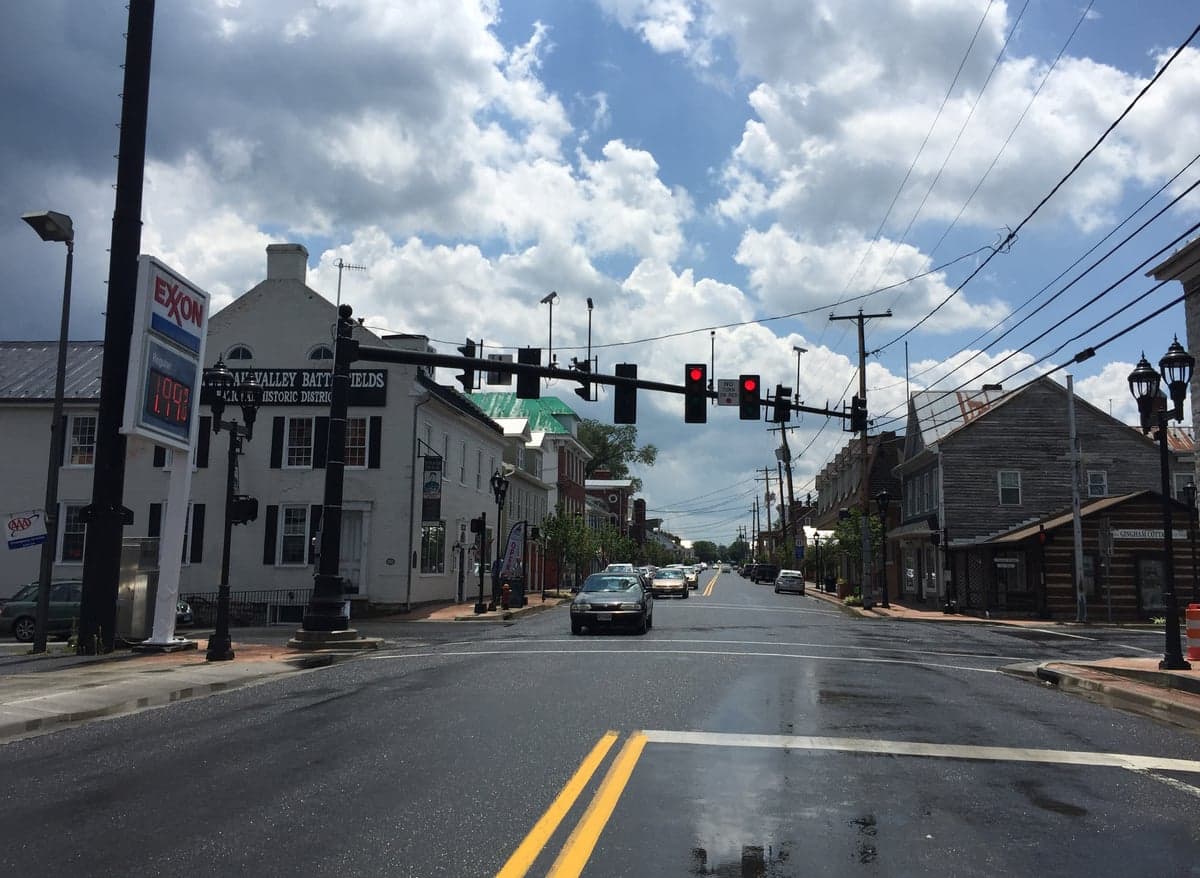
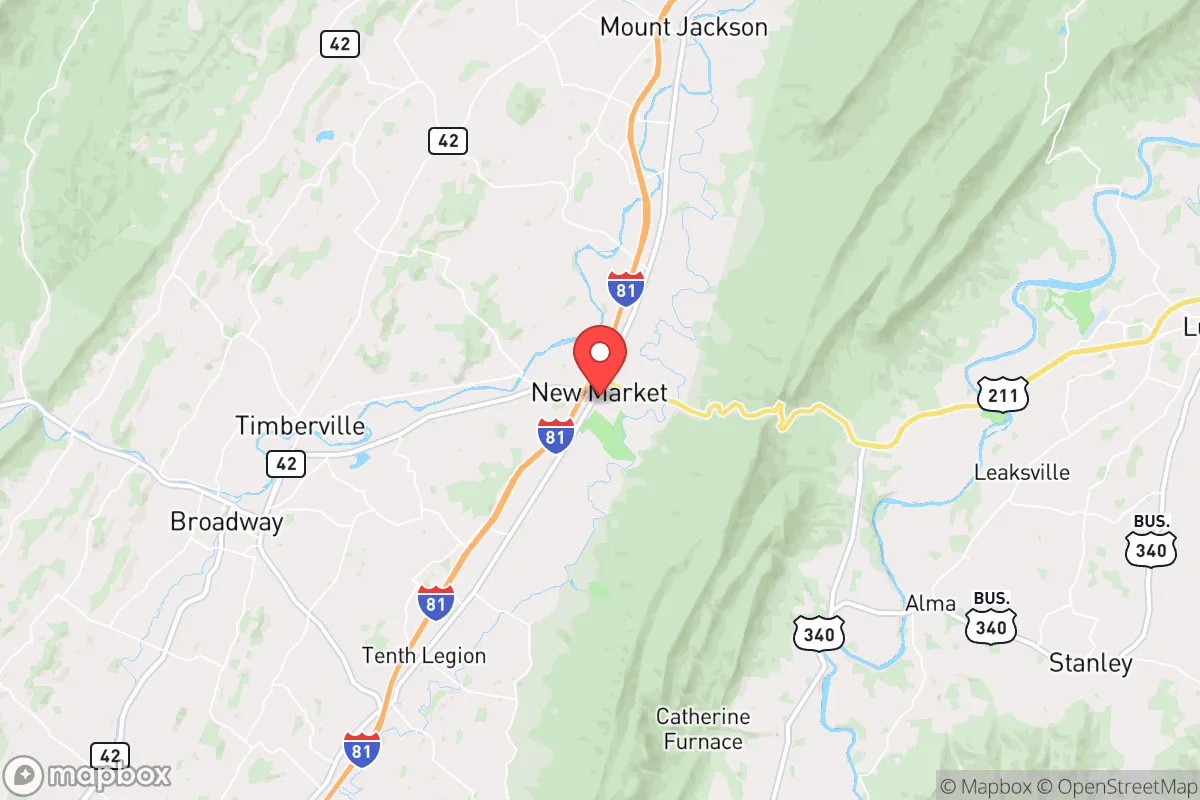
Photo: Wikipedia
Political ClimatePolitical Climate in New Market, VA
District shown is the primary district for this city’s centroid. Cities may span multiple districts.
Inherited from parent state — no local data available.
Local Political AnalysisPolitical Analysis of New Market, VA
New Market, Virginia, sits in the heart of the Shenandoah Valley with a political identity that is firmly and consistently conservative. The area’s Cook Political Report (PVI) of R+12 means the district votes roughly 12 points more Republican than the national average, a lean that has only solidified in recent cycles. This isn’t a purple swing area; it’s a place where Republican candidates can generally bank on winning, and the local political conversation reflects that reality. The trajectory here is one of steady, entrenched conservatism, driven by a mix of long-time farming families, a growing retiree population, and a cultural attachment to traditional values.
How it compares
The contrast with the rest of Virginia is stark. While New Market sits in an R+12 district, the state of Virginia as a whole carries a Cook PVI of D+4. That’s a massive 16-point swing, and it plays out in everyday life. You can drive 20 minutes north to Harrisonburg, a college town anchored by James Madison University, and you’ll find a much more liberal-leaning electorate, with younger voters and a strong progressive presence. Head south to Staunton or east to Charlottesville, and you see similar dynamics. New Market, by contrast, feels like a different world politically. It’s more aligned with the rural, conservative pockets of the Valley, like nearby Luray or Woodstock, than with the urban and suburban corridors of Northern Virginia that pull the state’s overall numbers blue. This split is the defining feature of Virginia politics, and New Market is squarely on the red side of that divide.
What this means for residents
For conservative residents, living in New Market means your views are the default. Local elections, school board decisions, and even casual conversations at the feed store or the local diner generally reflect a right-of-center worldview. You’re unlikely to feel like a political outlier, and your vote carries weight in local primaries, which often decide the actual outcome. For liberal residents, the reality is different. You’re in a clear minority, and you’ll likely need to find your community in specific circles—perhaps through the arts, the local library, or by commuting to Harrisonburg for social and political events. It’s not hostile, but it can be isolating. The practical upshot is that statewide races are often lost here by wide margins, but local issues like land use, school funding, and Second Amendment rights dominate the discourse. The area’s trajectory suggests this dynamic will hold for the foreseeable future, with in-migration from more moderate areas being offset by the strong cultural pull of the Valley’s conservative traditions.
Culturally, New Market is defined by its history—the Battle of New Market and the Virginia Museum of the Civil War are central to the town’s identity—and that heritage reinforces a deep-seated respect for tradition and self-reliance. Policy preferences here tend to favor limited government, low taxes, and a strong emphasis on individual liberty. While the national political climate can feel divisive, the local scene is more about practical concerns than ideological purity. It’s a place where your neighbor’s politics are often less important than whether you show up to help with haying or a barn raising. The long-term outlook is for continued Republican dominance, but with a growing awareness of the state’s broader diversity, making New Market a stable, if distinct, conservative anchor in a blue-leaning commonwealth.

State Political ClimatePolitical Climate in Virginia
State Political AnalysisPolitical Environment in the State
Virginia has shifted from a reliably red state to a solidly Democratic one over the past two decades, now carrying a Cook PVI of D+4. The transformation is driven almost entirely by the explosive growth of the Washington, D.C. suburbs in Northern Virginia, which now dwarf the rest of the state in population and electoral weight. A state that voted for George W. Bush in 2004 has voted Democratic in every presidential election since 2008, and the state legislature has trended blue in lockstep, though the margins remain competitive enough that Republicans still hold significant down-ballot power.
Urban vs. rural divide
The political map of Virginia is a stark study in geographic polarization. The state's Democratic majority is built on three pillars: the D.C. suburbs of Arlington, Alexandria, and Loudoun County, the state capital region around Richmond, and the Hampton Roads area anchored by Virginia Beach and Norfolk. Loudoun County alone has grown from a rural exurb to a majority-Democratic county of over 400,000 people, and its school board and board of supervisors have become national flashpoints in the education culture wars. Meanwhile, the rural west and south — places like Roanoke, Lynchburg, and the Shenandoah Valley — vote Republican by margins of 30 to 40 points. The divide is so pronounced that the state's 11th Congressional District (Arlington and part of Fairfax) is one of the most Democratic districts in the country, while the 9th District (southwest Virginia) is one of the most Republican. The practical effect is that statewide candidates must run up massive margins in the D.C. suburbs to offset the rural vote, which is why Democratic governors like Glenn Youngkin's predecessor, Ralph Northam, won by focusing almost exclusively on NoVA turnout.
Policy environment
Virginia's policy environment is a hybrid that reflects its purple-to-blue status. The state has a right-to-work law on the books, keeping union power relatively weak outside of the federal workforce. Income taxes are flat at 5.75% for most earners, and the state has a 6% sales tax (higher in some localities). Property taxes are set locally and are notably high in Northern Virginia, where a $700,000 home can carry a $7,000 annual bill. The regulatory posture is moderate — Virginia is not California, but it's not Texas either. Environmental regulations have tightened under recent Democratic governors, including a 2020 law mandating a transition to 100% carbon-free electricity by 2050. Education policy has swung dramatically: the state abolished its charter school cap in 2021, but also passed expansive transgender student protections that have made Loudoun County a national symbol of the parental rights debate. Healthcare is a mixed bag — Virginia expanded Medicaid under the Affordable Care Act in 2019, but the state still has a competitive private insurance market and a strong network of rural hospitals that are struggling financially.
Recent policy direction
The last five years have seen Virginia lurch between Democratic and Republican control, producing a whiplash of policy changes. Under Governor Glenn Youngkin (2022-2026), the state passed a 15-week abortion ban in 2023, a significant restriction that had been unthinkable under the previous Democratic trifecta. Youngkin also signed a permitless carry law for concealed handguns in 2022, reversing a Democratic push for universal background checks. On education, Youngkin issued executive orders banning "inherently divisive concepts" in schools and created a tip line for parents to report teachers — a move that energized both his base and the opposition. However, the Democratic legislature blocked his proposed 15-week abortion ban from going further and passed a constitutional amendment enshrining abortion rights that will appear on the 2026 ballot. On voting, Virginia has no-excuse absentee voting and same-day voter registration, but also requires a photo ID — a compromise that has held for a decade. The state has not passed a school choice voucher program, but Youngkin expanded the state's charter school approval process and increased funding for lab schools affiliated with universities.
Civil unrest & political movements
Virginia has been a flashpoint for political violence and organized activism on both sides. The 2017 Unite the Right rally in Charlottesville — where a counter-protester was killed — remains the defining moment of the state's modern political history, and it galvanized a generation of Democratic activists. Since then, the state has seen a wave of grassroots organizing: Moms for Liberty chapters have proliferated in Loudoun and Fairfax counties, while progressive groups like Indivisible have maintained a permanent presence in the D.C. suburbs. The 2021 gubernatorial race saw Youngkin successfully tap into parental anger over school closures and critical race theory, winning the state by 2 points despite Biden's 10-point victory there a year earlier. Immigration politics are less volatile than in border states, but Prince William County has become a battleground over sanctuary policies, with the board of supervisors voting in 2023 to limit cooperation with ICE. Election integrity has been a persistent issue — Youngkin's 2021 victory was followed by a Republican push to end same-day registration, which failed in the Democratic-controlled Senate.
Projection
Over the next decade, Virginia's Democratic lean is likely to strengthen, but not as dramatically as some predict. The D.C. suburbs continue to add tens of thousands of new residents annually, and the in-migration is overwhelmingly college-educated and Democratic-leaning. However, there are countervailing forces: Richmond's suburbs are trending red as former city residents move outward, and the Hampton Roads area remains a genuine swing region where military families and shipyard workers split their tickets. The 2025 gubernatorial race — where Republican Winsome Sears narrowly lost to Democrat Abigail Spanberger — suggests the state is settling into a D+4 to D+6 equilibrium rather than becoming a blowout blue state like Maryland. The most likely scenario is that Virginia remains a state where Democrats win statewide races by 3-6 points, but Republicans retain the ability to win the governorship and state house in wave years. A new resident moving to Virginia Beach or Roanoke should expect to live in a state where the political culture is permanently contested, with neither party able to fully entrench its agenda.
For a new resident, the bottom line is that Virginia offers a genuinely competitive political environment where your vote matters. If you're conservative, you'll find a state where you can win local races in most of the state outside the D.C. suburbs, but you'll be in the minority statewide. If you're liberal, you'll find a state that protects abortion rights and voting access, but you'll have to fight for every inch of policy against a well-organized Republican minority. The state's tax burden is moderate, its schools are above average nationally, and its political culture is intense but not dysfunctional. Just know that the politics you'll experience in Arlington are a world apart from what you'll find in Danville — and that's been the reality of Virginia for the last 20 years, with no sign of changing.
* Values derived from national, state, county, city and local statistics and may differ in a specific area. Last updated: 2026-11-02T05:08:37.000Z
Narrative content on this page is AI-generated and may contain mistakes. Verify any details that matter before acting on them.
ReloMaps may earn a commission from affiliate links at no extra cost to you.

