
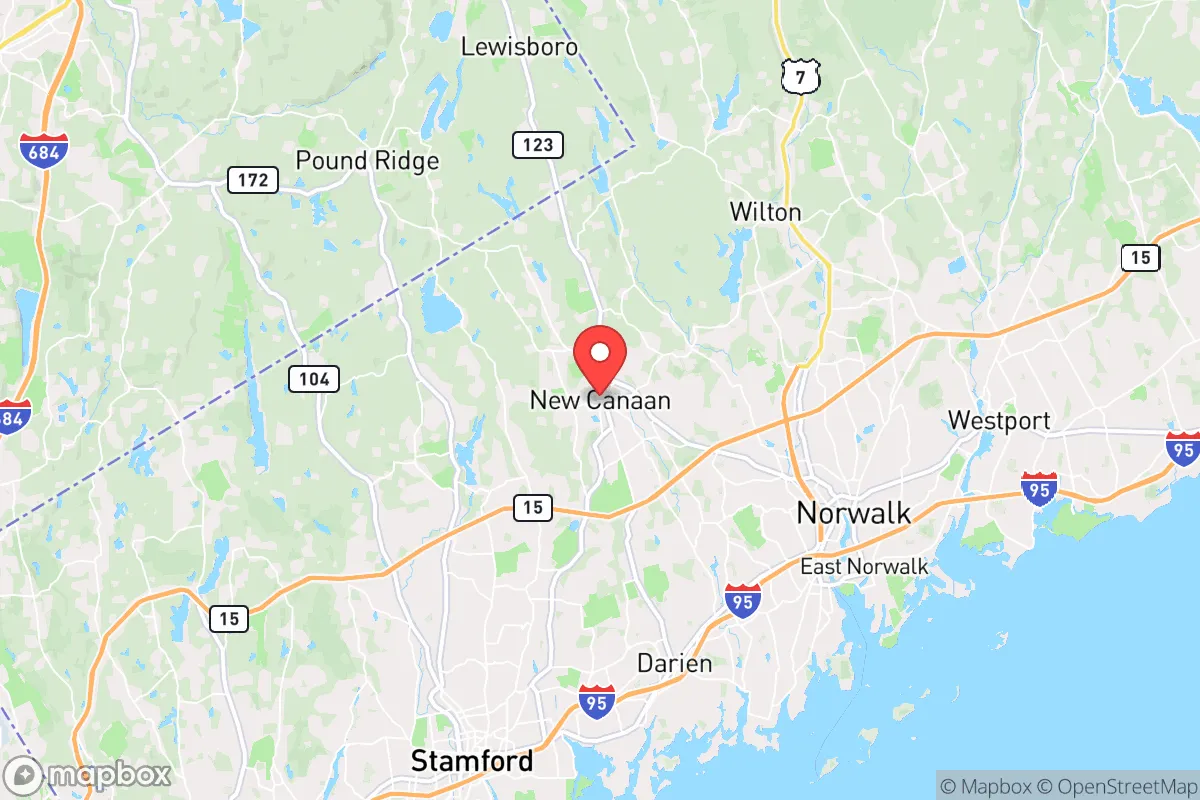
Photo: Wikipedia
Personal Sovereignty in New Canaan, CT
Viable for self-reliance. Generally workable, though some barriers may limit total independence.
What does Personal Sovereignty tell us?
Personal Sovereignty measures your capacity for self-reliance and independence with minimal government friction. Higher scores mean fewer barriers between you and the way you want to live... but it assumes you have the space you need and good neighbors.
What does this tell us?
Personal Sovereignty measures your capacity for self-reliance and independence with minimal government friction. Higher scores mean fewer barriers between you and the way you want to live... but it assumes you have the space you need and good neighbors.
State Policy
Energy independence: Importer (5% of energy produced in-state)
Personal Liberty
Homesteading

Personal Liberty Analysis
New Canaan, Connecticut, presents a complex and often contradictory environment for personal sovereignty, one that demands a clear-eyed assessment from anyone prioritizing autonomy, self-reliance, and minimal government overreach. While its affluent, well-educated populace and picturesque New England setting suggest a haven of order, the underlying legal and regulatory framework—largely dictated by the state of Connecticut—imposes significant constraints on individual freedoms, particularly in areas of taxation, self-defense, and property use. For the survivalist or prepper, New Canaan offers a high degree of community stability and resource access, but it sits within a state whose political trajectory is decidedly hostile to the unencumbered exercise of personal liberty.
Tax burden and regulatory posture in a high-cost state
The most immediate and tangible assault on personal sovereignty in New Canaan is its tax burden. Connecticut is one of the highest-taxed states in the nation, and New Canaan, as a wealthy Fairfield County suburb, bears the full brunt. Property taxes are the primary driver, with effective rates often exceeding 1.5% of a home's assessed value annually—a crushing, recurring cost that effectively makes the government a silent partner in any real estate holding. This is not a tax on consumption or income alone; it is a direct levy on your most significant asset, one that can force a sale or relocation if financial circumstances change. The state income tax is also steep, with a top marginal rate of 6.99% kicking in at relatively modest income levels. For a prepper focused on long-term financial independence, this tax structure is a slow bleed, reducing the capital available for land, supplies, and other investments in self-reliance. The regulatory posture mirrors this fiscal aggressiveness. Connecticut is a "blue state" in the truest sense, with a dense web of environmental, building, and land-use regulations that can make any significant property modification—from installing a backup generator to building a root cellar—a costly and time-consuming permitting process. The state's heavy-handed approach to business licensing and professional regulations further constrains the ability to operate a side business or trade skills informally, a key component of a resilient, sovereign lifestyle.
Self-defense and gun law specifics in Connecticut
For anyone serious about the right to keep and bear arms as a cornerstone of personal sovereignty, New Canaan is a deeply compromised location. Connecticut has some of the most restrictive gun laws in the country, and local enforcement in Fairfield County is generally unsympathetic to the Second Amendment. The state requires a permit to purchase any handgun or long gun, mandates a waiting period, and maintains a registry of all firearm transactions. The "assault weapon" ban is broad and poorly defined, effectively criminalizing the possession of many common semi-automatic rifles and their standard-capacity magazines. Magazine capacity is capped at ten rounds, a severe limitation for any defensive scenario. Concealed carry is "may-issue" in practice, meaning local authorities have significant discretion to deny permits, and the process is expensive and invasive. While New Canaan itself is a low-crime community, the legal framework ensures that law-abiding citizens are disarmed relative to potential threats. The state's "red flag" law allows for the seizure of firearms without due process based on a complaint, a clear erosion of property rights and the presumption of innocence. For the prepper, this means your ability to defend your home and family is legally hamstrung, and your inventory of firearms and ammunition is a matter of state record. This is not a location for building a robust, legally unencumbered arsenal.
Self-reliance and homesteading viability: lot sizes, zoning, and off-grid feasibility
The dream of self-reliance through homesteading or off-grid living is largely incompatible with the reality of New Canaan. The town is almost entirely zoned for suburban residential use, with minimum lot sizes typically ranging from one to two acres in the more rural pockets, but the vast majority of properties are on smaller, manicured plots. Zoning regulations are strict, prohibiting the keeping of livestock, poultry, or bees on most residential lots. Raising your own food in any meaningful quantity is effectively illegal. The homeowners' association (HOA) covenants that govern many neighborhoods add another layer of restriction, often dictating lawn height, exterior paint colors, and even the types of vehicles that can be parked in driveways. Off-grid living is a non-starter. The town requires connection to municipal water and sewer systems in most areas, and any attempt to install solar panels, a wind turbine, or a rainwater collection system is subject to extensive permitting and aesthetic review. Generators are common for backup power, but running one for extended periods is likely to draw complaints from neighbors and potential code enforcement action. The dense, interconnected nature of the community means that any deviation from the suburban norm is quickly noticed and often challenged. For a prepper seeking land for a retreat, a workshop, or a sustainable homestead, New Canaan offers almost none of the necessary conditions. The land is too expensive, the lots too small, and the regulations too restrictive.
Personal liberties: parental rights, medical autonomy, speech, and property
On the spectrum of personal liberties, New Canaan reflects the broader state's progressive tilt, which can be a source of friction for those with a conservative worldview. Parental rights are under constant pressure. Connecticut has some of the most expansive "minor consent" laws in the nation, allowing children as young as 12 to consent to mental health treatment and, with some limitations, reproductive healthcare without parental knowledge or approval. The state's education system, including the highly regarded New Canaan Public Schools, is aligned with state mandates on curriculum that many conservative parents find intrusive, particularly regarding social-emotional learning and gender identity discussions. Medical autonomy is similarly constrained. The state's aggressive vaccine mandates for school attendance and healthcare workers, along with its strict public health orders during the pandemic, demonstrated a willingness to override individual medical choice. Freedom of speech is legally protected, but the social climate in a wealthy, liberal-leaning suburb can be stifling for those who express dissenting views on hot-button issues. Property rights, as noted, are heavily circumscribed by zoning, environmental regulations, and high taxation. The ability to use your land as you see fit is severely limited. In short, while you are free to hold your beliefs, the legal and social architecture of New Canaan actively works to limit your ability to act on them in ways that deviate from the established progressive consensus.
In the final analysis, New Canaan offers a high baseline of safety, excellent schools, and a stable community—but it does so at the direct expense of personal sovereignty. The tax burden is a permanent drain on resources, the gun laws are among the most restrictive in the nation, the zoning and regulations make any form of self-reliant homesteading impossible, and the state's legal framework consistently prioritizes government authority over individual and parental rights. Compared to a free state like New Hampshire or a more rural, less regulated county in the South or Midwest, New Canaan is a poor choice for anyone prioritizing maximum personal autonomy. It is a location for those who value institutional stability and community conformity over the freedom to live life on their own terms. For the survivalist or prepper, it is a place to be from, not a place to build a sovereign future. The strategic relocation calculus here is clear: if personal sovereignty is your primary metric, look elsewhere.

* Values derived from national, state, county, city and local statistics and may differ in a specific area. Last updated: 2026-04-27T14:56:33.000Z
Narrative content on this page is AI-generated and may contain mistakes. Verify any details that matter before acting on them.
ReloMaps may earn a commission from affiliate links at no extra cost to you.

