Photo: Wikipedia
Political ClimatePolitical Climate in Carson City County
Showing district-level results — no local-only data available.
Local Political AnalysisPolitical Analysis of Carson City County
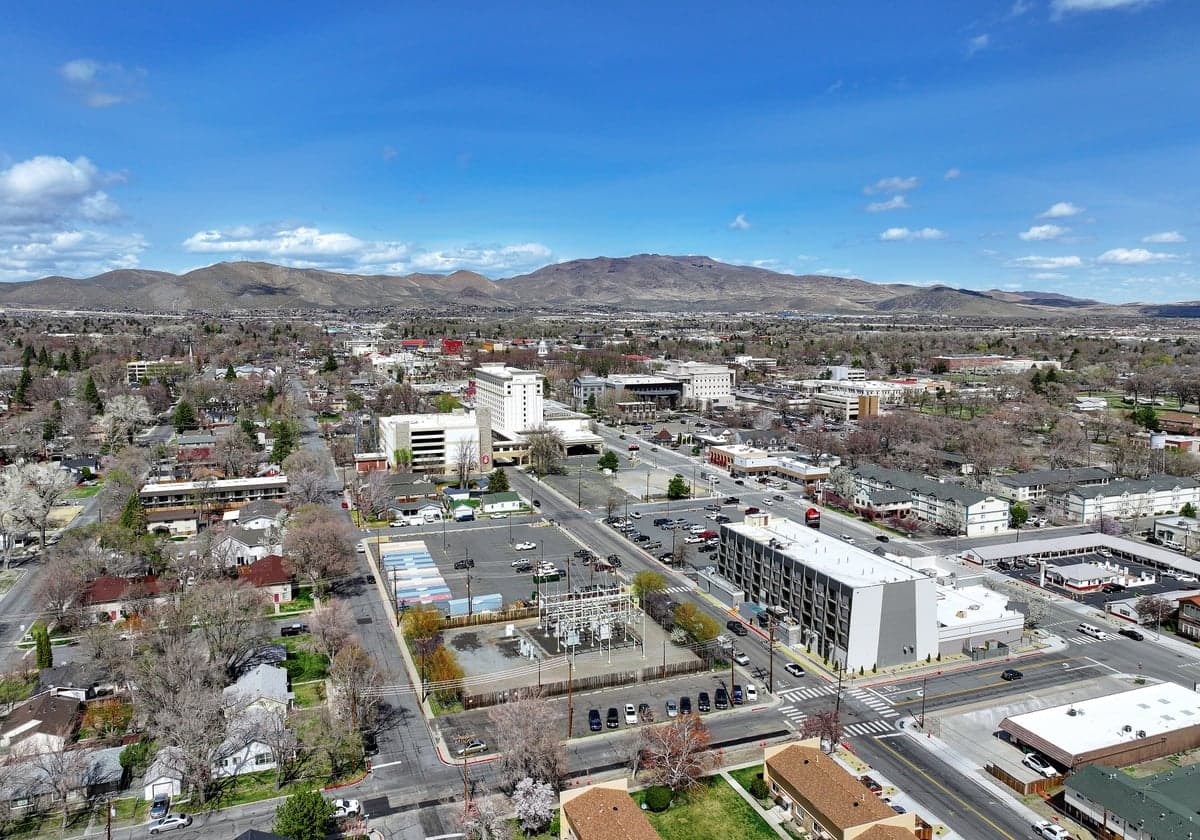
Carson City County, Nevada, carries a Cook PVI of R+7, making it a solidly Republican area in a state that is itself a battleground with a PVI of R+1. The county’s political lean is driven by its older, more rural demographic and a strong libertarian streak, though it’s not a monolith. Over the past decade, the county has held steady in its Republican tilt, but the margins have tightened slightly as new residents from California and the Reno-Sparks metro area bring more moderate and Democratic-leaning voters into the mix. The city of Carson City itself, which is coterminous with the county, shows the clearest divide: the older, established neighborhoods near the Capitol and the western foothills lean red, while the newer subdivisions and areas closer to the freeway, like the North Carson corridor, are more purple.
How it compares
Compared to Nevada as a whole, Carson City County is about six points more Republican, which is a significant gap. The state’s R+1 PVI reflects the influence of Clark County (Las Vegas) and Washoe County (Reno), which are Democratic-leaning and swing the statewide results. In Carson City, the political reality is closer to the rural counties like Douglas and Lyon, which are deep red, but with a more moderate edge because of the state government workforce. The city’s precincts near the downtown core and the historic district tend to be more competitive, with some even flipping blue in recent midterms, while the outlying areas like the hills above town and the eastern edge near the prison remain reliably Republican. This internal variation means that while the county is safe for GOP candidates in most races, local elections for city supervisor or school board can be surprisingly tight, with turnout in the swing precincts often deciding the outcome.
What this means for residents
For conservative residents, the R+7 lean means their votes carry more weight in county-level races, and they can expect local policies to reflect a pro-business, limited-government ethos. The county commission and school board have been reliably Republican for years, which translates to lower property tax rates compared to Washoe County and a more cautious approach to land-use regulation. For liberal residents, the political climate can feel isolating, but there is an active Democratic Party presence in Carson City, and the state government workforce provides a counterbalance. The city’s proximity to Reno and Lake Tahoe also means that progressive residents can easily access cultural and political events outside the county. In practice, the political divide here is less about daily conflict and more about a quiet, live-and-let-live attitude, though debates over growth, water rights, and the role of the state government can get heated during election season.
Culturally, Carson City County stands apart from the rest of Nevada in its small-town feel and its deep ties to state government. The Capitol building and the many state agencies give the city a stable, white-collar workforce that tempers the more libertarian, rural ethos of the surrounding areas. Policy-wise, the county has been slower to adopt the kind of rapid growth and development seen in Reno or Las Vegas, with a strong emphasis on preserving open space and historical character. This has led to some friction with newer residents who want more amenities and housing options, but it also means the area retains a distinct identity that is neither the high-desert libertarianism of rural Nevada nor the urban liberalism of the big cities. For anyone moving here, the key takeaway is that Carson City is a place where your vote matters more than in the statewide races, and where the local political culture is shaped as much by the state’s history as by its current residents.

State Political ClimatePolitical Climate in Nevada
State Political AnalysisPolitical Environment in the State
Nevada is a genuine swing state with a Cook PVI of R+1, meaning it leans just slightly more Republican than the nation as a whole, but in practice it’s been a true battleground for the last two decades. The state voted for Democrats in every presidential election from 2008 through 2020, then flipped to Donald Trump in 2024 by about 3 points, reflecting a broader realignment. The dominant coalition is a three-way tug-of-war: the powerful Culinary Union and Las Vegas’s diverse working class pull the state left, while the explosive growth in conservative-leaning exurbs and rural counties like Nye and Elko pushes it right. Over the last 10-20 years, Nevada has shifted from a reliably blue state in presidential years to a pure toss-up, driven by massive in-migration from California and a growing independent voter bloc that now makes up roughly a third of the electorate.
Urban vs. rural divide
The political map of Nevada is starkly split between the urban core of Clark County (Las Vegas) and the rest of the state. Clark County alone holds about 73% of the state’s population and has historically been the engine of Democratic wins, powered by union-heavy hospitality workers, a large Latino population, and younger transplants. But even within Clark County, the suburbs are shifting: Henderson and the master-planned community of Summerlin have trended right in recent cycles, with Henderson’s precincts flipping from blue to purple in 2024. Washoe County (Reno) is the other major population center and has become a classic swing county—it voted for Hillary Clinton in 2016, Joe Biden in 2020, and then narrowly for Trump in 2024, reflecting its mix of tech workers, University of Nevada students, and ranching families. The rural counties—Elko, Nye, White Pine, and Lander—are deeply Republican, often voting 70-80% for the GOP. The political reality is that a candidate must win Clark County by a comfortable margin (think 5-7 points) and keep Washoe close to even to carry the state; in 2024, Trump lost Clark but ran it closer than any Republican since 2004, while flipping Washoe by a hair.
Policy environment
Nevada’s policy environment is a study in contradictions that reflect its swing-state status. The state has no personal income tax and no corporate income tax, a major draw for conservatives and businesses, but it relies heavily on a high sales tax (8.25% in Clark County) and a gross receipts tax on businesses. Property taxes are relatively low, capped at a 3% annual increase for primary residences, which appeals to homeowners but creates budget constraints for local governments. On social policy, Nevada is libertarian-leaning in practice: marijuana is fully legal for recreational use, gambling is everywhere, and the state has some of the nation’s most permissive alcohol laws. But it also has a robust regulatory state—the Nevada Public Utilities Commission and the state’s housing authority are active, and the minimum wage is $12 an hour (tied to inflation). Education policy is a perennial battleground: the state ranks near the bottom nationally in K-12 outcomes, and the legislature has expanded charter schools and the Nevada Educational Choice Scholarship Program (a tax-credit scholarship for private school), but per-pupil funding remains low. Election laws are relatively accessible: same-day voter registration, no-excuse mail voting (permanently adopted after 2020), and a top-five primary system for non-presidential races, which moderates candidates by forcing them to appeal beyond party bases.
Recent policy direction
Nevada’s recent legislative sessions have moved in a distinctly moderate-to-liberal direction on most social and economic issues, but with notable carve-outs that keep the state competitive. In 2023, the legislature passed AB 286, which codified protections for out-of-state abortion providers and patients, and SB 131, which banned ghost guns and raised the purchase age for semiautomatic rifles to 21—a direct response to the 2017 Las Vegas shooting. On the other hand, the state has not passed a red-flag law, and the 2023 session saw the defeat of a proposed “assault weapons” ban. On parental rights, Nevada passed AB 195 in 2023, which requires schools to notify parents of any changes to a student’s mental or physical health services, but it stopped short of the more aggressive “Don’t Say Gay” laws seen in other states. Property rights remain strong: Nevada has no statewide rent control (though Clark County considered it in 2024), and the state’s “right to farm” law protects agricultural operations from nuisance lawsuits. On voting, the 2021 AB 121 made permanent the pandemic-era mail ballot system, but the 2023 session added voter ID requirements for in-person voting—a compromise that kept both sides unhappy. The overall direction is a cautious, incremental expansion of individual liberties on most fronts, with the legislature carefully calibrating to avoid alienating the swing voters who decide elections.
Civil unrest & political movements
Nevada has seen its share of political flashpoints, but they tend to be less explosive than in states with deeper partisan trenches. The 2020 election cycle brought significant controversy: the Clark County election department was the target of lawsuits and protests over mail ballot processing, and the 2022 and 2024 cycles saw a heavy presence of election integrity activists from both parties monitoring drop boxes. The state has a small but vocal “State of Jefferson” movement in its rural northeastern counties, where some residents have discussed secession from Nevada to join a proposed conservative state carved from eastern Oregon and Northern California—though it remains purely rhetorical. Immigration politics are a live wire: Nevada has a large undocumented population (estimated at 190,000), and while the state has not declared itself a “sanctuary” in law, the Las Vegas Metropolitan Police Department has a policy of not cooperating with ICE detainers unless a criminal warrant is issued. In 2023, a proposed bill to restrict local cooperation with ICE failed in the legislature. The most visible political movement in recent years has been the growth of the Nevada Republican Assembly, a conservative activist group that has pushed the state GOP to the right in primary elections, while the Culinary Union remains the most powerful Democratic-aligned institution, organizing massive door-knocking operations in every cycle. A new resident would notice the omnipresence of campaign signs and mailers in even-numbered years—Nevada is one of the most heavily targeted states for political advertising in the country.
Projection
Over the next 5-10 years, Nevada is likely to remain a true swing state, but the demographic trends favor a slight rightward drift. The state is growing fast—Nevada added over 200,000 residents between 2020 and 2025—and the newcomers are disproportionately conservative-leaning retirees and remote workers from California, settling in exurbs like Pahrump (Nye County) and Fernley (Lyon County). The Latino population, which has historically leaned Democratic, is becoming more politically diverse, with younger Latino voters showing less loyalty to either party. The Las Vegas Strip’s recovery from the pandemic has stabilized the union workforce, but the rise of non-union hospitality jobs in newer resorts and the growth of the tech sector in Reno (with companies like Tesla and Google expanding) are creating a new class of voters less tied to the old labor-Democratic coalition. The wild card is the independent voter: if they continue to break for Republicans as they did in 2024, Nevada will become a lean-Republican state by 2030. A relocator moving in now should expect a state where every election is close, where policy swings with the legislature’s partisan control, and where the political culture is transactional rather than ideological—Nevadans tend to vote on pocketbook issues and personal freedom rather than culture war flashpoints.
For a new resident, the bottom line is that Nevada offers a genuinely competitive political environment where your vote matters more than in almost any other state. Conservatives will find a low-tax, property-rights-friendly state with a growing rural and exurban base, but they’ll have to contend with a powerful union presence and a legislature that has moved left on social issues in recent years. Liberals will appreciate the state’s protections for abortion access, marijuana legalization, and voting rights, but they’ll face a state where the legislature is often divided and where the governor (currently Republican Joe Lombardo) can veto their priorities. The practical takeaway: Nevada is a place where political engagement is rewarded, where the outcome of any given election is genuinely uncertain, and where the state’s famous “live and let live” ethos means that most policy debates end in compromise rather than confrontation. If you want to live in a state where your vote is actually contested, Nevada is one of the last true battlegrounds left.
* Values derived from national, state, county, city and local statistics and may differ in a specific area. Last updated: 2026-06-16T16:45:55.000Z
Narrative content on this page is AI-generated and may contain mistakes. Verify any details that matter before acting on them.
ReloMaps may earn a commission from affiliate links at no extra cost to you.

