Photo: Wikipedia
Demographics of Carson City County
Affluence Level in Carson City County
A middle-class area roughly in line with national averages across income, home values, education, and employment.
People of Carson City County
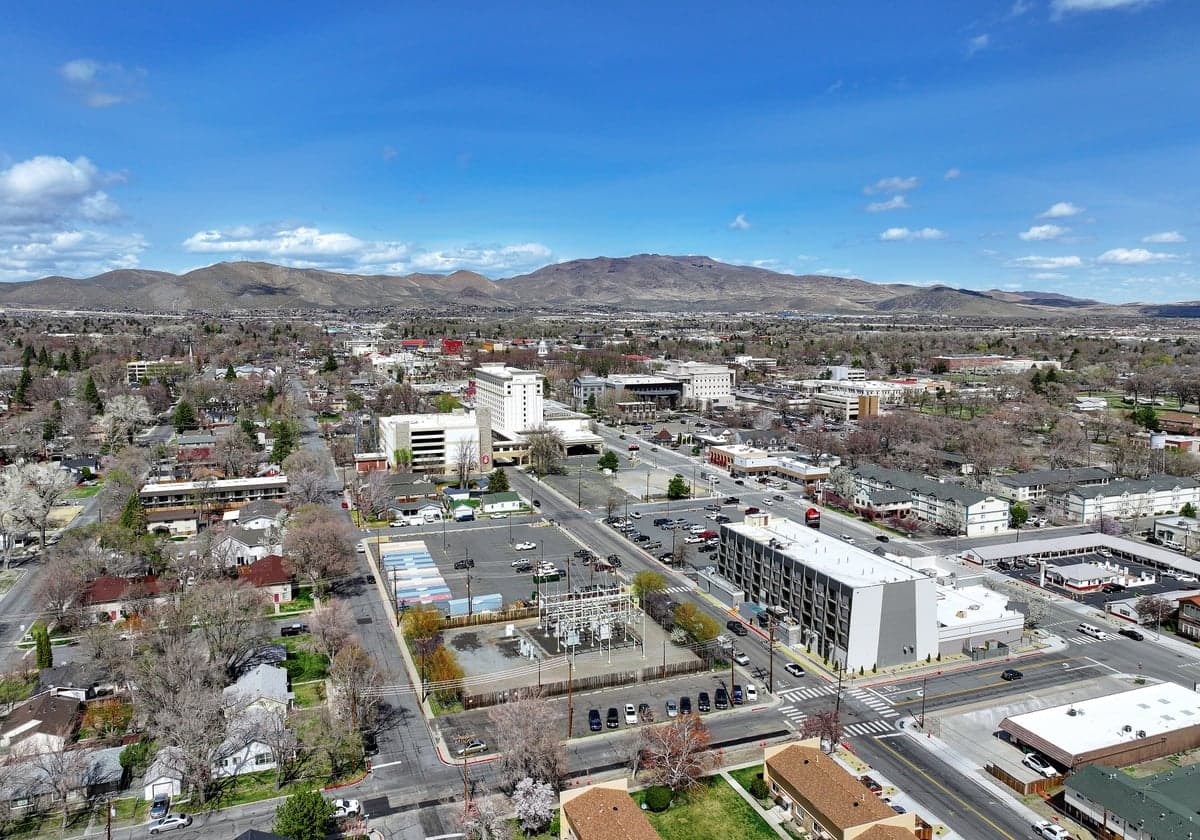
Carson City County, with a population of 58,364, is a unique blend of Nevada's historic frontier character and a growing, diversifying state capital. The county is notably less dense than its urban neighbors, with a population that is 63.2% White and 25.9% Hispanic, creating a cultural identity rooted in Western independence and government service. Its residents are slightly less college-educated than the national average at 24.5%, and the foreign-born population stands at a modest 6.5%, reflecting a community shaped more by domestic migration than international immigration.
Settlement & growth (pre-1960)
The region's human history begins with the Wa She Shu (Washoe) people, who inhabited the Sierra Nevada and Great Basin for millennia, with seasonal camps around the Carson River and the shores of Washoe Lake. The first permanent American settlement began in 1851 when a Mormon trading post, known as Mormon Station, was established in the Carson Valley. This outpost, later renamed Genoa, became the first non-Native settlement in Nevada. The discovery of the Comstock Lode in 1859 in nearby Virginia City triggered a massive silver rush, transforming the area into a bustling supply hub. In 1858, the settlement of Eagle Station was founded, which would later become the core of Carson City.
The city was formally founded in 1858 by Abraham Curry, who envisioned it as a territorial capital. When the Nevada Territory was created in 1861, Carson City was chosen as its capital, a status it retained when Nevada became a state in 1864. The early population was overwhelmingly white and American-born, drawn by mining, government jobs, and the promise of land. A significant wave of Irish immigrants arrived in the 1860s and 1870s to work in the mines and on the Virginia & Truckee Railroad, settling in working-class neighborhoods near the rail yards. Chinese laborers, who built much of the railroad infrastructure, also formed a small but vital community, though they faced severe discrimination and were largely confined to a segregated district near the Carson River. By the early 20th century, the mining boom had faded, and Carson City's economy stabilized around state government, with the population remaining small and predominantly white through the 1950s.
Modern era (post-1965)
The post-1965 era, driven by the Hart-Cellar Act, brought a gradual but significant demographic shift to Carson City County. While the county did not experience the explosive international immigration seen in coastal cities, the Hispanic population began to grow steadily from the 1970s onward, driven by agricultural work in the Carson Valley and construction jobs in the expanding state capital. Today, the Hispanic community makes up 25.9% of the population, with many families tracing their roots to Mexico and Central America. This community is dispersed throughout the county, with notable concentrations in the historic neighborhoods south of the Capitol building and in the newer subdivisions along Highway 50 East.
Domestic migration has been the primary driver of population change since the 1990s. Retirees and remote workers from California, seeking lower taxes and a more conservative political climate, have moved into master-planned communities like those in the western foothills near Lake Tahoe. The East/Southeast Asian population, now at 2.4%, is a small but growing presence, with families drawn to the area's schools and safety, often settling in the newer developments around the Carson City Airport. The Indian subcontinent population remains minimal at 0.2%, and the Black population is 1.9%, reflecting the county's limited historical draw for these groups. The overall foreign-born share of 6.5% is well below the national average, underscoring that Carson City remains a predominantly native-born, domestic-migration destination.
The future
The population of Carson City County is projected to continue its slow, steady growth, driven by an aging population and continued in-migration from California and other high-cost states. The county is becoming slightly more diverse, with the Hispanic share expected to rise toward 30% by 2035, while the White share will likely decline to around 58-60%. The East/Southeast Asian and Indian populations will grow modestly, but the county is unlikely to see the rapid diversification of larger Nevada metros like Las Vegas or Reno. New residential development is concentrating in the eastern part of the county, near the Carson River, and in the western foothills, where larger lots and mountain views attract affluent newcomers. The cultural identity is evolving from a purely Western frontier character to a more suburban, politically conservative enclave that values outdoor recreation and low taxes.
For someone moving in now, Carson City County offers a stable, family-oriented environment with a strong sense of local history and a government-anchored economy. The population is becoming more diverse but remains predominantly white and Hispanic, with a conservative political tilt and a growing number of remote workers. The county's future is one of moderate growth, gradual diversification, and a continued emphasis on quality of life over rapid urbanization.

* Values derived from national, state, county, city and local statistics and may differ in a specific area. Last updated: 2026-06-16T16:45:55.000Z
Narrative content on this page is AI-generated and may contain mistakes. Verify any details that matter before acting on them.
ReloMaps may earn a commission from affiliate links at no extra cost to you.

