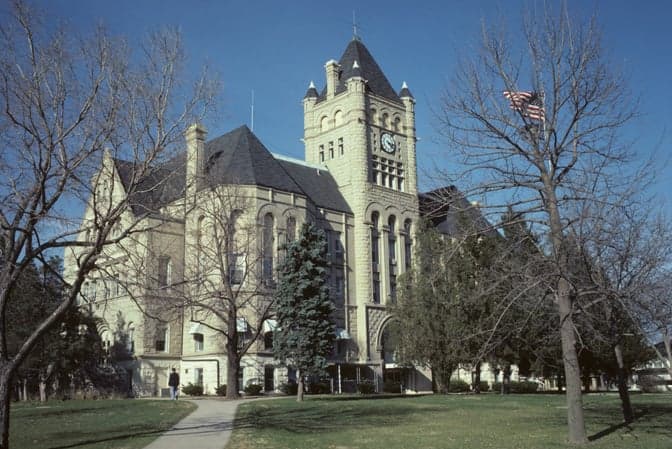
Photo: Wikipedia
Political ClimatePolitical Climate in Gage County
Showing district-level results — no local-only data available.
Local Political AnalysisPolitical Analysis of Gage County
Gage County, Nebraska, is a deeply conservative area where the Republican Party holds a commanding and durable advantage, reflected in a Cook Partisan Voting Index (PVI) of R+27. That rating means the county votes about 27 points more Republican than the national average, making it one of the most reliably red counties in the state. The county's political trajectory has been stable for decades, with no signs of a significant shift toward the center or left, though local precincts do show some variation that reveals a more nuanced picture than the countywide numbers suggest.
How it compares
To put Gage County's R+27 PVI in context, the state of Nebraska as a whole carries a PVI of R+10. That means Gage County is 17 points more Republican than the state average, which is already a solidly red state. This gap is substantial and places Gage County among the most conservative rural counties in eastern Nebraska, alongside neighbors like Jefferson and Pawnee counties. Within Gage County itself, the political landscape is not entirely uniform. The county seat, Beatrice, is the largest city and the political anchor of the area. While Beatrice votes reliably Republican in most races, its precincts near the downtown core and around the local colleges (like Southeast Community College) sometimes show a slightly more moderate or even Democratic lean in local elections, particularly for school board or city council seats. In contrast, the smaller towns and rural precincts—places like Wymore, Blue Springs, Odell, and Pickrell—are overwhelmingly Republican, often voting 80% or more for GOP candidates. The swing precincts are few and far between, but the area around the Homestead National Historical Park and the more suburban fringe of Beatrice can occasionally produce closer margins in non-presidential years, though these are still reliably red by national standards.
What this means for residents
For conservative residents, Gage County's political climate means their values are broadly reflected in local governance, from county commission decisions to school board policies. Tax rates are kept low, gun rights are strongly supported, and social issues like abortion and religious freedom are generally handled in line with conservative views. For liberal or moderate residents, the reality is more about finding community within a minority. They often find their voice in local Democratic Party chapters, in civic organizations like the Beatrice Rotary Club, or in informal networks around the arts and education scenes. Political conversations in daily life—at the grocery store, at the coffee shop, or at a high school football game—tend to assume a conservative baseline, so liberals often choose their words carefully. The county's strong Republican lean also means that primary elections are often the decisive contests, especially for county-level offices, so the most conservative candidates tend to prevail. This can create a sense of political homogeneity that some residents find comforting and others find stifling.
Culturally, Gage County is defined by its agricultural roots, its strong sense of community, and its connection to Nebraska's pioneer history, celebrated at the Homestead National Historical Park. Policy-wise, the county has been a stronghold for Second Amendment sanctuary resolutions and has consistently opposed state-level efforts to expand gambling or marijuana access, though neighboring counties have taken different stances. The local economy, anchored by agriculture, manufacturing (like the Exmark plant in Beatrice), and healthcare, tends to reinforce a pragmatic, low-tax, small-government ethos. For anyone moving here, the political climate is less a source of daily friction and more a steady, predictable backdrop—one that shapes everything from property tax debates to the tone of local news coverage, but rarely erupts into the kind of partisan conflict seen in more competitive areas.

State Political ClimatePolitical Climate in Nebraska
State Political AnalysisPolitical Environment in the State
Nebraska is a solidly Republican state with a Cook PVI of R+10, but it’s not a monolith. The state’s political lean is driven by a deep rural-urban split, with Omaha’s Douglas County and Lincoln’s Lancaster County providing the only real Democratic strongholds, while the rest of the state votes overwhelmingly red. Over the last 20 years, the trend has been a slow but steady rightward shift in rural areas, even as the Omaha metro has become more competitive, creating a fascinating political tension that defines life here.
Urban vs. rural divide
The political map of Nebraska is a study in contrasts. Omaha (Douglas County) is the state’s Democratic engine, routinely voting blue by 10-15 points in presidential elections, and it’s the only county that consistently flips the 2nd Congressional District, which has given Nebraska a split electoral vote in 2008, 2020, and 2024. Lincoln (Lancaster County) is a lighter shade of blue, usually voting Democratic by 5-8 points, driven by the University of Nebraska and state government workers. Drive 30 minutes outside either city, and you hit deep red territory. Grand Island, Kearney, and North Platte are reliably Republican, often voting +30 to +40 points for the GOP. The Panhandle, including Scottsbluff and Chadron, is among the most conservative regions in the state, with many counties voting +50 points or more for Trump in 2024. The rural-urban divide is stark: the 1st and 3rd Congressional Districts are safe Republican seats, while the 2nd District is a perennial battleground that both parties pour money into.
Policy environment
Nebraska’s policy environment is a mix of conservative fiscal management and pragmatic, sometimes moderate, social policy. The state has a unicameral, nonpartisan legislature, which is unique in the U.S. and tends to produce less partisan gridlock than other states. Taxes are relatively low: no state income tax on Social Security benefits, a flat state income tax rate of 5.84% (with a scheduled reduction to 5.5% by 2027), and a state sales tax of 5.5% (local options can add up to 2%). Property taxes are a perennial complaint, especially in rural areas, but the state has a property tax credit program. Education policy is locally controlled, with school choice options like charter schools and open enrollment, though they’re less expansive than in some neighboring states. Healthcare policy is conservative: Nebraska expanded Medicaid under the Affordable Care Act in 2020 via a ballot initiative, but the state has not pursued a state-based exchange. Election laws are straightforward: voter ID is required (passed in 2023), and the state has no-excuse absentee voting, with early voting starting 35 days before an election. Nebraska also has a winner-take-all system for its electoral college votes, except for the 2nd Congressional District, which awards its vote separately.
Recent policy direction
Recent legislation in Nebraska reflects a clear conservative trajectory, but with some notable exceptions. On gun and self-defense law, Nebraska is a constitutional carry state (passed in 2023), meaning no permit is needed to carry a concealed handgun. The state also has a “stand your ground” law. On parental and education rights, the legislature passed LB 753 in 2023, creating a school choice program that provides tax credits for private school scholarships, and LB 1084 in 2024, which restricts instruction on sexual orientation and gender identity in K-12 schools (similar to Florida’s “Don’t Say Gay” law). On speech and privacy, Nebraska has no broad privacy law, but it does have a data breach notification statute. On medical and bodily autonomy, the state passed a 12-week abortion ban in 2023 (LB 574), with exceptions for rape, incest, and medical emergencies. This was a compromise after a failed attempt at a near-total ban. On property rights, Nebraska is a “right-to-farm” state, limiting nuisance lawsuits against agricultural operations. On taxation, the state passed LB 873 in 2023, which accelerates the reduction of the top individual income tax rate to 5.84% and cuts corporate taxes. On voting and ballot access, the voter ID law (LB 514) took effect in 2024, requiring a valid photo ID to vote, which has been controversial but has not yet caused major disruptions.
Civil unrest & political movements
Nebraska is not a hotbed of civil unrest, but it has seen its share of political movements. The 2020 George Floyd protests in Omaha and Lincoln were largely peaceful, with some property damage in Omaha. The 2023 abortion ban protests drew thousands to the state capitol in Lincoln, with both pro-choice and pro-life groups mobilizing. Immigration politics are less visible here than in border states, but Scottsbluff and Grand Island have seen tensions over meatpacking plant workers, many of whom are immigrants. There are no sanctuary cities in Nebraska; in fact, the state passed a law in 2023 (LB 535) requiring law enforcement to cooperate with federal immigration authorities. Election integrity controversies have been minimal, though the 2020 and 2024 elections saw some local GOP activists questioning mail-in voting procedures. The “Nebraska Way” of pragmatic, nonpartisan governance has generally kept extreme movements at bay, but the state’s rightward shift has emboldened more conservative activist groups, particularly around school board elections and library content.
Projection
Over the next 5-10 years, Nebraska’s political trajectory is likely to continue its slow rightward drift, but with a key wildcard: the Omaha metro. Douglas County is growing faster than the rest of the state, driven by tech and insurance jobs, and its demographic shift (more young professionals and diverse populations) could make the 2nd District even more competitive. However, rural areas are depopulating, which amplifies their political weight in the state legislature. The unicameral system will likely keep things from swinging too far in either direction, but expect more fights over school choice, abortion access, and property taxes. In-migration is modest, mostly from neighboring states like Iowa and Kansas, and tends to be conservative-leaning. A new resident moving in now should expect a state that remains reliably Republican at the statewide level, but with a growing urban-rural tension that will keep the 2nd District a national battleground.
For a new resident, the bottom line is this: Nebraska offers a stable, low-tax, and generally safe environment for conservative families, with a strong sense of community and local control. Liberal residents will find a welcoming home in Omaha or Lincoln, but will face a state government that is increasingly conservative on social issues. The political climate is not as polarized as in many other states, thanks to the nonpartisan legislature, but the divide between the cities and the countryside is real and growing. If you’re looking for a place where your vote matters, the 2nd District is one of the few competitive seats in the Great Plains. If you’re looking for a place where the politics are predictable and the pace is slower, the rest of Nebraska delivers exactly that.
* Values derived from national, state, county, city and local statistics and may differ in a specific area. Last updated: 2026-07-19T04:04:33.000Z
Narrative content on this page is AI-generated and may contain mistakes. Verify any details that matter before acting on them.
ReloMaps may earn a commission from affiliate links at no extra cost to you.

