Photo: Wikipedia
Demographics of Gage County
Affluence Level in Gage County
A middle-class area roughly in line with national averages across income, home values, education, and employment.
People of Gage County
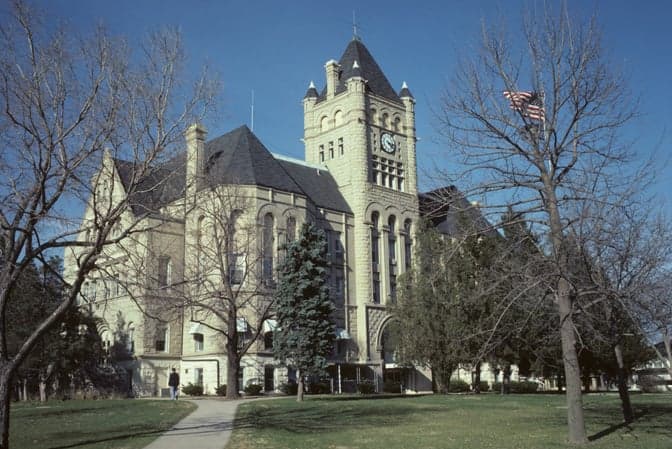
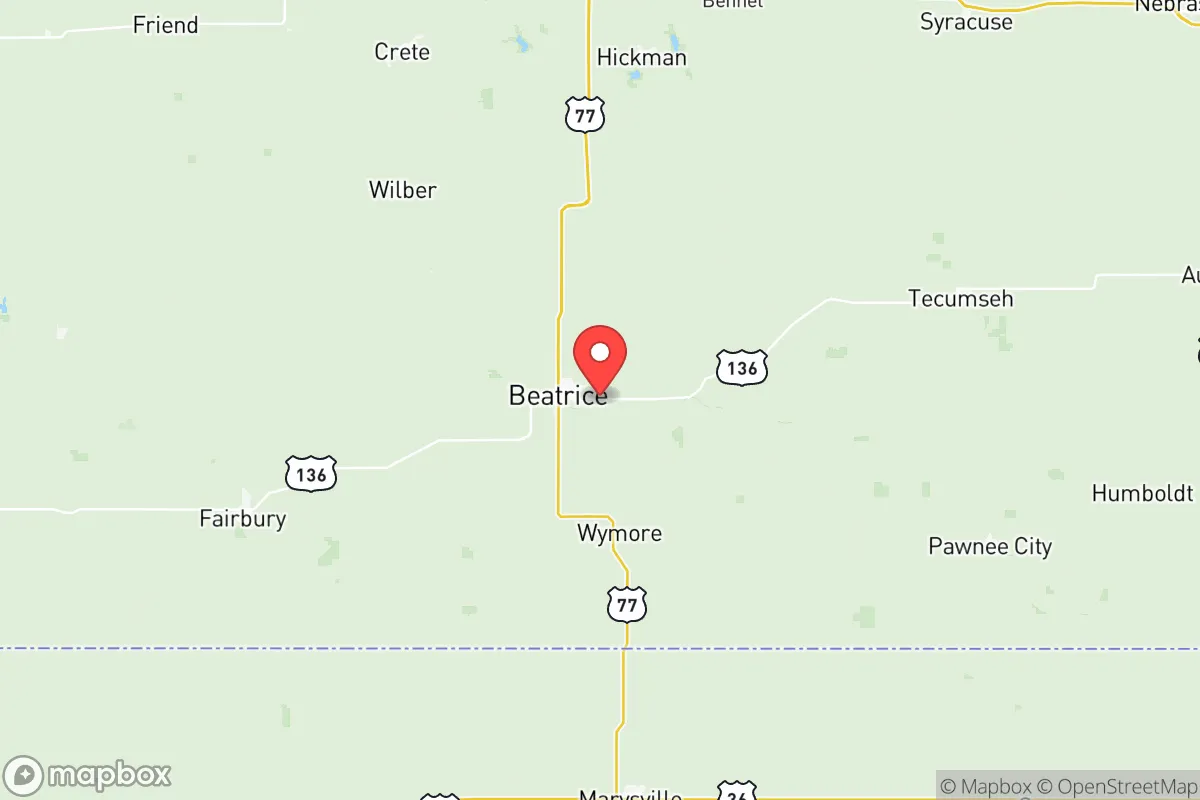
Gage County, Nebraska, is home to 21,646 residents, a population that is 92.9% white and overwhelmingly native-born, with a foreign-born share of just 0.3% — one of the lowest in the nation. The county’s character is rooted in its agricultural and small-town heritage, anchored by the county seat of Beatrice, which holds roughly half the population. This is a place where family histories run deep, often tracing back to the same homesteads staked by European settlers in the 1860s and 1870s, and where the cultural identity remains distinctly Midwestern, conservative, and community-oriented.
Settlement & growth (pre-1960)
The land that became Gage County was originally inhabited by the Pawnee and Otoe nations, who used the region for hunting and seasonal camps along the Big Blue River. The U.S. government extinguished Native title through a series of treaties in the 1830s and 1850s, opening the area to Euro-American settlement. The first permanent white settlers arrived in the late 1850s, but the real population surge came after the Homestead Act of 1862, which offered 160 acres of free land to anyone willing to farm it for five years.
The earliest homesteaders were predominantly Yankee stock — families from New England, New York, and the upper Midwest — who followed the newly built railroad lines into the territory. They founded Beatrice in 1857, naming it after the daughter of a railroad official, and it quickly became the commercial and governmental hub. Simultaneously, a wave of German immigrants began arriving in the 1860s and 1870s, drawn by cheap land and the promise of agricultural independence. These German settlers concentrated in the northern and western parts of the county, establishing tight-knit farming communities like Pickrell and Clatonia, where German was spoken in homes and churches well into the 20th century.
A smaller but notable wave of Czech and Polish immigrants arrived in the 1880s and 1890s, settling primarily around Odell and Liberty. They brought with them Catholic traditions and a strong work ethic that complemented the existing Protestant Yankee and Lutheran German cultures. By 1900, Gage County’s population had peaked at roughly 30,000, supported by a thriving agricultural economy of corn, wheat, and livestock. The railroad towns of Wymore and Blue Springs grew as shipping points, each developing distinct commercial districts and ethnic social halls.
The Dust Bowl and Great Depression of the 1930s hit Gage County hard, causing a slow population decline as young people left for urban jobs in Lincoln and Omaha. Unlike the Great Plains farther west, however, the county did not experience a mass exodus of Okies or Arkies; instead, the population gradually aged in place. The post-World War II era brought modest growth through agricultural mechanization, but no new immigrant waves arrived. By 1960, the county’s population had stabilized around 22,000, and its ethnic composition was nearly entirely white, with small clusters of German and Czech descendants still identifiable by surname and church affiliation.
Modern era (post-1965)
The 1965 Hart-Cellar Act, which dramatically reshaped U.S. immigration by eliminating national-origin quotas, had virtually no effect on Gage County. The foreign-born population today stands at just 0.3%, meaning the county has received almost no post-1965 immigration from Asia, Latin America, or Africa. The small Hispanic population — 3.2% of the total — is largely composed of second- and third-generation Mexican-American families who arrived as migrant farmworkers in the 1970s and 1980s, many of whom settled permanently in Beatrice and Wymore to work in meatpacking and food processing plants. These families have established a modest but visible presence, with Spanish-language services at some churches and a small Hispanic grocery in Beatrice.
The East/Southeast Asian population (0.6%) is almost entirely the result of a single employer: the Beatrice State Developmental Center, which recruited a handful of Filipino nurses and healthcare workers in the 1990s and 2000s. There is no Indian-subcontinent population (0.0%), and the Black population (0.7%) consists mostly of families who moved from Lincoln or Omaha for employment at the state center or at local manufacturing plants like Exmark Manufacturing in Beatrice. Domestic migration has been minimal; the county has not attracted significant numbers of retirees, remote workers, or coastal transplants. Instead, the population has slowly declined from 22,993 in 2000 to 21,646 in 2024, driven by outmigration of young adults seeking education and jobs in larger cities.
Suburbanization has been limited. The only notable growth area is the southern edge of Beatrice, where a few new subdivisions have been built to accommodate families who work in town but want larger lots. The smaller towns — Barneston, Filley, Virginia — have seen steady population loss, with many homes now vacant or used as weekend properties by hunters and retirees from Lincoln.
The future
Gage County’s demographic future points toward continued slow decline and aging. The median age is already above the national average, and the school-age population in Beatrice and Wymore has been shrinking for two decades. Without a major employer moving in or a significant shift in remote-work patterns, the county is unlikely to attract new domestic migrants. The Hispanic population may grow modestly as existing families have children, but it will remain a small minority — likely reaching 5-6% by 2040. The foreign-born share will probably stay below 1%, as the county lacks the job diversity or ethnic networks that draw immigrants to larger Nebraska cities like Omaha or Grand Island.
Culturally, the county will remain overwhelmingly white and conservative, with a strong attachment to agricultural traditions, local churches, and community events like the Gage County Fair in Beatrice. The most significant change may be the gradual consolidation of rural schools and churches as the population thins, and a growing reliance on Beatrice as the sole service hub for the entire county. For a newcomer, this is a place where fitting in means respecting deep-rooted family histories and participating in local civic life — not expecting rapid change or diversity.
In short, Gage County is a stable, aging, and culturally homogeneous rural community that has changed little demographically since 1960. For someone moving in now, it offers quiet, affordable living and strong social bonds, but little of the ethnic diversity or rapid growth found in other parts of Nebraska. The county’s future is one of gentle contraction, not transformation.

* Values derived from national, state, county, city and local statistics and may differ in a specific area. Last updated: 2026-07-19T04:04:33.000Z
Narrative content on this page is AI-generated and may contain mistakes. Verify any details that matter before acting on them.
ReloMaps may earn a commission from affiliate links at no extra cost to you.

