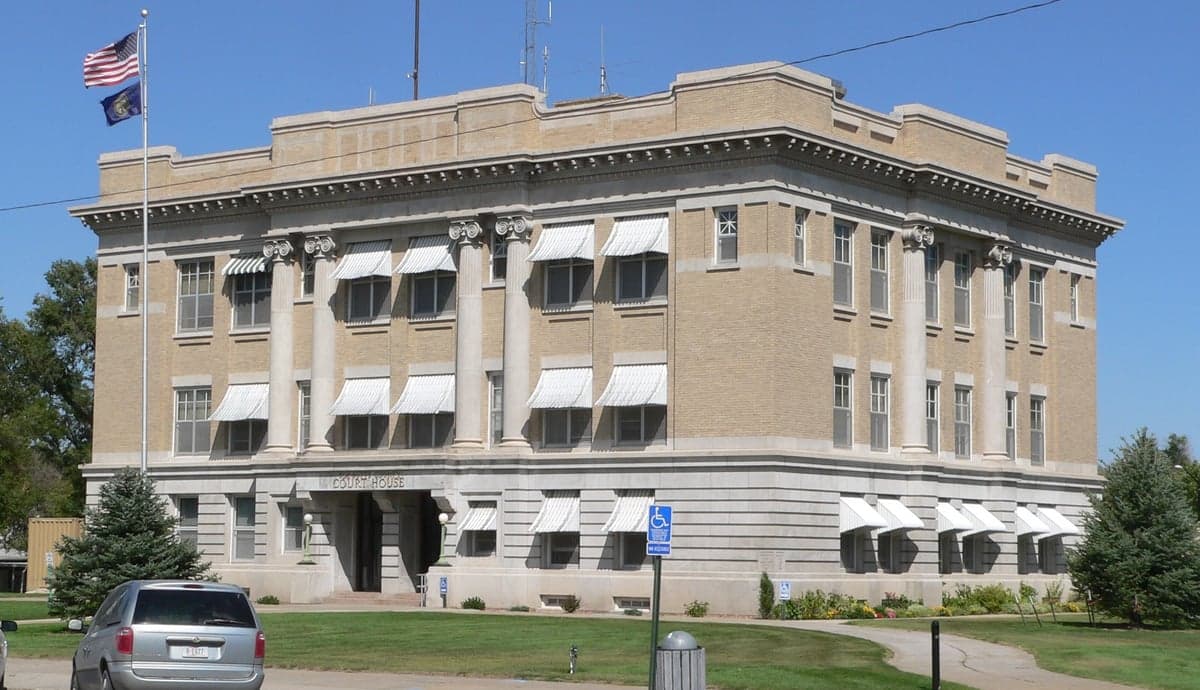
Photo: Wikipedia
Political ClimatePolitical Climate in Box Butte County
Showing district-level results — no local-only data available.
Local Political AnalysisPolitical Analysis of Box Butte County
Box Butte County is one of the most reliably Republican counties in Nebraska, with a Cook Partisan Voting Index (PVI) of R+27 — meaning it votes nearly 30 points more Republican than the national average. That’s a stark contrast to the state of Nebraska as a whole, which sits at R+10, and it puts Box Butte in the same league as the deeply red Panhandle counties to its west. The county has been trending redder over the last two decades, driven largely by rural depopulation in its more moderate precincts and a growing conservative base in and around the county seat, Alliance. While the county hasn’t flipped in any dramatic way — it’s been solidly Republican since at least the 1990s — the margins have widened. In 2020, Donald Trump carried Box Butte by over 40 points, up from about 35 points in 2016, reflecting a broader rural shift to the right across the Great Plains.
How it compares to Nebraska as a whole
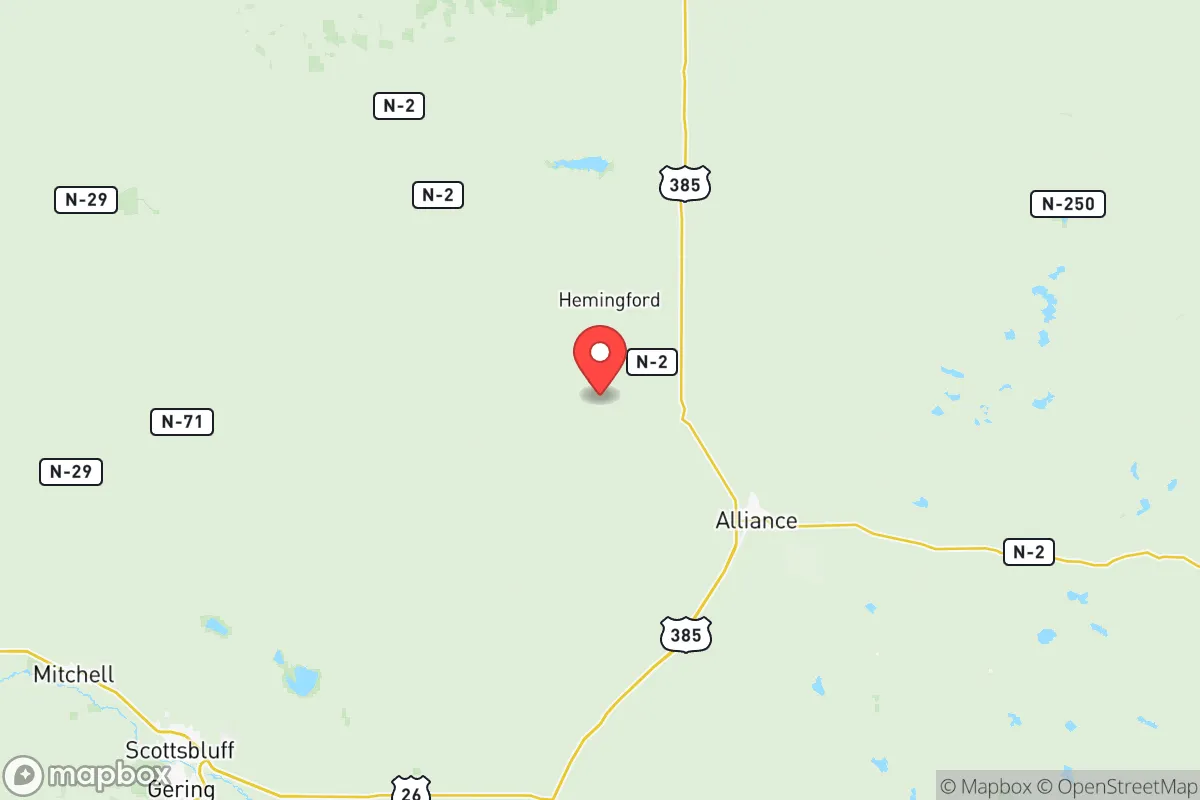
The R+27 PVI for Box Butte County is more than two and a half times as conservative as Nebraska’s statewide R+10 rating. To put that in perspective, while Nebraska’s 2nd Congressional District (Omaha) is competitive enough to have voted for Joe Biden in 2020, Box Butte County has not voted for a Democratic presidential candidate since Lyndon B. Johnson in 1964. The county’s political geography isn’t entirely monolithic, though. The city of Alliance, home to roughly 8,000 people, contains the county’s only precincts that occasionally vote Democratic — specifically the downtown and near-downtown precincts, where a mix of renters, younger residents, and public-sector workers create a small blue pocket. In the 2022 gubernatorial race, these precincts went for the Democratic challenger by single-digit margins. By contrast, the rural precincts around Hemingford and the unincorporated areas west of Alliance are among the most conservative in the Panhandle, often delivering 80-85% of the vote to Republican candidates. The town of Hemingford itself is reliably red but slightly less so than the open country, with a small contingent of moderate voters who sometimes split tickets in local races.
What this means for residents
For conservative residents, Box Butte County offers a political environment where their values are the clear majority — local school board meetings, county commission decisions, and even informal community gatherings tend to reflect a broadly conservative worldview. There’s little need to organize or advocate for conservative priorities because they’re already baked into the local culture. For liberal or moderate residents, the reality is more isolating. While they’re not actively suppressed — Alliance has a functional Democratic Party chapter and there’s no shortage of civil discourse — they are a distinct minority. Voting in local primaries often feels like a formality, as most general elections are decided in the Republican primary. That said, the small blue precincts in Alliance do give Democrats a foothold in city council races, and the county’s nonpartisan school board elections occasionally see more moderate candidates prevail. The broader cultural tone is set by the area’s agricultural economy, strong gun culture, and evangelical Protestant churches, which together reinforce the conservative majority.
One notable policy distinction that sets Box Butte apart from Nebraska’s more urban counties is its approach to land use and taxation. The county operates under a limited-government philosophy — property taxes are among the lowest in the state, and zoning regulations are minimal, especially outside city limits. This appeals to residents who value autonomy and low overhead, but it also means fewer public services and a heavier reliance on volunteer fire departments and self-funded infrastructure projects. For newcomers, especially those moving from blue states, the lack of zoning can be a shock — you might find a hog farm next to a subdivision. That’s not a bug; it’s a feature of the local political culture, and it’s unlikely to change anytime soon. Looking ahead, the county’s political trajectory seems set: as long as the agricultural economy holds and out-migration continues to skew older and more conservative, Box Butte will remain one of Nebraska’s reddest counties, with the small blue islands in Alliance serving as a reminder that even in deep-red territory, political diversity exists at the precinct level.

State Political ClimatePolitical Climate in Nebraska
State Political AnalysisPolitical Environment in the State
Nebraska is a solidly Republican state with a Cook PVI of R+10, but its politics are far more nuanced than that number suggests. The state has been trending rightward in presidential elections — Donald Trump won it by 19 points in 2024, up from 19 in 2020 and 25 in 2016 — yet it remains one of the few states that splits its Electoral College votes by congressional district. The dominant coalition is a mix of rural conservatives, agricultural interests, and Omaha-area suburbanites who have kept the state GOP firmly in control of the legislature and governor's mansion for decades, though a persistent Democratic stronghold in the Omaha metro and a growing independent streak in Lincoln keep things interesting.
Urban vs. rural divide
The political map of Nebraska is a textbook case of urban-rural polarization. Omaha's Douglas County is the state's Democratic engine, consistently voting blue in presidential elections and sending the state's only Democratic congressman to Washington. Lincoln's Lancaster County has been trending Democratic as the University of Nebraska-Lincoln expands and young professionals move in — it voted for Biden in 2020 and Harris in 2024. Meanwhile, the rest of the state is deeply Republican. Scottsbluff in the Panhandle and Norfolk in the northeast are reliably red, while Grand Island and Kearney in the central Platte River valley lean conservative but have growing Latino populations that are slowly diversifying the electorate. The real outlier is Sarpy County, just south of Omaha — a fast-growing suburban area that has shifted from reliably red to competitive, with Trump winning it by only single digits in 2024. That's the kind of shift that keeps both parties watching closely.
Policy environment
Nebraska's policy environment is broadly conservative but with some notable wrinkles. The state has no income tax on Social Security benefits and a flat individual income tax rate that is being phased down to 3.99% by 2027. Property taxes are a perennial complaint — among the highest in the region relative to home values — and the legislature has passed multiple rounds of relief, including LB 1107 in 2020 which expanded property tax credits. The state is a right-to-work state, and its regulatory posture is business-friendly, with no state-level minimum wage above the federal floor (though a 2022 ballot initiative raised it to $15 by 2026). On education, Nebraska has a robust system of public schools but also passed LB 753 in 2023, creating a school choice program that allows tax credits for donations to scholarship-granting organizations. Election laws are moderately restrictive: voter ID is required (passed via ballot initiative in 2022), and the state has no automatic voter registration, but same-day registration is available during early voting and on Election Day. Nebraska also has a unique unicameral, nonpartisan legislature — officially no party labels appear on the ballot, though in practice nearly every member caucuses with a party.
Recent policy direction
The last few years have seen Nebraska move decisively in a conservative direction on several fronts. On gun rights, the state passed constitutional carry (LB 77) in 2023, allowing permitless concealed carry for anyone 21 or older. On abortion, the legislature passed a 12-week ban in 2023 (LB 574), which also banned gender-affirming care for minors — a combination that sparked intense debate. Parental rights have been a major theme: LB 1089 (2024) requires schools to notify parents of any changes to a student's mental or physical health, and LB 575 (2023) restricts classroom instruction on sexual orientation and gender identity. On property rights, Nebraska has strong eminent domain protections, and a 2022 law (LB 1062) limited the ability of local governments to regulate short-term rentals. On privacy and surveillance, the state has no comprehensive data privacy law, but a 2024 bill (LB 1074) created a task force to study the issue. Voting access remains a flashpoint: the 2022 voter ID law is being implemented, and a 2024 law (LB 20) shortened the early voting window. The overall direction is toward more conservative governance, but the unicameral's filibuster rules mean that major changes often require a supermajority, which moderates have used to slow down the most aggressive proposals.
Civil unrest & political movements
Nebraska is not a hotbed of civil unrest, but there have been notable flashpoints. The 2020 George Floyd protests in Omaha were large and occasionally violent, leading to property damage and a heavy police response. More recently, the 2023 abortion and gender-affirming care ban (LB 574) drew sustained protests at the state capitol in Lincoln, with activists on both sides turning out in force. Immigration politics are less visible here than in border states, but South Sioux City and Lexington have seen tensions over meatpacking plant labor and housing. There is no sanctuary city movement of any significance — Omaha and Lincoln both cooperate with federal immigration enforcement. Election integrity controversies have been relatively muted, though the 2020 and 2024 cycles saw some local GOP figures raise questions about mail-in voting. The most organized political movements are the Nebraska Republican Party's grassroots conservative wing, which has pushed for more restrictive abortion laws and school choice, and the progressive coalition in Omaha, which has focused on criminal justice reform and affordable housing. A new resident would notice the strong presence of both pro-life and Second Amendment advocacy groups, as well as a growing libertarian streak in the rural areas.
Projection
Over the next 5-10 years, Nebraska is likely to remain a reliably Republican state, but the margins could narrow. The Omaha metro — Douglas and Sarpy counties — is growing faster than the rest of the state, and that growth is diversifying the electorate. The Latino population in central Nebraska is also expanding, and while it is not uniformly Democratic, it is adding a new political dynamic. The state's in-migration is modest but tilts toward the Lincoln-Omaha corridor, which could slowly shift the balance. At the same time, rural depopulation continues, which could amplify the urban vote share. The most likely scenario is that Nebraska stays R+8 to R+12 for the next decade, with the Omaha congressional district remaining competitive and the rest of the state solidly red. A new resident moving in now should expect a state that is conservative but not uniformly so, with a legislature that will continue to pass culturally conservative laws but may face increasing pushback from the growing urban and suburban areas.
For a new resident, the bottom line is this: Nebraska offers a stable, conservative policy environment with low taxes and a business-friendly climate, but you'll want to be aware of the property tax burden and the ongoing debates over education and abortion. If you're conservative, you'll find a state that largely aligns with your values and is actively moving in your direction. If you're liberal, you'll find solid communities in Omaha and Lincoln where you can live comfortably, but you'll be in the minority at the state level and may find the recent legislative direction frustrating. Either way, the state's politics are transparent, the government is relatively small, and the pace of change is deliberate — which is exactly how most Nebraskans like it.
* Values derived from national, state, county, city and local statistics and may differ in a specific area. Last updated: 2026-07-10T12:47:43.000Z
Narrative content on this page is AI-generated and may contain mistakes. Verify any details that matter before acting on them.
ReloMaps may earn a commission from affiliate links at no extra cost to you.

