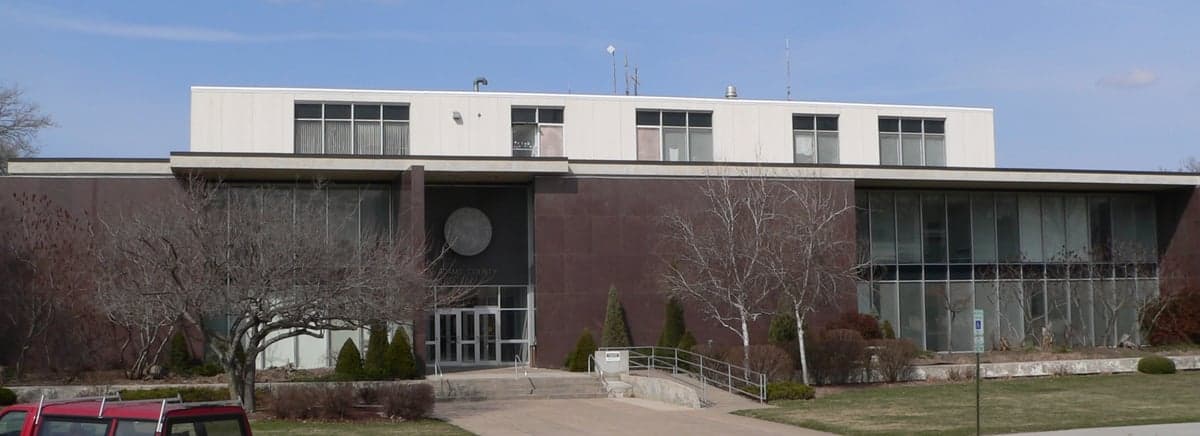
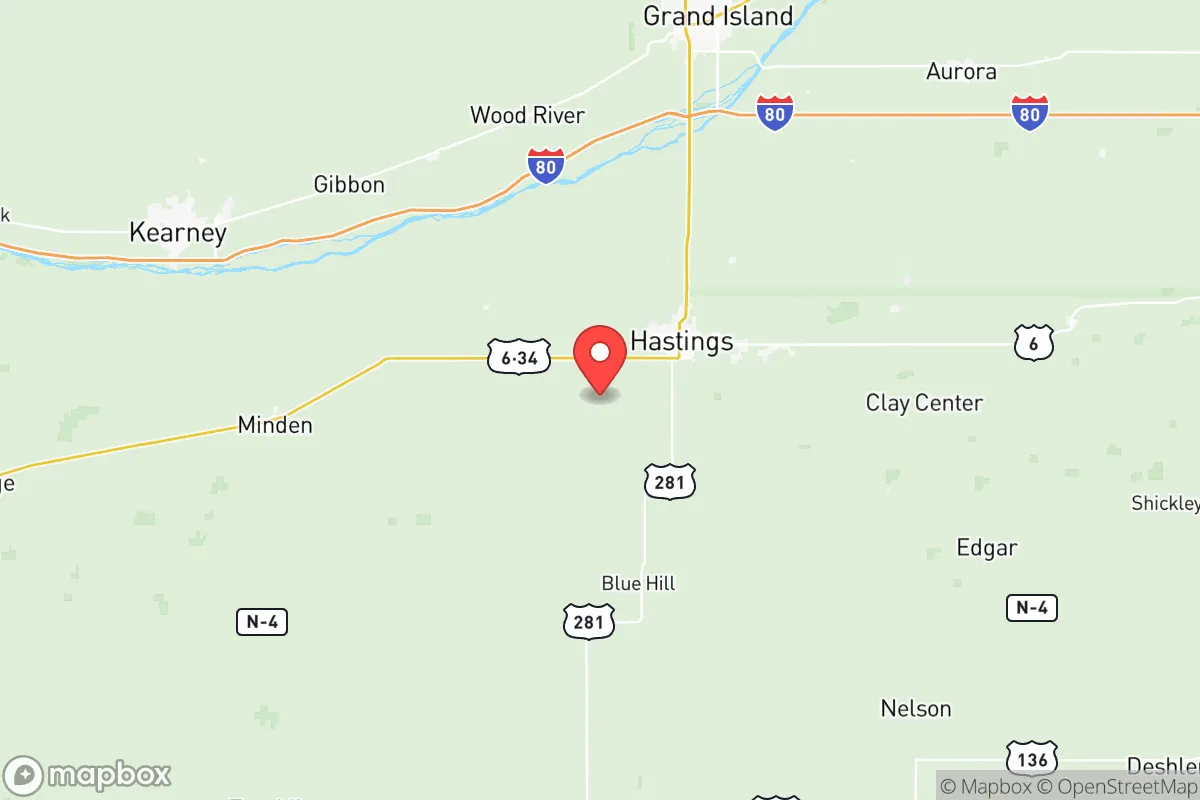
Photo: Wikipedia
Political ClimatePolitical Climate in Adams County
Showing district-level results — no local-only data available.
Local Political AnalysisPolitical Analysis of Adams County
Adams County is one of the most reliably Republican counties in Nebraska, carrying a Cook PVI of R+27 that places it far to the right of the state’s already red R+10 baseline. The county has not voted for a Democratic presidential candidate since Lyndon B. Johnson in 1964, and in 2024, Donald Trump carried it by a margin exceeding 40 points. The political center of gravity is Hastings, the county seat and largest city, but even there, the Democratic vote is concentrated in a few precincts around Hastings College and the downtown core, while the rural townships and smaller communities like Juniata, Kenesaw, and Ayr vote overwhelmingly Republican. The trajectory has been steadily rightward: as recently as 2008, John McCain won the county by 28 points, but that gap has widened with each subsequent cycle as national polarization deepened and local Democratic organizing atrophied.
How it compares
Nebraska as a whole is a solidly red state with a PVI of R+10, but Adams County is nearly three times more Republican than the state average. That means Hastings and its surrounding farm country sit in the same political territory as the Nebraska Panhandle, not the more competitive eastern counties like Douglas (Omaha) or Lancaster (Lincoln). Within Adams County, the political geography is fairly simple: the city of Hastings has a few blue-leaning precincts—particularly around the college campus and the older, denser neighborhoods near the downtown—but those pockets are small and shrinking. The rural townships, where agriculture and manufacturing dominate the economy, vote Republican by margins of 70-80% or more. The county’s Republican lean is so deep that even in 2020, when Joe Biden made inroads with suburban voters nationally, Adams County shifted slightly right relative to the state, suggesting that the local GOP base is both large and motivated.
What this means for residents
For conservative residents, Adams County is a comfortable environment where Republican candidates and policies are the default. Local offices—county commission, school boards, the Hastings City Council—are dominated by Republicans, and conservative viewpoints are well-represented in local media and civic life. For liberal residents, the reality is more isolating. Democratic organizing exists primarily through Hastings College and a small group of active party members, but there are no Democratic elected officials at the county level, and progressive candidates rarely break 35% in countywide races. That said, Hastings itself is not a political monolith: the city’s precincts near the college and the hospital district can swing in local elections, especially when school bond issues or zoning questions are on the ballot. The practical effect for both sides is that national political debates feel distant; local governance tends to focus on roads, water, and property taxes, where there is broad consensus.
Culturally, Adams County reflects the broader Nebraska values of self-reliance, community involvement, and fiscal conservatism, but with a distinctly rural inflection. The county is home to the Nebraska Law Enforcement Training Center and a strong agricultural extension presence, which reinforces a law-and-order, pro-business ethos. Policy distinctions from the state as a whole are subtle: Adams County has been a stronghold for anti-tax ballot measures and has consistently supported state-level restrictions on abortion and expanded gun rights. For newcomers, the most noticeable political difference from Omaha or Lincoln is the near-total absence of visible partisan conflict—most residents simply assume a conservative baseline, and political conversations tend to be pragmatic rather than ideological. That may shift as the county’s population ages and younger residents move to larger cities, but for now, Adams County remains one of Nebraska’s most reliably red corners, with little sign of change on the horizon.

State Political ClimatePolitical Climate in Nebraska
State Political AnalysisPolitical Environment in the State
Nebraska is a solidly Republican state with a Cook PVI of R+10, but its politics are far more nuanced than that number suggests. The state has a unique, nonpartisan unicameral legislature and a history of pragmatic, moderate conservatism, though the last decade has seen a steady rightward shift driven by rural resentment of coastal policies and a growing urban-rural cultural divide. While Omaha and Lincoln keep the state from being a deep-red monolith, the trajectory over the past 20 years is unmistakably toward a more conservative, populist posture, especially on cultural and economic issues.
Urban vs. rural divide
The political map of Nebraska is a textbook case of the urban-rural split. The state’s two population centers — Omaha (Douglas County) and Lincoln (Lancaster County) — are the only reliably blue or purple areas. Omaha’s 2nd Congressional District is famously competitive; it split its electoral vote for Barack Obama in 2008 and Joe Biden in 2020, making it a perennial battleground. Lincoln, home to the University of Nebraska, leans left on social issues but remains moderate on fiscal matters. Outside of these two cities, the state is overwhelmingly Republican. Scottsbluff, Grand Island, Kearney, and North Platte are deeply conservative, with many counties routinely voting 75-80% Republican. The rural-urban divide is stark: Douglas and Lancaster counties account for over half the state’s population, yet the remaining 91 counties dominate the legislature and statewide elections. This tension drives much of Nebraska’s policy, as rural lawmakers often view Omaha and Lincoln with suspicion, pushing back on what they see as big-city overreach on issues like mask mandates, property taxes, and land use.
Policy environment
Nebraska’s policy environment is defined by fiscal conservatism and a growing cultural conservatism. The state has no personal or corporate income tax on the horizon — though it currently has a progressive income tax — and has been steadily cutting rates. In 2023, the legislature passed LB 754, which accelerates income tax rate reductions and moves toward a flat tax. Property taxes are a perennial flashpoint, with rural homeowners and farmers feeling the squeeze as agricultural land values rise. The state has a right-to-work law, no state-level minimum wage above the federal floor (though voters approved a $15 minimum wage by 2026 via ballot initiative), and a regulatory climate that is generally business-friendly. On education, Nebraska has seen a push for school choice, with LB 753 (the Opportunity Scholarships Act) passed in 2023, providing tax credits for private school donations. Election laws are moderately restrictive: voter ID is now required (passed in 2022 via ballot measure), and the state has no-excuse absentee voting, though early voting is available. Healthcare policy is a mixed bag: Nebraska expanded Medicaid under the Affordable Care Act in 2018 via a ballot initiative, but the state has some of the strictest abortion laws in the region, banning the procedure after 12 weeks with limited exceptions.
Recent policy direction
The last five years have seen Nebraska move decisively to the right on a broad range of liberties. On gun and self-defense law, the state passed constitutional carry (LB 77) in 2023, allowing permitless concealed carry for anyone 21 or older. On parental and education rights, the legislature passed LB 1084 in 2023, which restricts instruction on sexual orientation and gender identity in K-12 schools, mirroring Florida’s “Don’t Say Gay” law. On speech and privacy, Nebraska has not enacted broad surveillance laws, but it has joined multi-state lawsuits against federal vaccine mandates and social media content moderation. On medical and bodily autonomy, the 12-week abortion ban (LB 209) passed in 2023, with no exceptions for rape or incest after that point; a 2024 ballot initiative to enshrine abortion rights failed. On property rights, the state has strong eminent domain protections, and a 2022 law (LB 1062) restricted local governments from regulating short-term rentals like Airbnb. On taxation, the trajectory is toward lower rates: the top individual income tax rate will drop to 3.99% by 2027 under LB 754. On voting and ballot access, voter ID is now in effect, and the state has purged inactive voter rolls, but same-day registration is not available. The overall direction is toward a more culturally conservative, low-tax, limited-government posture, though the unicameral’s nonpartisan structure sometimes produces surprises — like the 2023 failure to pass a near-total abortion ban.
Civil unrest & political movements
Nebraska is not known for widespread civil unrest, but there have been notable flashpoints. In 2020, Omaha saw several nights of protests after the killing of George Floyd, with some property damage and a heavy police response. The state has a small but vocal progressive activist community centered in Omaha and Lincoln, focused on racial justice, abortion access, and immigrant rights. On the right, the Nebraska Republican Party has been increasingly influenced by populist and libertarian factions, with groups like the Nebraska Freedom Coalition pushing for school choice, gun rights, and anti-vaccine mandates. Immigration politics are a live issue: in 2023, the legislature passed LB 535, which requires law enforcement to cooperate with federal immigration authorities, though Omaha’s mayor has resisted full compliance. There is no serious secession or nullification movement, but rural counties have occasionally floated the idea of splitting from the state over perceived neglect by Lincoln. Election integrity controversies flared after 2020, with some rural counties calling for hand-counting ballots, but no major fraud was found. A new resident would notice that political signs and bumper stickers are common in rural areas, but the overall tone is civil — Nebraskans tend to avoid the kind of street-level confrontation seen in coastal states.
Projection
Over the next 5-10 years, Nebraska is likely to continue its rightward drift, but the pace will be moderated by demographic realities. The Omaha metro area is growing faster than the rest of the state, attracting younger, more diverse residents who lean Democratic. If this trend continues, the 2nd Congressional District could become safely blue, and statewide races could tighten. However, rural depopulation is accelerating, and the remaining rural voters are becoming more conservative. The state’s in-migration is modest and tends to come from other Midwestern states, not from high-tax coastal areas, so a dramatic political shift is unlikely. Expect continued battles over property tax reform, school funding, and abortion access. The unicameral legislature’s nonpartisan structure may prevent the most extreme bills from passing, but the overall direction will remain conservative. A relocator moving in now should expect a state that is culturally traditional, fiscally cautious, and increasingly skeptical of federal authority, but with enough urban moderation to keep it from becoming a deep-red outlier like Oklahoma or the Dakotas.
For a new resident, the bottom line is this: Nebraska offers a stable, low-cost, and generally safe environment with a government that is responsive to conservative priorities but not hostile to moderates. If you lean right, you’ll find a state that is moving in your direction on guns, taxes, and education. If you lean left, you’ll find two cities where your views are represented, but you’ll need to accept that state policy will often run counter to your preferences. The state’s politics are serious but not angry — Nebraskans tend to disagree without being disagreeable, and that’s a rare quality worth considering.
* Values derived from national, state, county, city and local statistics and may differ in a specific area. Last updated: 2026-07-16T18:36:49.000Z
Narrative content on this page is AI-generated and may contain mistakes. Verify any details that matter before acting on them.
ReloMaps may earn a commission from affiliate links at no extra cost to you.

