Demographics of Nacogdoches, TX
Affluence Level in Nacogdoches, TX
A low-income area with significant economic hardship. Household wealth and educational attainment are well below national averages.
People of Nacogdoches, TX
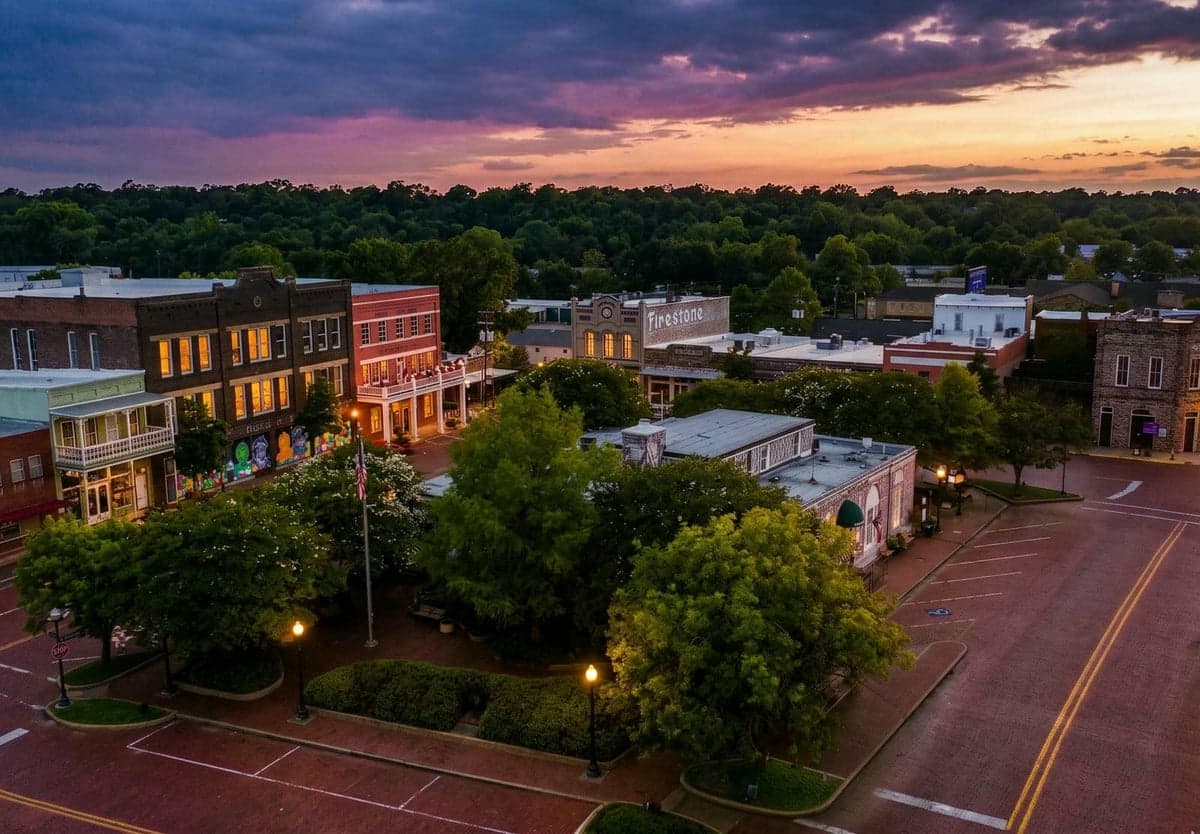
The people of Nacogdoches, Texas today form a community of 32,104 that is notably more diverse than much of rural East Texas, with a population that is 50.7% White, 25.7% Black, 19.8% Hispanic, and a small but present East/Southeast Asian community at 0.4%. The city’s identity is shaped by its role as the home of Stephen F. Austin State University, which brings a steady flow of younger, college-educated residents and tempers the area’s otherwise conservative, small-town character. With 28.5% of adults holding a bachelor’s degree or higher and a foreign-born population of just 4.2%, Nacogdoches remains a predominantly native-born, Southern city with deep historical roots that are visibly layered across its distinct neighborhoods.
How the city was settled and grew
Nacogdoches claims the title of the oldest town in Texas, with its recorded settlement beginning in 1716 when the Spanish established the Mission Nuestra Señora de Guadalupe. The original population was a mix of Spanish missionaries, soldiers, and indigenous Caddo peoples, who had long inhabited the area. After Mexican independence, the town became a magnet for Anglo-American settlers under the empresario system, with Stephen F. Austin’s colony drawing families from the southern United States. These early Anglo settlers established the North Street Historic District, where many of the city’s oldest homes still stand, reflecting the Greek Revival and Victorian architecture of the 19th century. The arrival of the railroad in the 1880s spurred a second wave, bringing a significant Black population who worked in the timber and railroad industries. These families settled in the Washington Square and South Pecan Street areas, which remain historically Black neighborhoods with strong community institutions, including churches and the former E.J. Campbell School. By the early 20th century, Nacogdoches was a thriving agricultural and timber hub, with a population that was roughly two-thirds White and one-third Black, a ratio that persisted through the mid-1900s.
Modern era (post-1965)
The post-1965 period brought two major demographic shifts: the expansion of Stephen F. Austin State University and the growth of the Hispanic population. The university, which now enrolls over 11,000 students, drew a more diverse faculty and student body, including a small but growing number of East/Southeast Asian and Indian subcontinent residents (0.4% and 0.2% of the city’s population, respectively). These groups tend to concentrate near the university campus in the University District, a mixed-use area of apartments, student housing, and older homes. The Hispanic population, which now makes up 19.8% of residents, began growing significantly in the 1990s, driven by immigration from Mexico and Central America for work in construction, poultry processing, and agriculture. This community has established a visible presence in the East Main Street corridor, where Mexican grocery stores, taquerias, and Spanish-language churches serve a growing population. Meanwhile, the Black population, which has held steady at around 25-26% since the 1970s, remains concentrated in the Washington Square and Martin Luther King Jr. Boulevard areas, though younger Black families have begun moving into newer subdivisions on the city’s north and west sides. The White population, at 50.7%, is the most dispersed, living across all neighborhoods but with a notable concentration in the North Street Historic District and newer developments like Lake Nacogdoches Estates.
The future
Nacogdoches is becoming slightly more diverse, but the pace of change is slow. The Hispanic share of the population is projected to continue rising, driven by both natural increase and continued in-migration, potentially reaching 25-28% within the next two decades. This growth is likely to expand the Hispanic presence beyond East Main Street into the University District and newer subdivisions on the city’s southern edge. The Black population share is expected to remain stable, as out-migration of younger Black residents to larger Texas cities like Houston and Dallas is offset by in-migration from surrounding rural counties. The White population share will likely continue a gradual decline, from 50.7% toward the mid-40% range, as the city’s overall growth is driven by minority groups. The East/Southeast Asian and Indian subcontinent populations, while small, may grow modestly as the university recruits more international students, but Nacogdoches lacks the job base in tech or healthcare to attract large numbers of these groups. The city’s cultural identity is evolving from a historically Black-and-White Southern town into a tri-ethnic community, with Hispanic culture becoming an increasingly visible part of public life—seen in bilingual signage, festivals like the annual Fiesta Nacogdoches, and the growing number of Hispanic-owned businesses.
For someone moving in now, Nacogdoches offers a small city with a tangible sense of history and a population that is more diverse than its rural surroundings, yet still predominantly native-born and conservative-leaning. The university provides a steady infusion of youth and education, while the historic neighborhoods—North Street, Washington Square, and East Main Street—each offer a distinct community character. The city is becoming more Hispanic and slightly more diverse overall, but it remains a place where the past is never far from the present, and where newcomers will find a community that values tradition as much as change.

* Values derived from national, state, county, city and local statistics and may differ in a specific area. Last updated: 2026-09-02T15:12:21.000Z
Narrative content on this page is AI-generated and may contain mistakes. Verify any details that matter before acting on them.
ReloMaps may earn a commission from affiliate links at no extra cost to you.

