

Photo by Matthew Lancaster on Unsplash
Political ClimatePolitical Climate in Mt Jackson, VA
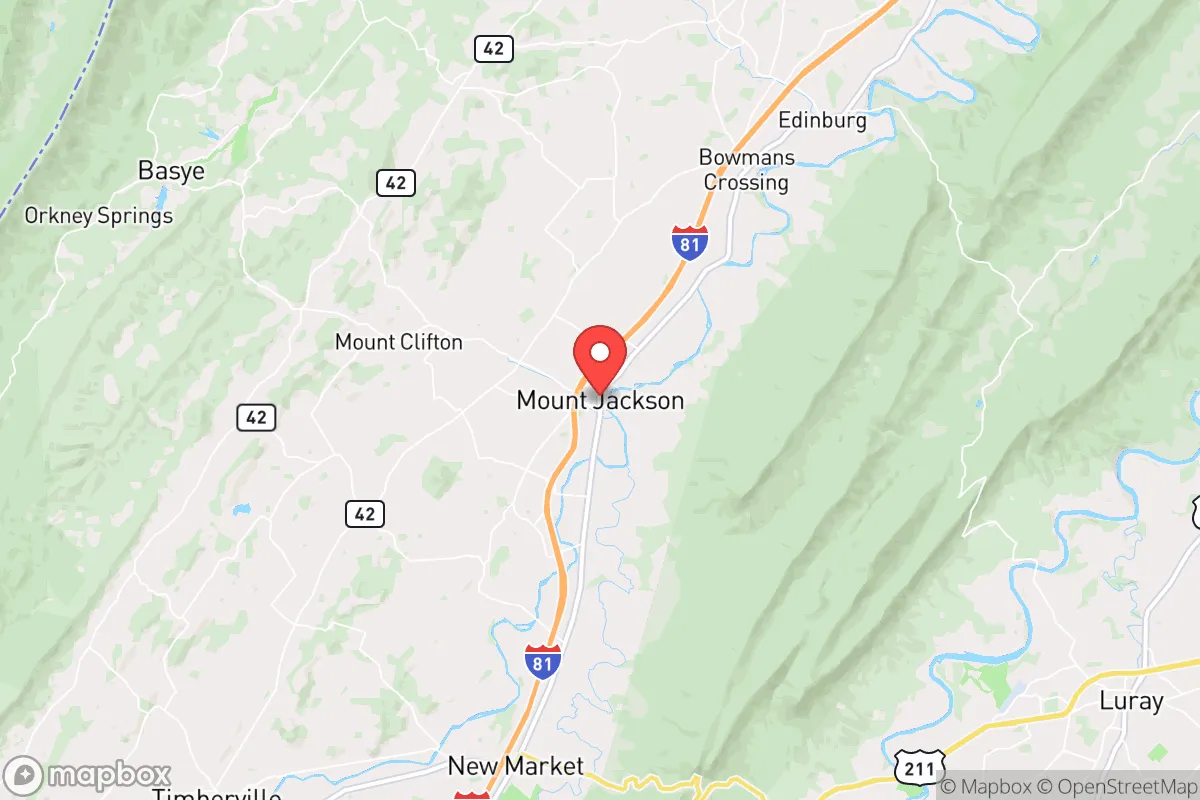
District shown is the primary district for this city’s centroid. Cities may span multiple districts.
Inherited from parent state — no local data available.
Local Political AnalysisPolitical Analysis of Mt Jackson, VA
Mt Jackson leans heavily Republican, with a Cook PVI of R+12 that places it firmly in the reddest tier of Shenandoah Valley towns. That’s a stark contrast to Virginia as a whole, which has shifted to a D+4 lean in recent cycles, driven largely by the explosive growth of Northern Virginia and the Richmond suburbs. Locally, though, the political reality hasn’t budged much in decades—this is a place where conservative values aren’t just a voting pattern but a lived, everyday norm. If you’re looking for a bellwether of the Valley’s stubbornly Republican character, Mt Jackson is it.
How it compares
The gap between Mt Jackson and the rest of Virginia is about as wide as it gets in the state. While the commonwealth’s D+4 rating reflects a purple-to-blue tilt, driven by the D.C. exurbs and Hampton Roads, Mt Jackson sits in a pocket where Democrats rarely crack 40% in a presidential race. Drive 20 minutes north to Woodstock, and you’ll find a slightly more moderate vibe—still red, but with a few more independent voters and a small but visible Democratic presence. Head 30 minutes south to Harrisonburg, and the contrast is even sharper: that city’s growing immigrant and university population has pushed it toward a D+5 lean, making it a blue island in a red sea. Mt Jackson, by contrast, feels like a time capsule of the Valley’s older, agrarian conservatism. The surrounding county, Shenandoah, voted +30 for Trump in 2020, and local races rarely see competitive Democratic challengers. The trajectory here isn’t shifting left—if anything, the area is doubling down, with new residents from more liberal parts of the state often self-selecting for the quiet, low-regulation lifestyle.
What this means for residents
For conservative residents, Mt Jackson is about as comfortable as it gets. Local government, school board meetings, and even the zoning board tend to reflect a small-government, pro-business ethos. You won’t find much pushback on Second Amendment rights, and the tax burden is light—property taxes in Shenandoah County are among the lowest in the state. For liberal residents, the reality is more about navigating a social landscape where your views are a clear minority. There’s no active hostility, but you’ll likely be the only one at the town council meeting arguing for more public transit or affordable housing mandates. That said, the area’s political homogeneity means less gridlock on local issues—roads get paved, schools stay funded, and the biggest debates tend to be about land use and farm preservation, not culture wars. Both sides can agree on one thing: the pace of life is slow, and the politics reflect that.
Culturally, Mt Jackson’s political lean shows up in everyday ways that go beyond the ballot box. The local diner’s TV is tuned to Fox News, not CNN. The high school’s FFA chapter is a bigger deal than the debate team. And the annual community events—like the Mt Jackson Apple Harvest Festival—are heavy on church potlucks and volunteer fire department fundraisers, not political rallies. Policy-wise, the area’s Republican tilt means a lighter regulatory touch on everything from home-based businesses to hunting seasons. But it also means fewer public services: don’t expect robust public transit or a county-funded arts center. For anyone moving here, the key takeaway is that Mt Jackson’s politics aren’t just a label—they’re woven into the fabric of daily life, and they’re not changing anytime soon.

State Political ClimatePolitical Climate in Virginia
State Political AnalysisPolitical Environment in the State
Virginia has shifted from a reliably competitive swing state to a solidly Democratic-leaning one, with a Cook PVI of D+4, driven almost entirely by the explosive growth of the Washington, D.C. suburbs in Northern Virginia. Over the last 20 years, the state has gone from voting for George W. Bush in 2004 to backing Democrats by comfortable margins in every presidential election since 2008, while still electing Republican governors in off-years—a pattern that tells you everything about its split personality. The dominant coalition is a mix of affluent, college-educated suburbanites in NoVA and a growing, diverse population in the Hampton Roads and Richmond areas, but the rest of the state—especially the rural Southside, Shenandoah Valley, and Southwest—remains deeply conservative and feels increasingly left behind by the Richmond and D.C. power centers.
Urban vs. rural divide
The political map of Virginia is a textbook case of the urban-rural chasm. Northern Virginia—specifically Arlington, Alexandria, and Fairfax County—is the Democratic engine, delivering margins of 60-70% for statewide Democrats. The I-95 corridor through Richmond and down to Hampton Roads (Norfolk, Virginia Beach) adds another layer of blue, with Richmond city proper voting over 80% Democratic in recent cycles. Meanwhile, the rural crescent from Roanoke west through Bristol and down to Danville in the Southside is reliably red, often voting 70%+ Republican. The real battlegrounds are the exurban and suburban counties like Loudoun and Prince William—these were once swing counties but have flipped decisively blue since 2016 as tech workers and federal contractors moved in. Virginia Beach remains a purple outlier, with a strong military and retiree base that keeps it competitive, but even there, the city council has shifted left in recent years.
Policy environment
Virginia’s policy environment is a study in contrasts. The state has a flat income tax rate of 5.75% and a sales tax of 5.3% (higher in some localities), which is moderate by national standards but high for the South. Property taxes are set locally and vary widely—Loudoun County rates are around 1.15% of assessed value, while Bristol is under 0.80%. The regulatory posture is business-friendly in theory, but the state has a strong environmental review process and a growing list of green energy mandates. Education policy is a flashpoint: Virginia has some of the best public schools in the country (Fairfax County schools are nationally ranked), but the state also saw a fierce battle over transgender student policies and critical race theory in the early 2020s, leading to Governor Glenn Youngkin’s 2021 win on a parental rights platform. Election laws are moderately restrictive—voter ID is required, but same-day registration is not allowed, and early voting is available for 45 days. The state has no right-to-work law (a major difference from its southern neighbors), and union membership is low but not prohibited.
Recent policy direction
The last five years have seen Virginia swing back and forth on key liberty issues. Under the 2020-2021 Democratic trifecta, the state passed the Virginia Clean Economy Act, mandating 100% carbon-free electricity by 2050, and expanded voting access with no-excuse absentee voting and 45 days of early voting. But the 2021 election of Governor Youngkin brought a sharp reversal on education and crime: the state eliminated the grocery tax, increased teacher pay, and passed a parental rights bill requiring schools to notify parents of sexually explicit content. On gun rights, Virginia remains a mixed bag—it has a one-handgun-per-month law, universal background checks, and a red flag law passed in 2020, but it also allows open carry and has no ban on assault weapons. On medical and bodily autonomy, abortion remains legal up to 26 weeks (one of the most permissive windows in the South), but a 2024 ballot measure to enshrine it in the state constitution failed. Property rights are generally strong, but localities have wide latitude on zoning, which has led to battles over density in NoVA. Privacy and surveillance are moderate—Virginia passed one of the nation’s first comprehensive data privacy laws in 2021, but law enforcement access to cell phone data remains a concern for civil libertarians.
Civil unrest & political movements
Virginia has been a stage for some of the most visible political flashpoints in the country. The 2017 Unite the Right rally in Charlottesville put the state on the map for white nationalist violence and counter-protests, and the city is still grappling with the aftermath of the statue removals. More recently, the 2020-2021 protests over the Lee statue in Richmond drew both Black Lives Matter activists and armed militia groups, leading to a temporary ban on firearms at the Capitol. Immigration politics are less heated than in border states, but Prince William County has been a battleground over sanctuary policies—the county board flipped to Democratic control in 2019 and ended cooperation with ICE detainers, while Loudoun County has seen fierce school board meetings over transgender policies that drew national attention. Election integrity remains a live issue: the 2020 election saw no major fraud in Virginia, but the 2021 gubernatorial race was decided by just 2 points, and both sides have invested heavily in voter mobilization and legal challenges. A new resident in NoVA will notice political yard signs and bumper stickers year-round, while in rural areas, the politics are quieter but just as deeply felt.
Projection
Over the next 5-10 years, Virginia is likely to continue its slow drift leftward, but not as fast as some predict. The key demographic driver is the continued growth of Northern Virginia—Loudoun County alone added over 40,000 residents between 2020 and 2024, most of them college-educated professionals who lean Democratic. However, the state’s off-year election pattern (electing Republican governors in 2009, 2013, 2017, and 2021) suggests that the Democratic lean is not baked in for state-level races, especially when the national environment is unfavorable. The real wildcard is the exurban and rural backlash: if the Democratic Party continues to push on gun control and transgender policies, it could mobilize conservative voters in the Shenandoah Valley and Southside to turn out in higher numbers. A new resident moving in now should expect that the state will remain a purple-to-light-blue battleground for the next decade, with the balance of power shifting every 2-4 years depending on turnout. The state’s economy is strong and diversified, but the political culture will remain a tug-of-war between the D.C. suburbs and the rest of the state.
For a new resident, the bottom line is that Virginia offers a genuinely mixed political environment. If you’re a conservative, you’ll find your people in the rural counties and smaller cities like Roanoke or Bristol, but you’ll be living under a state government that is likely to be Democratic-controlled for most of the next decade. If you’re a liberal, you’ll feel at home in Arlington or Richmond, but you’ll need to accept that the state’s rural areas will push back hard on social issues. The practical takeaway: Virginia is not a place where you can ignore politics—it’s a state where every election matters, where school boards are contested, and where your property taxes and local zoning decisions will reflect the political lean of your specific county. Choose your locality carefully, because in Virginia, the county you live in matters more than the state you live in.
* Values derived from national, state, county, city and local statistics and may differ in a specific area. Last updated: 2026-10-11T03:11:33.000Z
Narrative content on this page is AI-generated and may contain mistakes. Verify any details that matter before acting on them.
ReloMaps may earn a commission from affiliate links at no extra cost to you.

