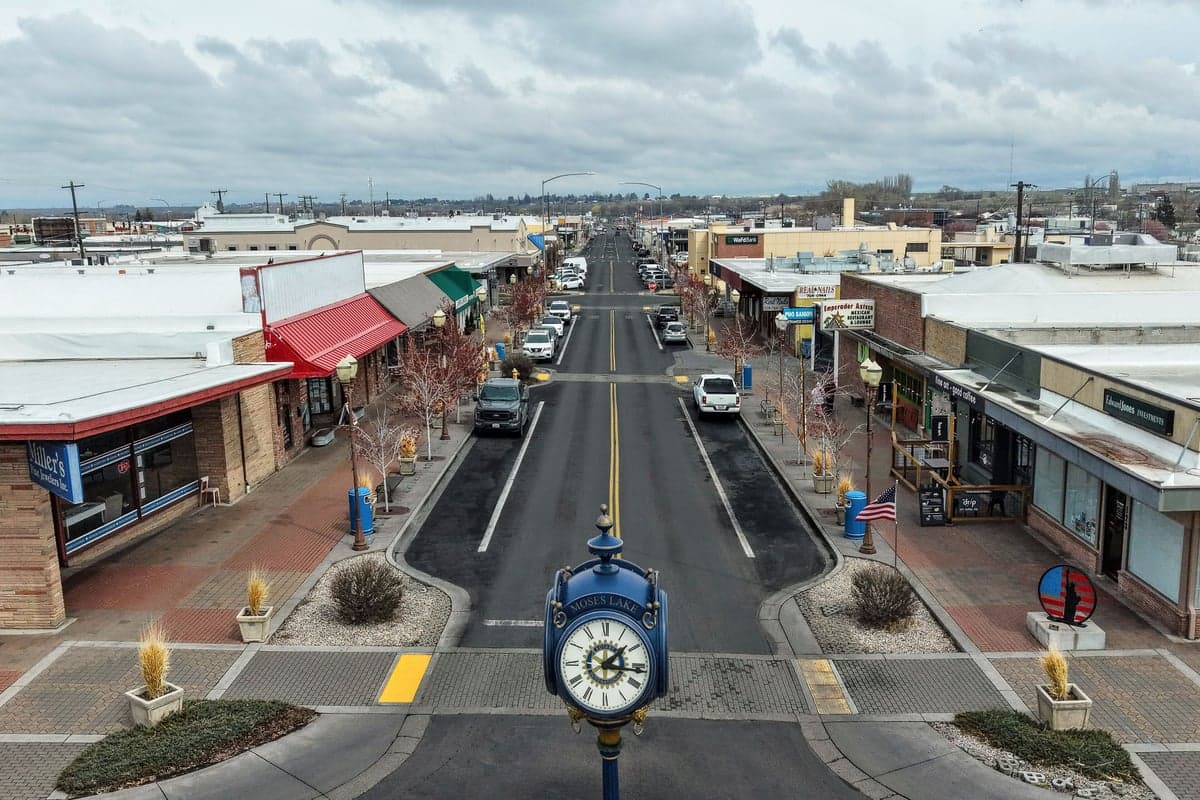
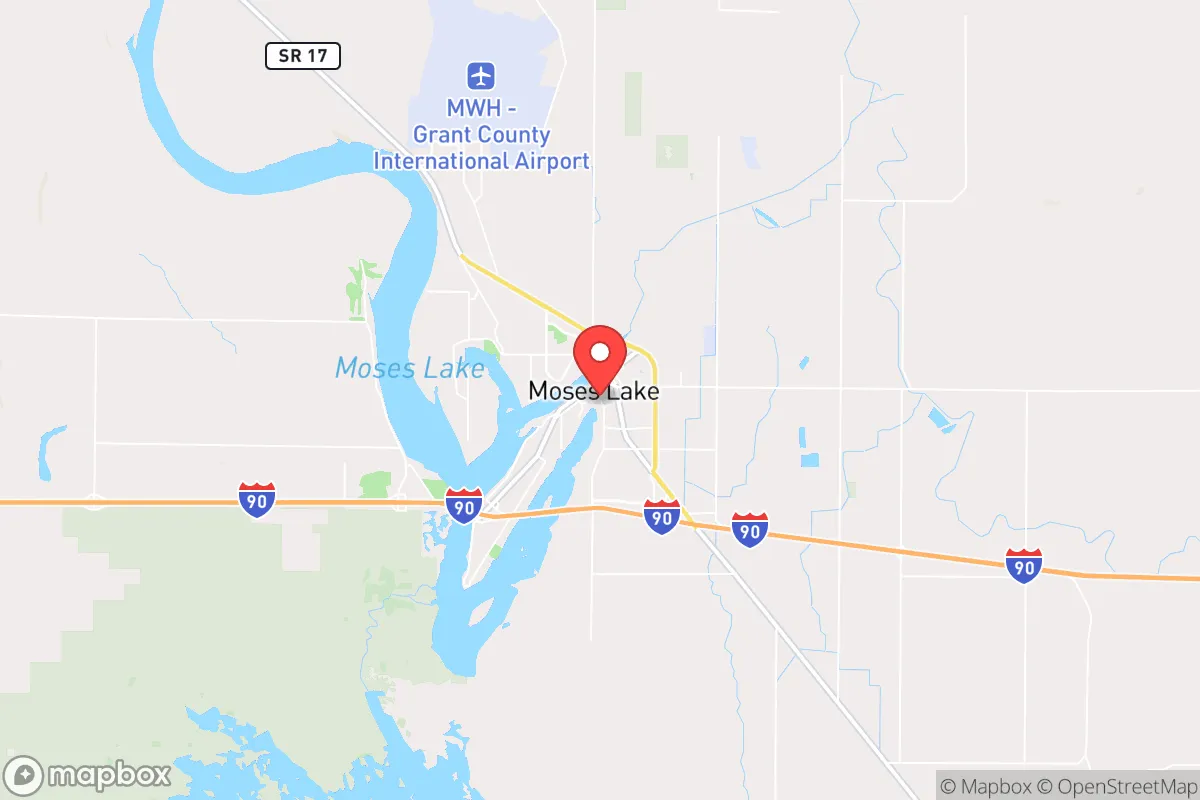
Photo: Wikipedia
Political ClimatePolitical Climate in Moses Lake, WA
District shown is the primary district for this city’s centroid. Cities may span multiple districts.
Local Political AnalysisPolitical Analysis of Moses Lake, WA
Moses Lake is a solidly conservative stronghold in an otherwise blue state, with a Cook Partisan Voting Index of R+10 that puts it well to the right of most of Washington. The city and surrounding Grant County have voted Republican by comfortable margins in every presidential election since at least 2000, and that trend has only hardened in recent cycles. If you’re moving here from the Seattle side of the state, you’ll notice the difference the moment you start talking to neighbors or flipping through local news—this is a place where conservative values are the default, not the exception.
How it compares
The contrast between Moses Lake and the rest of Washington is stark. While the state as a whole has trended steadily blue—voting Democratic by double digits in every presidential election since 2008—Moses Lake has moved in the opposite direction. The nearest large city, Spokane, is more politically mixed, with a moderate Republican lean in the suburbs but a Democratic core. Meanwhile, cities like Seattle, Bellevue, and Olympia are overwhelmingly liberal, making Moses Lake something of an island of red in a sea of blue. Even nearby towns like Ephrata and Quincy lean conservative, but Moses Lake is the largest population center in the region and anchors the area’s Republican voting bloc. If you drive 30 minutes west to Soap Lake or 45 minutes north to Coulee City, you’ll find even more rural, deeply conservative communities, but none with the economic and political weight of Moses Lake.
What this means for residents
For conservative residents, Moses Lake feels like a comfortable fit. Local government, school board meetings, and civic organizations tend to reflect conservative priorities, and you won’t feel out of place flying a Trump flag or discussing gun rights at the coffee shop. For liberal residents, the reality is more nuanced. You won’t face hostility in most everyday interactions—people here are generally polite and neighborly—but you will be in the minority on most political issues. Progressive candidates rarely win local elections, and policy debates around land use, taxes, and public spending tend to tilt right. That said, the city’s growing population—driven by tech and manufacturing jobs—has brought in some new voices, and the political temperature is not as hot as it is in more polarized parts of the country. Most people here just want good schools, safe streets, and a strong local economy, regardless of party label.
One cultural distinction worth noting: Moses Lake residents tend to be more skeptical of state-level mandates from Olympia, whether on environmental regulations, gun laws, or education policy. You’ll hear plenty of grumbling about "the West Side" and its influence over state politics. At the same time, the city benefits from state funding for infrastructure and schools, so the relationship is more pragmatic than outright hostile. Looking ahead, the area’s conservative lean is likely to persist, but as the population diversifies and grows—especially with new residents from other parts of the state and country—the political landscape may shift slightly toward the center over the next decade. For now, though, Moses Lake remains one of the most reliably Republican cities in Washington, and that’s unlikely to change anytime soon.

State Political ClimatePolitical Climate in Washington
State Political AnalysisPolitical Environment in the State
Washington state has been a reliably Democratic stronghold for over a decade, but its politics are far from a monolith. The state’s overall lean is driven by the massive, left-leaning population centers of King County (Seattle) and its immediate suburbs, which have powered Democratic presidential victories by double digits since 2008. However, the political reality is a tale of two states: the urban crescent along Puget Sound votes deep blue, while the rest of the state—eastern Washington, the Olympic Peninsula, and many exurban and rural areas—votes reliably red. This divide has only sharpened over the last 20 years, with the urban core becoming more progressive and the rural areas becoming more conservative, creating a state that feels like two different countries depending on where you live.
Urban vs. rural divide
The political map of Washington is defined by a stark urban-rural split. The Democratic vote is concentrated in the I-5 corridor from Olympia north through Tacoma, Seattle, and Everett, with King County alone delivering about a third of the state’s total vote. Seattle’s politics are among the most progressive in the nation, with city council races often dominated by democratic socialist candidates and policies like a city income tax on high earners (struck down by courts) and a head tax on large businesses. Just south, Tacoma and Pierce County have been trending blue but remain more moderate, with a significant working-class and military population around Joint Base Lewis-McChord. In contrast, the vast eastern half of the state—places like Spokane, the Tri-Cities (Kennewick, Pasco, Richland), and Yakima—votes heavily Republican. Spokane County, once a swing area, has shifted right in recent cycles, while the rural counties of Ferry, Stevens, and Pend Oreille routinely vote 70%+ Republican. Even within the blue metro areas, there are conservative pockets: the suburbs of Snohomish County (like Lake Stevens and Arlington) and the exurbs of Pierce County (like Graham and Eatonville) often elect Republicans to local office, giving conservative relocators a place to land without leaving the job market.
Policy environment
Washington’s policy environment is shaped by a progressive majority in Olympia that has held power for most of the last decade. The state has no personal income tax, which is a major draw for conservatives, but it has one of the highest state sales tax rates in the nation (around 6.5% state-level, with local add-ons pushing it over 10% in Seattle). Property taxes are moderate but have been rising due to a 2019 state Supreme Court ruling (the McCleary decision) that forced the legislature to fully fund public schools, leading to a statewide property tax increase. The regulatory environment is business-friendly in some sectors (tech, aerospace) but heavily regulated in others (environmental, labor). Washington has a strong public-sector union presence, a $16.28 minimum wage (2024, indexed to inflation), and a paid family leave program funded by payroll taxes. On education, the state funds K-12 through a complex levy system, and while test scores are above national averages, there is a persistent achievement gap between wealthy and poor districts. Election laws are among the most accessible in the country: Washington has all-mail voting, automatic voter registration at the DMV, and same-day registration, which Democrats argue increases turnout and Republicans argue reduces ballot security.
Recent policy direction
The last five years have seen Washington move decisively left on a range of issues that matter to relocators. On gun and self-defense law, the state passed a ban on high-capacity magazines (2022), a ban on assault weapons (2023), and a "duty to retreat" law that eliminated the "stand your ground" defense in most public places. A 2024 law also requires a 10-day waiting period for all firearm purchases. On parental and education rights, the state has expanded LGBTQ+ inclusive curriculum requirements and passed a law (2023) that prohibits school districts from notifying parents if a child changes their gender identity or pronouns without the child’s consent—a flashpoint for conservative families. On speech and privacy, Washington has some of the strongest privacy laws in the nation (the Washington Privacy Act), but also allows for "public records" requests that can expose personal information of public employees. On medical and bodily autonomy, the state has codified abortion rights into law (2018), protects gender-affirming care for minors (2023), and has a "shield law" protecting providers who travel to Washington to perform abortions for patients from states with bans. On property rights, the state has a strong growth management act that limits development in rural areas, and a controversial 2023 law that effectively eliminated single-family zoning in most cities, allowing duplexes and triplexes in formerly single-family neighborhoods. On taxation, a 2023 capital gains tax (7% on gains over $250,000) was upheld by the state Supreme Court, and a 2024 law created a state long-term care payroll tax (0.58% of wages) that is opt-out only for those with private insurance. On voting and ballot access, the state has moved to automatic voter registration and has no voter ID requirement for mail ballots (signature verification is used instead).
Civil unrest & political movements
Washington has a visible history of civil unrest, particularly in Seattle. The 2020 Capitol Hill Autonomous Zone (CHAZ) in Seattle was a national flashpoint, with protesters occupying several city blocks for weeks, leading to a political backlash that helped elect a more moderate mayor (Bruce Harrell) in 2021. The state also saw large-scale protests during the 2020 racial justice demonstrations, with property damage in downtown Seattle and Portland-style confrontations between police and protesters. On the right, there is an active "Three Percenters" and militia presence in eastern Washington, particularly around Spokane and the Okanogan County area, and the state has seen armed standoffs over land use and federal property. Immigration politics are a major fault line: Washington is a "sanctuary state" (2019 law), meaning local law enforcement cannot cooperate with federal immigration authorities for civil enforcement, and the state provides driver’s licenses to undocumented immigrants. This has led to tensions in more conservative counties like Yakima and Grant, where agricultural employers rely on immigrant labor but some residents oppose sanctuary policies. Election integrity has been a recurring issue: after the 2020 election, a small number of ballot drop boxes were set on fire in Vancouver and Portland, and there have been ongoing lawsuits over signature verification procedures. The state’s all-mail voting system has generally been viewed as secure, but conservative activists continue to raise concerns about ballot harvesting and voter roll accuracy.
Projection
Over the next 5-10 years, Washington is likely to become more Democratic at the state level, but the urban-rural divide will deepen. In-migration from California and other high-cost states is driving growth in the Seattle suburbs (places like Bothell, Redmond, and Issaquah) and the Tri-Cities, but the new arrivals tend to be younger, more diverse, and more liberal, reinforcing the blue trend in the metro areas. The eastern part of the state is growing too, but more slowly, and its political influence is waning as the population shifts west. The state’s tax structure is likely to see further changes: a wealth tax or a progressive income tax is a perennial proposal, though it would require a constitutional amendment or a court reversal. The gun laws will likely tighten further, with potential magazine capacity limits and a possible ban on open carry. The biggest wildcard is housing: if the state’s new zoning laws succeed in increasing density, it could slow the exodus of conservative families to Idaho and Texas, but if they fail, the political divide will only widen. For a conservative relocator, the practical reality is that you can find a community that matches your values—especially in the eastern half of the state or the outer exurbs—but you will be living under a state government that is increasingly at odds with those values on most cultural and economic issues.
Bottom line for a new resident: If you’re a conservative moving to Washington, expect to pay higher taxes (sales and property) than in many red states, live under some of the nation’s strictest gun laws, and navigate a school system that may not align with your values on parental rights. But you’ll also find no state income tax, a booming job market in tech and healthcare, and a stunning natural environment. The key is choosing your location carefully: the Tri-Cities or Spokane offer a more conservative lifestyle, while the Seattle suburbs offer career opportunities but a blue political culture. If you’re liberal, you’ll find a state that largely aligns with your views, but be prepared for high housing costs and a growing backlash against progressive policies in the rural areas. Either way, Washington is a state where your vote matters less in statewide races but can still swing local elections in your favor if you pick the right county.
* Values derived from national, state, county, city and local statistics and may differ in a specific area. Last updated: 2026-10-24T04:31:50.000Z
Narrative content on this page is AI-generated and may contain mistakes. Verify any details that matter before acting on them.
ReloMaps may earn a commission from affiliate links at no extra cost to you.

