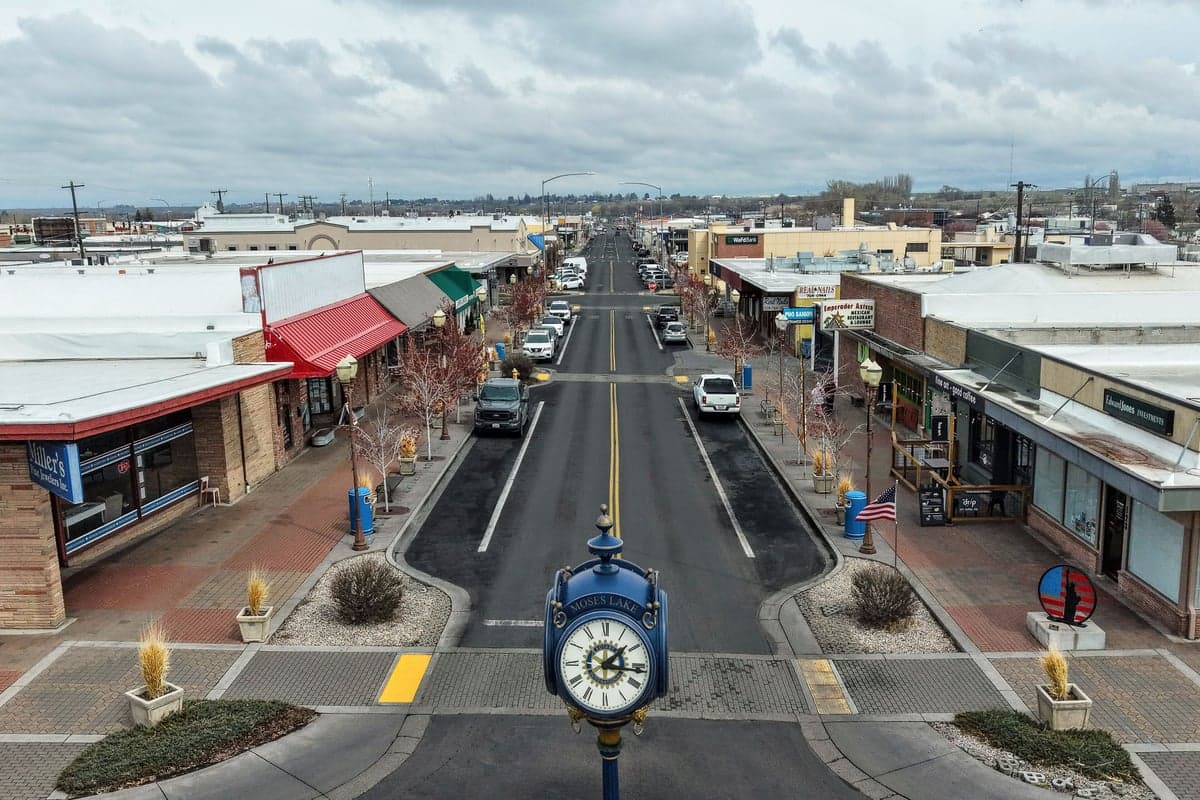
Photo: Wikipedia
Demographics of Moses Lake, WA
Affluence Level in Moses Lake, WA
A middle-class area roughly in line with national averages across income, home values, education, and employment.
People of Moses Lake, WA
Moses Lake, Washington, is a city of 25,594 residents defined by its working-class roots, agricultural heritage, and a rapidly diversifying population that is now majority-minority. The city’s character is shaped by a blend of long-standing white families tied to the region’s farming and aerospace history, a large and growing Hispanic community, and smaller but established Black and East/Southeast Asian populations. With a foreign-born share of 5.8% and a college attainment rate of 21.7%, Moses Lake remains a blue-collar hub where newcomers are drawn by affordable housing and industrial jobs, not by tech-sector growth.
How the city was settled and grew
Moses Lake was not a pioneer-era settlement; its population history begins in earnest with the Columbia Basin Project in the 1930s and 1940s. The U.S. Bureau of Reclamation’s irrigation system transformed the arid sagebrush into fertile farmland, drawing Dust Bowl migrants from Oklahoma, Texas, and the Great Plains. These white Protestant families settled the original core around downtown Moses Lake and the Lakeview neighborhood, building the town’s first schools, churches, and Main Street businesses. A second major wave arrived during World War II with the construction of Larson Air Force Base (now Grant County International Airport). Military personnel and civilian contractors—predominantly white, but including a small number of Black service members—settled in the Airport Area and Peninsula neighborhoods, which still contain mid-century ranch homes and duplexes originally built for base housing. By 1960, the city was nearly 95% white, with a small Hispanic population of migrant farmworkers living in seasonal camps on the outskirts.
Modern era (post-1965)
The closure of Larson Air Force Base in 1966 was a demographic turning point. The base’s departure eliminated thousands of military jobs, but the city pivoted to industrial and agricultural employment, which reshaped its ethnic composition. The Immigration and Nationality Act of 1965 opened the door for new immigration streams, and by the 1970s, Mexican and Central American workers were settling permanently in the Westside and Northwest Moses Lake neighborhoods, areas that remain the heart of the Hispanic community today. These families worked in potato processing plants, onion sheds, and the region’s expanding dairy industry. A smaller wave of East/Southeast Asian immigrants—primarily Filipino and Vietnamese—arrived in the 1980s and 1990s, often sponsored by local churches or recruited for technical roles at the nearby Hanford nuclear site; they concentrated in the Stratford area and the eastern edge of the city. The Black population, which had been minimal since the base closure, grew modestly through internal migration from other Washington cities and now stands at 2.6%, with families dispersed across the Peninsula and Lakeview neighborhoods rather than in a single enclave. Today, the city’s racial breakdown is 51.6% white, 37.7% Hispanic, 2.6% Black, and 1.0% East/Southeast Asian, with no measurable Indian-subcontinent population. The white share has declined steadily from 70% in 2000, while the Hispanic share has more than doubled.
The future
Moses Lake’s population is becoming more diverse, and this trend is expected to accelerate. The Hispanic share is projected to approach 45–50% within 15 years, driven by higher birth rates and continued migration from agricultural regions in Mexico and Central America. New housing developments on the south side and near Moses Lake High School are absorbing much of this growth, with many families moving out of older Westside neighborhoods into newer subdivisions. The white population is aging and declining in absolute numbers, as younger white residents often leave for college or white-collar jobs in Spokane or Seattle. The city’s cultural identity is evolving from a white, rural, agricultural town into a bilingual, bicultural community where Spanish is increasingly heard in stores, schools, and city council meetings. For a newcomer moving in now, Moses Lake offers a stable, family-oriented environment with a low cost of living, but the social and political character is shifting—reflected in local school board and city council elections that increasingly hinge on language access, housing affordability, and representation.
Moses Lake is becoming a majority-Hispanic working-class city with a shrinking white plurality, a small but stable Black and East/Southeast Asian presence, and no significant Indian-subcontinent community. For a relocating family or individual, this means a community where affordable housing and industrial jobs remain plentiful, but where the cultural and political landscape is in active transition—less insular than a generation ago, but still deeply rooted in its agricultural and aerospace past.

* Values derived from national, state, county, city and local statistics and may differ in a specific area. Last updated: 2026-10-24T04:31:50.000Z
Narrative content on this page is AI-generated and may contain mistakes. Verify any details that matter before acting on them.
ReloMaps may earn a commission from affiliate links at no extra cost to you.

