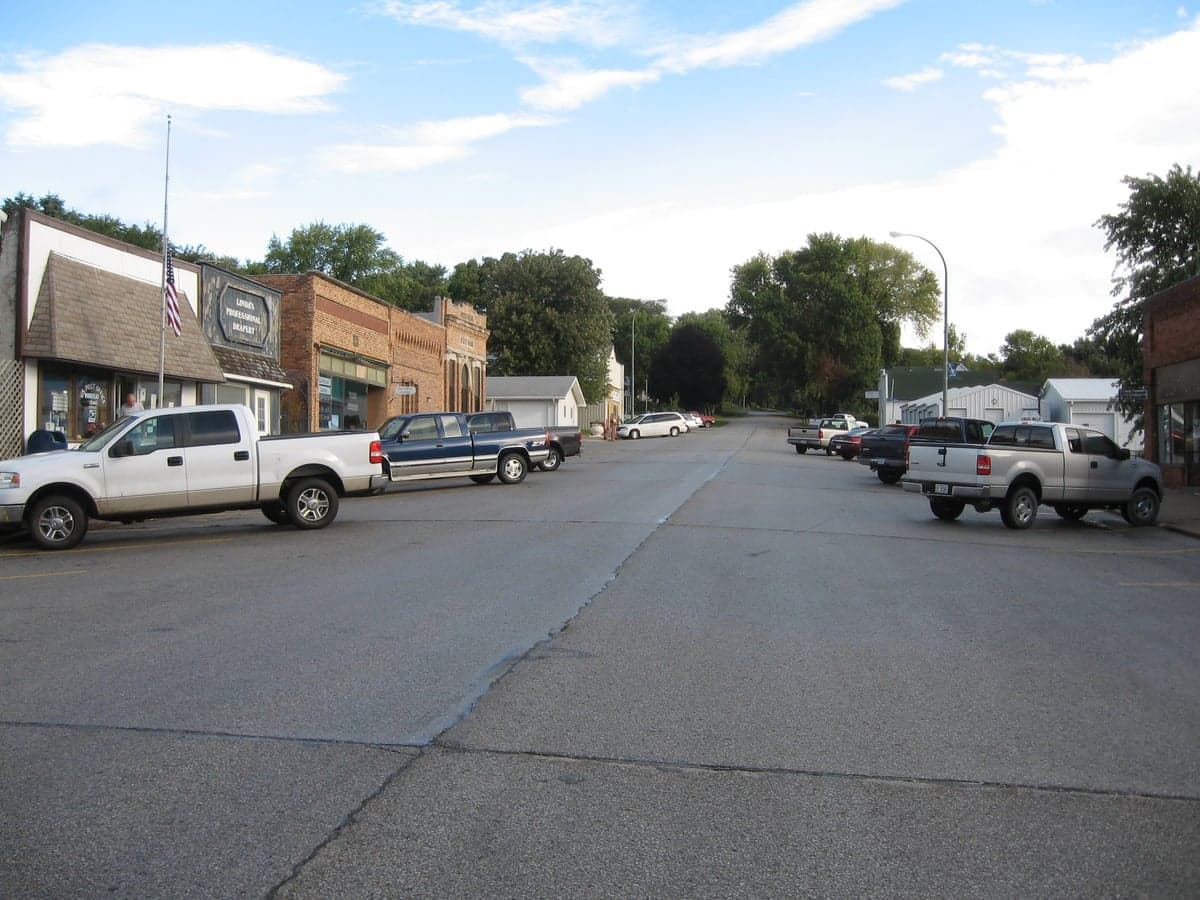
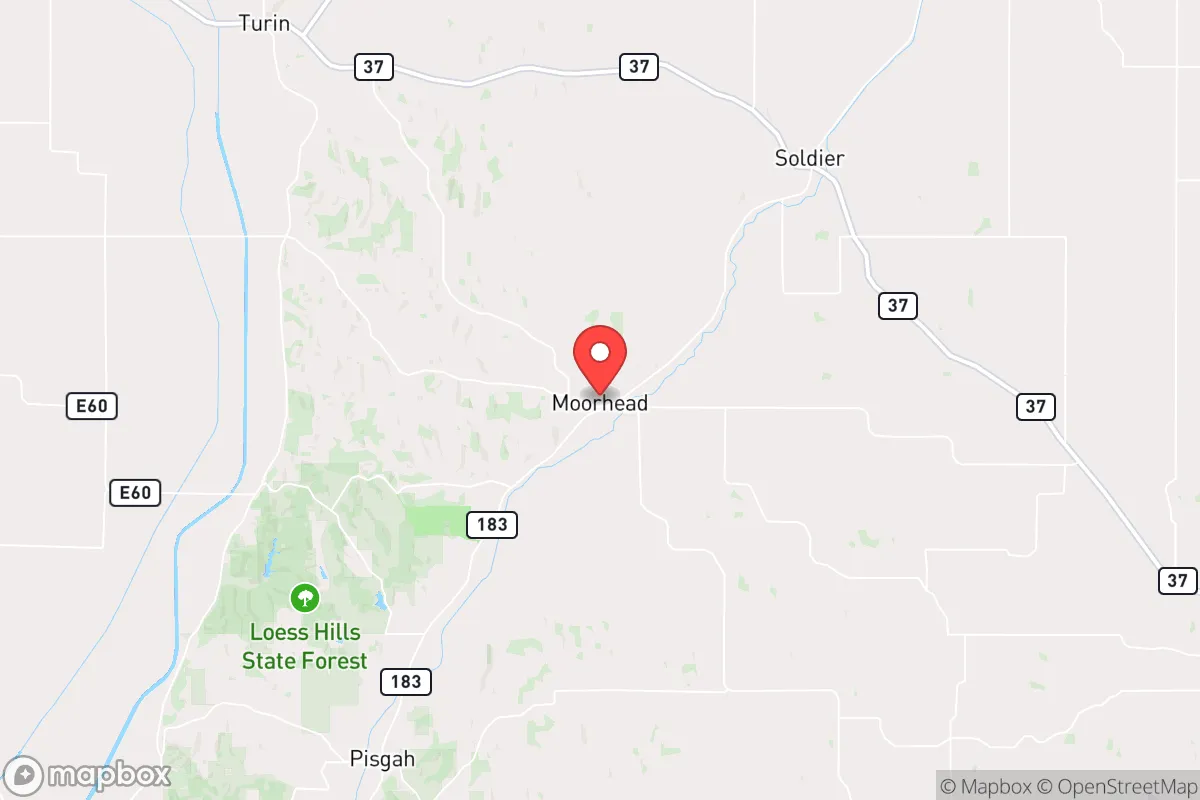
Photo: Wikipedia
Demographics of Moorhead, IA
Affluence Level in Moorhead, IA
A low-income area with significant economic hardship. Household wealth and educational attainment are well below national averages.
People of Moorhead, IA
The people of Moorhead, Iowa, today form a small, tightly-knit community of 263 residents, characterized by its overwhelming ethnic homogeneity and a distinctly rural, agricultural identity. With 99.6% of the population identifying as White and no measurable foreign-born, Hispanic, Black, or Asian residents, Moorhead stands as one of the most demographically uniform towns in western Iowa. The community’s identity is rooted in deep generational ties to the land, a strong sense of local self-reliance, and a population density that makes neighborly familiarity a given rather than a choice.
How the city was settled and grew
Moorhead’s human history begins with the Euro-American settlement of the Monona County region in the mid-19th century, driven by the promise of fertile, inexpensive farmland under the Homestead Act of 1862. The town was platted in 1882 along the Chicago and North Western Railway, which made it a shipping point for grain and livestock. The earliest settlers were primarily of German and Scandinavian descent, drawn from the crowded states of the Upper Midwest. These families built the original core of the community in what is now known as Old Town Moorhead, the area immediately surrounding the railroad depot and Main Street. A second, slightly later wave of settlers, largely of Irish and English stock, established farms and homes in the East End district, along what is now County Road K45. By 1900, the population had stabilized around 200, and the town’s character as a service center for surrounding farms was firmly set. The town never experienced a major industrial boom or a wave of immigrant labor; its growth was organic, tied entirely to the agricultural economy and the slow, steady expansion of family farms.
Modern era (post-1965)
The post-1965 period in Moorhead is defined not by demographic diversification but by a long, slow decline in population and the consolidation of its existing ethnic character. The Immigration and Nationality Act of 1965, which reshaped the ethnic makeup of many American cities, had virtually no effect on Moorhead. The town’s isolation from major interstate highways and its lack of large employers meant it attracted no new immigrant communities. Instead, the dominant demographic trend was out-migration: young adults left for college and jobs in larger cities like Sioux City and Omaha, leaving an aging, stable population. The West Side neighborhood, originally built up in the 1940s and 1950s with modest ranch homes for farm families, saw many of its houses pass to retirees or sit vacant for periods. The South Ridge area, a small cluster of newer homes built in the 1970s, absorbed the few families who moved in from other parts of Monona County. The town’s racial and ethnic composition remained static: 99.6% White, with no measurable growth in any other group. The college-educated share of the population stands at just 10.9%, reflecting the town’s role as a home for those who work in agriculture, trades, or local services rather than in professional or knowledge-based industries.
The future
Moorhead’s population trajectory points toward continued stability at a very small scale, with no significant demographic diversification on the horizon. The town’s population has hovered between 250 and 300 for decades, and projections suggest it will remain in that range through the 2030s. The Prairie View Addition, a small subdivision platted in the early 2000s on the town’s northern edge, has seen only a handful of new homes built, indicating that even local demand for new housing is minimal. The population is aging, with a median age likely in the mid-40s to low 50s, and the lack of job opportunities for younger families suggests the town will continue to see a slow, natural decrease. There is no evidence of any new ethnic or racial groups moving in; the foreign-born population remains at 0.0%, and the Hispanic and Black populations are also at 0.0%. The cultural identity of Moorhead will likely remain deeply tied to its agricultural roots, with community life centered on the local church, the volunteer fire department, and the annual town picnic. For a newcomer, this means moving into a place where the social fabric is already tightly woven and where fitting in requires a genuine commitment to rural, small-town values.
Moorhead is becoming a quieter, older version of itself—a place where the population is stable but not growing, and where the cultural identity remains firmly rooted in its 19th-century origins. For someone moving in now, the town offers a predictable, low-diversity environment with strong social cohesion, but also limited economic opportunity and a population that is not expected to change significantly in the coming decades. It is a place for those seeking a deliberate, slow-paced life in a community where everyone knows everyone else.

* Values derived from national, state, county, city and local statistics and may differ in a specific area. Last updated: 2026-10-17T20:07:41.000Z
Narrative content on this page is AI-generated and may contain mistakes. Verify any details that matter before acting on them.
ReloMaps may earn a commission from affiliate links at no extra cost to you.

