Photo: Wikipedia
Political ClimatePolitical Climate in Montclair, NJ
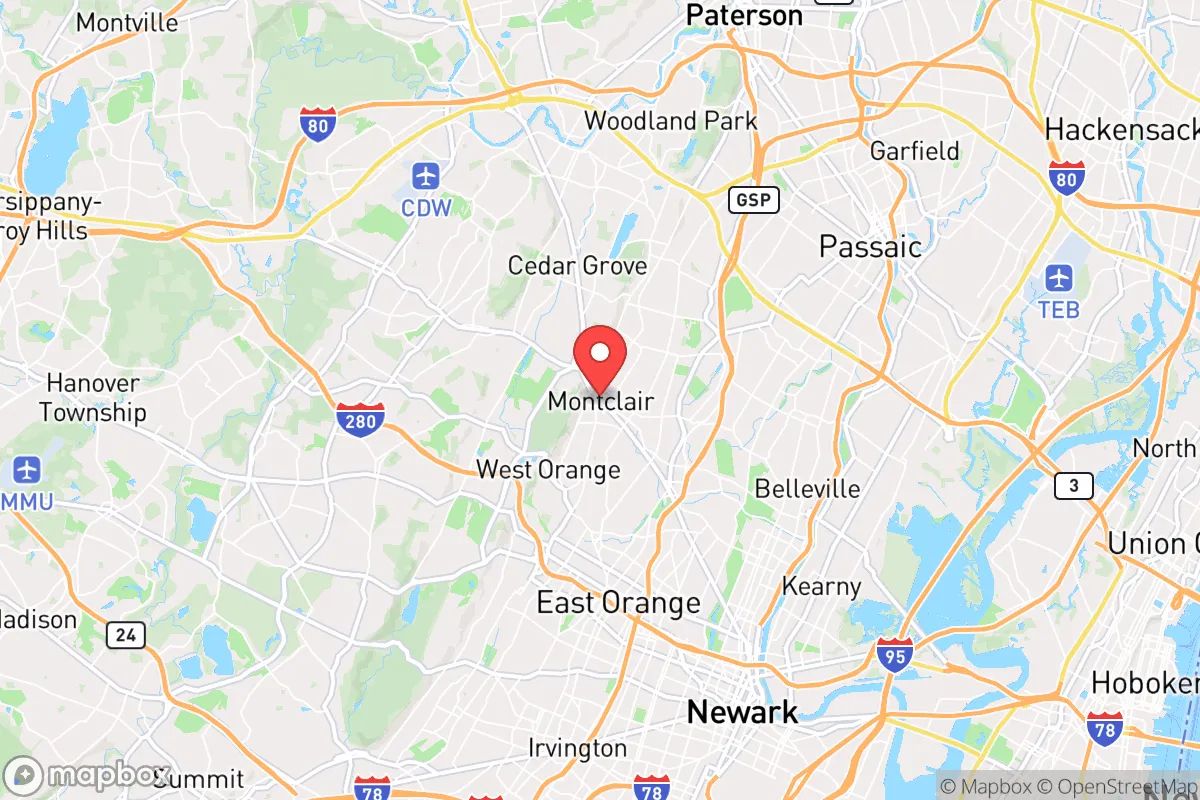
District shown is the primary district for this city’s centroid. Cities may span multiple districts.
Political rankings in New Jersey
- Most Conservative Cities in New Jersey
- Most Liberal Cities in New Jersey
- Best Conservative-Leaning Towns in the Northeast
- Best Conservative-Leaning Towns in the Mid-Atlantic
- Safest Liberal-Leaning Towns on the East Coast
- Safest Conservative-Leaning Towns on the East Coast
- Most Affordable Liberal-Leaning Small Towns in the U.S.
- Safest Liberal-Leaning Cities in the U.S.
- Most Conservative Counties in New Jersey
- Most Liberal Counties in New Jersey
Local Political AnalysisPolitical Analysis of Montclair, NJ
Montclair has long been one of New Jersey's most reliably liberal towns, and that hasn't changed. The town's Cook Partisan Voting Index (PVI) of D+5 means it votes about five points more Democratic than the national average, which is exactly the same as New Jersey's statewide PVI. But if you spend any time here, you'll notice the local politics feel a lot more intense than that number suggests. Montclair's Democratic lean is baked into everything from school board elections to zoning debates, and it's been that way for decades—though the flavor of that liberalism has shifted over time.
How it compares
On paper, Montclair and New Jersey share the same D+5 PVI, but the lived experience is different. New Jersey as a whole is a blue state with deep purple pockets—places like Sussex County or parts of Ocean County vote heavily Republican, and even in Democratic strongholds like Essex County, you'll find conservative enclaves. Montclair, by contrast, is a solid blue island surrounded by towns that range from moderate to conservative. Head west a few miles to Verona or Cedar Grove, and you'll find more Trump signs in yards. Go south to Bloomfield, and the politics get more working-class and mixed. Montclair's liberalism is more pronounced and more culturally dominant than the state average suggests. The town hasn't voted for a Republican presidential candidate since 1988, and local offices are almost entirely held by Democrats. In statewide races, Montclair's margins are often 20-30 points more Democratic than the state as a whole.
What this means for residents
For liberal residents, Montclair is a comfortable place to live. Progressive policies on affordable housing, environmental sustainability, and racial equity are part of the town's DNA. The school system is heavily focused on diversity and inclusion, and local government regularly takes stands on national issues. For conservative residents, it can feel like swimming against the current. You won't find many Republican candidates on the ballot for local office, and social conservatism is largely absent from public discourse. That said, Montclair is not a monoculture. There are fiscally conservative homeowners who grumble about property taxes (which are high, even by New Jersey standards) and parents who push back on certain curriculum changes. But those voices rarely win elections. The practical effect is that if you're conservative, you'll likely feel like a minority in your own town, especially during election season when yard signs are overwhelmingly blue.
Culturally, Montclair's politics show up in everyday life. The town has a strong local food co-op, a thriving arts scene, and a reputation for being LGBTQ+ friendly. It's the kind of place where climate change is a dinner-table topic and where the local library hosts more author talks on social justice than on personal finance. Policy-wise, Montclair was an early adopter of rent control and has some of the strictest affordable housing requirements in the state. The town's trajectory seems to be staying the course—if anything, the politics have gotten more progressive over the last decade, with younger families and New York City transplants pushing for even bolder action on housing and transit. For anyone moving here, the political climate is less a question of "which side wins" and more a question of whether you're comfortable living in a place where the answer is almost always the same.

State Political ClimatePolitical Climate in New Jersey
State Political AnalysisPolitical Environment in the State
New Jersey is a solidly Democratic state with a Cook PVI of D+5, but don't let that single number fool you — it's a far more complicated place politically than a simple "blue state" label suggests. The state hasn't voted Republican for president since 1988, but it's also home to some of the most competitive suburban and exurban districts in the country, and the GOP holds real power at the county and local level. Over the last 10-20 years, the trend has been a slow but steady Democratic consolidation in the densely populated northeast corridor, while the rural south and northwest have become more reliably Republican, creating a sharper urban-rural split than many outsiders expect.
Urban vs. rural divide
The political map of New Jersey is essentially a story of three regions. The northeast corridor — Newark, Jersey City, Hoboken, and the close-in suburbs of Bergen and Essex counties — is the Democratic engine room, delivering massive margins that swamp the rest of the state. These areas are dense, diverse, and heavily unionized, with a strong base among public-sector workers, professionals, and immigrant communities. In contrast, South Jersey and the Skylands region (Sussex, Warren, Hunterdon counties) are where the GOP lives. Places like Toms River in Ocean County and Flemington in Hunterdon have become reliably red, driven by a mix of exurban families, retirees, and small-business owners. The Princeton and Montclair areas are the state's liberal intellectual hubs, while Middletown in Monmouth County is a classic swing suburb — it went for Biden in 2020 but still elects Republicans to local office. The real action is in the exurban ring around Philadelphia and New York, where fast-growing towns like Voorhees and Bridgewater are seeing demographic shifts that are slowly nudging them leftward, but not fast enough to flip them overnight.
Policy environment
New Jersey's policy environment is defined by its high-tax, high-service model. The state has the highest property taxes in the nation (averaging over $9,500 annually), a progressive income tax that tops out at 10.75% for earners over $1 million, and a sales tax of 6.625%. In return, residents get some of the best public schools in the country, a robust public university system (Rutgers, NJIT, and a strong network of county colleges), and a generous Medicaid expansion under the Affordable Care Act. Election laws lean heavily toward access: no-excuse mail-in voting is permanent, same-day registration is available, and early in-person voting has been expanded. Gun laws are among the strictest in the nation — a permit-to-purchase system, a ban on "assault weapons" and large-capacity magazines, and a "may issue" concealed carry regime that was recently tightened after the Bruen decision. Education policy is centralized and well-funded, with the state's school funding formula heavily favoring urban districts, which has been a source of tension for suburban and rural taxpayers. Healthcare is heavily regulated, with a strong individual mandate and a state-based exchange that has kept uninsured rates low.
Recent policy direction
Over the past five years, New Jersey has moved decisively left on several fronts. The 2022 Clean Energy Act set a goal of 100% clean electricity by 2035, and the state has aggressively subsidized offshore wind and solar. On gun policy, the 2023 "Gun Safety Package" (S-3214) expanded the list of prohibited places for carry, mandated liability insurance for gun owners, and raised the purchase age for long guns to 21. On parental and education rights, the state has been a flashpoint: in 2022, Governor Murphy signed a law requiring school districts to adopt policies on transgender student participation in sports and bathroom access, and the state's Department of Education has pushed LGBTQ-inclusive curriculum standards that have drawn lawsuits from conservative parents. On property rights, the state's Mount Laurel Doctrine continues to force municipalities to zone for affordable housing, a policy that has been both praised for inclusion and criticized for overriding local control. On voting and ballot access, the 2020 election saw a massive expansion of mail-in voting, and the state has since made it permanent — a move that Republicans argue benefits Democrats but that has been upheld by the courts. On medical and bodily autonomy, New Jersey has codified abortion rights into state law (the Freedom of Reproductive Choice Act, 2022) and expanded Medicaid coverage for gender-affirming care. On speech and privacy, the state has a strong data privacy law (the New Jersey Data Privacy Act, effective 2025) but has also expanded surveillance powers for law enforcement, including license-plate reader networks and drone use.
Civil unrest & political movements
New Jersey has seen its share of political flashpoints. The 2020 Black Lives Matter protests were large and sustained in Newark, Jersey City, and Trenton, leading to police reform legislation that included a ban on chokeholds and a requirement for body cameras. On the right, the 2021 school board elections in towns like Middletown and Bridgewater saw a surge of conservative activism around critical race theory and mask mandates, with parents packing meetings and winning seats. The state's sanctuary policies are a major point of contention: New Jersey is a "sanctuary state" under the 2019 Immigrant Trust Directive, which limits local law enforcement cooperation with ICE. This has led to clashes between the Murphy administration and Republican-led counties like Ocean and Monmouth, which have passed resolutions opposing the policy. Election integrity has been a persistent issue: after the 2020 election, Republican candidates in close races (like the 7th Congressional District) challenged mail-in ballot procedures, and the state's GOP has pushed for voter ID laws, which have been blocked by Democratic majorities. There have been no serious secession or nullification movements, but the New Jersey State Police has been involved in controversies over use of force and racial profiling, particularly in traffic stops on the Turnpike.
Projection
Over the next 5-10 years, New Jersey is likely to become more Democratic, but not uniformly so. The state's population is aging and slowly declining, but the areas that are growing — the urban cores and close-in suburbs — are trending left. The exurban and rural areas that are losing population are becoming more Republican, but their electoral weight is shrinking. The wild card is in-migration from New York City: as remote work allows more families to move to New Jersey for lower costs (relative to Manhattan), towns like Jersey City and Hoboken are seeing an influx of younger, more liberal professionals. However, the state's high taxes and regulatory burden are pushing some businesses and wealthy individuals to Florida and Texas, which could shift the tax base and political calculus. The GOP's best hope is to hold the line in the 7th and 11th Congressional Districts and flip a few State Assembly seats in the exurbs, but the overall trend is toward a deeper blue shade. A conservative moving in now should expect to live in a state where their vote matters most at the local level — school board, county commission, and municipal races — while the state government will continue to push progressive policies on taxes, education, and social issues.
Bottom line for a new resident: If you're a conservative, you'll find your people in Ocean, Sussex, and Hunterdon counties, and you'll have real influence in local government and school boards. If you're a liberal, you'll feel at home in the urban corridor and the college towns. Either way, you're moving to a state where the politics are intense, the taxes are high, and the schools are excellent — and where the fight over what kind of place New Jersey will be is far from over.
* Values derived from national, state, county, city and local statistics and may differ in a specific area. Last updated: 2026-11-15T18:45:38.000Z
Narrative content on this page is AI-generated and may contain mistakes. Verify any details that matter before acting on them.
ReloMaps may earn a commission from affiliate links at no extra cost to you.

