
Photo: Wikipedia
Personal Sovereignty in Silver Bow County
Viable for self-reliance. Generally workable, though some barriers may limit total independence.
What does Personal Sovereignty tell us?
Personal Sovereignty measures your capacity for self-reliance and independence with minimal government friction. Higher scores mean fewer barriers between you and the way you want to live... but it assumes you have the space you need and good neighbors.
What does this tell us?
Personal Sovereignty measures your capacity for self-reliance and independence with minimal government friction. Higher scores mean fewer barriers between you and the way you want to live... but it assumes you have the space you need and good neighbors.
State Policy
Energy independence: Net exporter (120% of energy produced in-state)
Personal Liberty
Homesteading

Personal Liberty Analysis
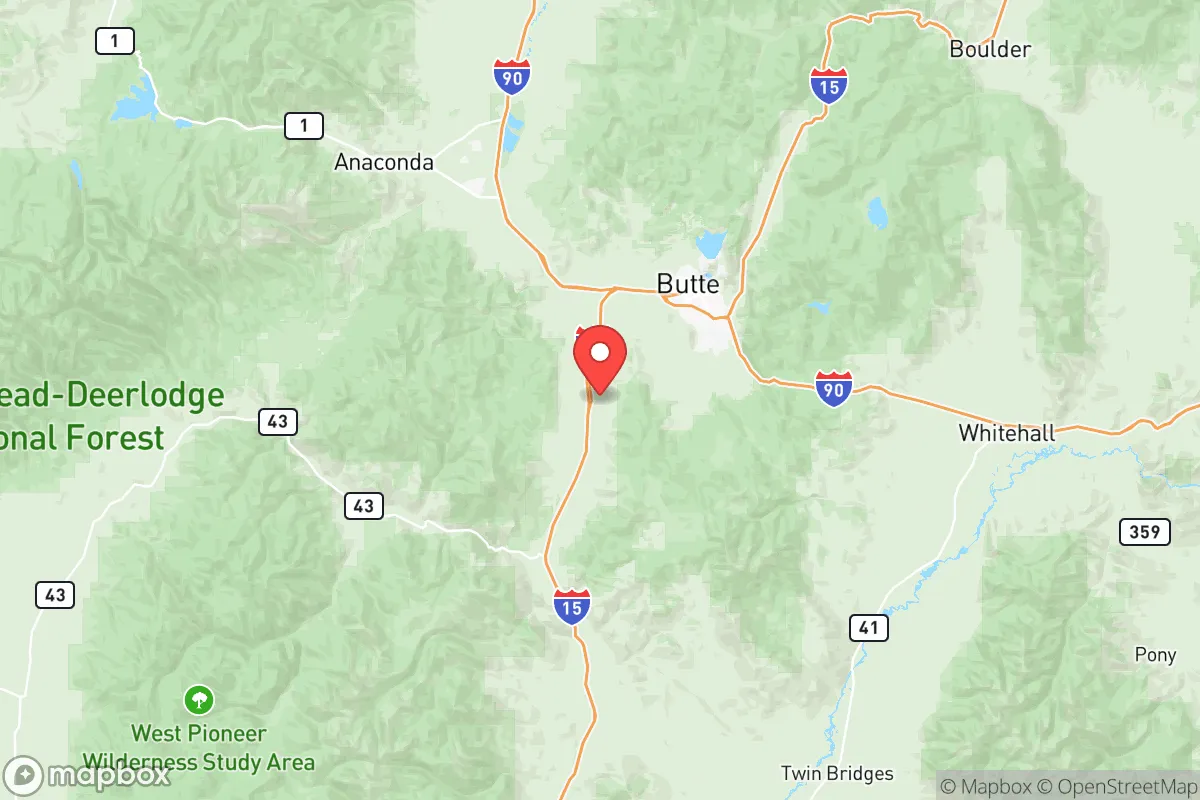
Silver Bow County, Montana, offers a notably high degree of personal sovereignty, grounded in Montana’s strong constitutional protections for individual rights and a local culture that prizes self-reliance. The county’s regulatory environment is generally light-touch, particularly outside the urban core of Butte, with state-level preemption laws limiting local government overreach in areas like firearms, land use, and property rights. For individuals and families seeking maximum personal autonomy—whether in tax burden, self-defense, or the ability to live off-grid—Silver Bow County presents a compelling option, though the specific experience varies significantly between Butte proper and the surrounding unincorporated communities like Walkerville, Ramsay, Melrose, and Divide.
Tax burden and regulatory posture in Silver Bow County
Montana’s tax structure is favorable for those prioritizing financial sovereignty. There is no state sales tax, which keeps the cost of goods and services lower than in neighboring states. Property taxes in Silver Bow County are moderate, with the county’s mill levy rate hovering around 700 mills (2025 data), translating to roughly $7,000 annually on a $200,000 home—comparable to other rural Montana counties but significantly lower than urban centers like Missoula or Bozeman. The state’s income tax is a flat 5.9% on all income above a modest standard deduction, a structure that is predictable and relatively low by national standards. Regulatory posture is light-touch at the county level: there is no county-wide building code for unincorporated areas, meaning property owners in places like Ramsay or Melrose can build, renovate, or demolish structures without county permits, provided they meet basic septic and well requirements. Butte, however, enforces a municipal building code and zoning ordinances, so homeowners inside city limits face more oversight. The county also has no county-wide noise ordinance, no restrictions on backyard chickens or livestock in unincorporated zones, and no county-level business licensing beyond state requirements. This regulatory minimalism is a deliberate reflection of local values, with county commissioners consistently opposing state-level efforts to impose uniform land-use rules.
Self-defense and gun law specifics in Silver Bow County
Montana is a constitutional carry state, meaning no permit is required to carry a concealed firearm for anyone 18 or older who is legally allowed to possess a gun. Silver Bow County fully aligns with this, and local law enforcement does not actively enforce any additional restrictions. The county has no local ordinances restricting magazine capacity, firearm types, or storage requirements. Stand-your-ground law is in effect, with no duty to retreat in any place where a person is lawfully present. The county sheriff’s office, led by a sheriff elected on a pro-Second Amendment platform, has publicly stated that they will not enforce any federal firearms regulations they deem unconstitutional, a stance shared by many rural Montana sheriffs. Gun ranges are accessible: the Butte Rifle and Pistol Club offers a 200-yard outdoor range, and public land in the Deerlodge National Forest (which covers much of the county’s eastern half) allows recreational shooting with standard safety precautions. For those living in unincorporated areas like Melrose or Divide, target shooting on private property is unrestricted. Butte’s city limits do have a discharge ordinance prohibiting firearm use within 150 yards of an occupied building, but this is typical for urban areas and does not affect the broader county’s gun-friendly culture.
Self-reliance and homesteading viability: lot sizes, zoning, and off-grid feasibility
Silver Bow County is one of the more homestead-friendly areas in Montana, particularly outside Butte. Unincorporated areas have no minimum lot size for residential use, so parcels as small as one acre are common in places like Ramsay and Walkerville, while larger tracts of 5 to 40 acres are available near Melrose and Divide. Zoning is virtually nonexistent in the county’s rural zones: there are no restrictions on keeping livestock (including goats, chickens, or horses), no limits on gardening or food production, and no county-level HOA-style covenants. Off-grid living is fully legal: there is no requirement to connect to municipal water or power, and many properties in the county’s southern and eastern reaches rely on private wells, septic systems, and solar arrays. The county does enforce basic health and safety standards for septic systems (per Montana DEQ rules) and well water testing, but these are minimal and one-time costs. The biggest practical challenge for off-grid homesteaders is water availability: the county’s high desert climate averages only 12 inches of precipitation annually, so rainwater catchment and deep wells (often 200–400 feet) are common. Butte’s city limits impose more restrictions—livestock is limited, and off-grid utilities are not permitted within the municipal water district—so homesteaders should prioritize unincorporated areas. The county’s planning department is small and generally responsive, with permit fees for new construction under $200 for most rural projects.
Personal liberties: parental rights, medical autonomy, speech, and property
Montana’s state constitution explicitly protects the right to privacy, which courts have interpreted as covering medical autonomy and parental decision-making. Silver Bow County does not have any local ordinances that infringe on these rights. Parental rights in education are strong: Montana law requires school districts to notify parents of any curriculum changes involving sexuality or gender identity, and parents have the right to opt their children out of any instruction they find objectionable. The county’s school board in Butte has been relatively moderate on these issues, but the legal framework favors parental control. Medical autonomy is similarly protected: there are no county-level vaccine mandates, no restrictions on alternative or holistic medicine, and no local health orders that override individual choice (the county health department has not issued any such orders since 2021). Free speech is robust, with no local noise or signage ordinances that would limit political or religious expression on private property. Property rights are strongly protected: Montana’s “right to farm” law shields agricultural operations from nuisance lawsuits, and Silver Bow County has no county-level eminent domain authority beyond state-defined utility easements. The county assessor’s office is transparent, with property valuations appealable through a straightforward process. For those who value the ability to live without government interference in daily life, Silver Bow County’s legal and cultural environment is among the most permissive in the Mountain West.
Overall, Silver Bow County ranks as one of the most sovereignty-friendly areas in Montana, comparable to neighboring Beaverhead or Madison counties but with the added advantage of Butte’s lower cost of living and existing infrastructure. The county’s light regulatory touch, strong Second Amendment protections, and full support for off-grid homesteading create an environment where personal autonomy is the default, not an exception. For individuals and families who prioritize self-reliance and minimal government intrusion, Silver Bow County offers a practical, affordable, and legally secure base—especially in the unincorporated communities of Walkerville, Ramsay, Melrose, and Divide, where the regulatory footprint is smallest and the culture of independence is most deeply rooted.

* Values derived from national, state, county, city and local statistics and may differ in a specific area. Last updated: 2026-07-10T07:15:37.000Z
Narrative content on this page is AI-generated and may contain mistakes. Verify any details that matter before acting on them.
ReloMaps may earn a commission from affiliate links at no extra cost to you.

