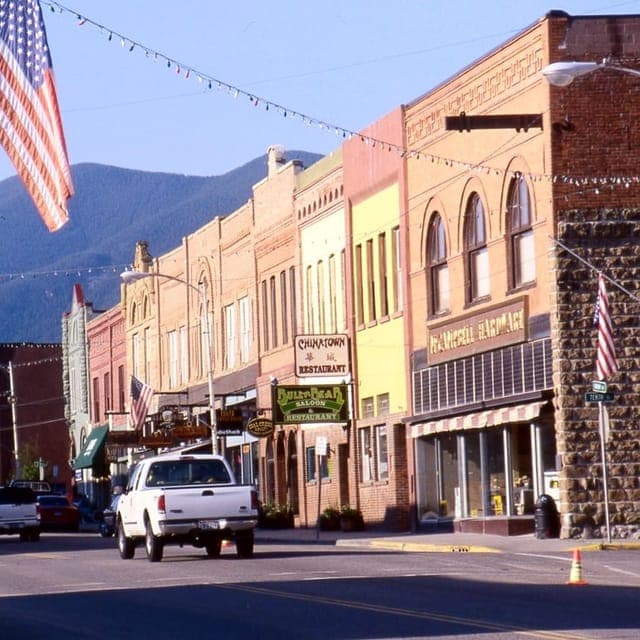
Photo: Wikipedia
Personal Sovereignty in Montana
Viable for self-reliance. Generally workable, though some barriers may limit total independence.
What does Personal Sovereignty tell us?
Personal Sovereignty measures your capacity for self-reliance and independence with minimal government friction. Higher scores mean fewer barriers between you and the way you want to live... but it assumes you have the space you need and good neighbors.
What does this tell us?
Personal Sovereignty measures your capacity for self-reliance and independence with minimal government friction. Higher scores mean fewer barriers between you and the way you want to live... but it assumes you have the space you need and good neighbors.
State Policy
Energy independence: Net exporter (120% of energy produced in-state)
Personal Liberty
Homesteading

Personal Liberty Analysis
Montana stands as one of the last strongholds of personal sovereignty in the lower 48, where the state constitution explicitly guarantees the right to a clean and healthful environment and the right to pursue life, liberty, and property without undue interference. For those viewing relocation through a survivalist or prepper lens, the Treasure State offers a legal and cultural environment that prioritizes individual autonomy over collective mandates, particularly when compared to states like California, Oregon, or Colorado. The state’s vast geography, low population density, and deeply ingrained frontier ethos create a baseline of freedom that is increasingly rare, though the degree of personal sovereignty varies significantly between urban centers like Missoula and Bozeman and rural strongholds like Libby, Hamilton, or the Hi-Line communities near Havre.
Tax burden and regulatory posture: How Montana compares to high-control states
Montana’s tax structure is deliberately designed to minimize government reach into personal finances. There is no state sales tax, which means every dollar earned or spent stays in your pocket, a stark contrast to states like Washington or Texas where sales taxes can exceed 8%. The state income tax is a relatively flat structure with a top marginal rate of 5.9%, but for those living off-grid or running small homestead operations, the lack of a sales tax on essential supplies like tools, seeds, and building materials is a significant advantage. Property taxes are moderate, averaging around 0.83% of assessed value, but counties like Ravalli (Hamilton) and Flathead (Kalispell) have historically been more resistant to aggressive reassessments than Gallatin County (Bozeman). Regulatory posture is equally favorable: Montana has right-to-farm laws that protect agricultural operations from nuisance lawsuits, and the state’s Department of Environmental Quality is notably less intrusive than counterparts in the Pacific Northwest. For preppers, this means fewer permitting hurdles for building a root cellar, installing a rainwater catchment system, or constructing a detached workshop without triggering a zoning review. However, the city of Missoula has adopted stricter building codes and environmental regulations, so those seeking maximum regulatory freedom should target counties like Sanders (Thompson Falls) or Lincoln (Libby), where county commissions are openly hostile to federal land-use overreach.
Self-defense and gun law specifics: Constitutional carry and castle doctrine in practice
Montana is a constitutional carry state, meaning no permit is required to carry a concealed firearm for anyone legally allowed to possess one. This is not a recent concession but a deeply embedded cultural norm, codified in state law and reinforced by a 2021 law that prohibits state and local agencies from enforcing any federal gun regulations that infringe on the Second Amendment. The castle doctrine is absolute: there is no duty to retreat in any place where a person has a legal right to be, and the use of deadly force is presumed justified if an intruder has unlawfully entered a dwelling, vehicle, or occupied structure. For preppers, this legal framework is critical. In towns like Kalispell and Hamilton, gun stores and shooting ranges are abundant, and the local sheriff’s offices are known for issuing concealed carry permits (though not required) as a courtesy for reciprocity in other states. The contrast with Bozeman is notable: while still gun-friendly by national standards, the influx of out-of-state transplants has created a more cautious political climate, and some ranges have reported increased membership from newcomers who feel the cultural shift. For those prioritizing self-defense sovereignty, the rural counties of the Hi-Line—places like Glasgow and Malta—offer the most permissive environment, where local law enforcement is unlikely to question a firearm visible on a hip or in a truck cab.
Self-reliance and homesteading viability: Lot sizes, zoning, and off-grid feasibility
Montana’s land-use regulations are among the most favorable in the nation for those seeking true self-reliance. Outside of incorporated city limits, county zoning is minimal or nonexistent in most areas. In Ravalli County, for example, a five-acre parcel can be subdivided without a formal plat, and there are no county-wide building codes for structures under a certain square footage. Off-grid living is not just tolerated but actively supported by state law: Montana has a statutory right to harvest rainwater, and the state’s Department of Natural Resources and Conservation provides guidance on well drilling without the bureaucratic delays common in states like Colorado or New Mexico. Septic systems require a permit, but the process is straightforward and inexpensive compared to coastal states. For homesteaders, the sweet spot is often the Bitterroot Valley (Hamilton to Stevensville), where 10- to 40-acre parcels are still available at prices far below the Gallatin Valley, and the growing season—while short—is long enough for cold-hardy crops like potatoes, kale, and root vegetables. The Hi-Line towns of Havre and Chinook offer even cheaper land, often under $1,000 per acre, but with a harsher climate and limited water access. Solar panels are common, and many rural properties already have off-grid power setups. The key constraint is water: in eastern Montana, well depths can exceed 300 feet, and drilling costs can run $15,000 to $25,000. Preppers should prioritize properties with existing wells or surface water rights, as the state’s prior appropriation system can make new water rights difficult to obtain in over-appropriated basins.
Personal liberties: Parental rights, medical autonomy, speech, and property
Montana’s legal framework for personal liberties is robust, particularly in areas where federal overreach has been most aggressive. Parental rights are explicitly protected under state law, with a 2023 statute affirming that parents have the fundamental right to direct the upbringing, education, and healthcare of their children. This has practical implications: school boards in rural counties like Lincoln and Sanders have resisted curriculum mandates from the state level, and the Montana Supreme Court has historically upheld parental authority in medical decisions. Medical autonomy is similarly strong. Montana was one of the first states to pass a law prohibiting vaccine passports, and the state’s medical freedom laws prevent employers from mandating experimental treatments as a condition of employment. For those concerned about government overreach into healthcare, the town of Libby has a network of independent practitioners who operate outside the mainstream insurance system, offering direct primary care and holistic services. Speech and property rights are protected by the Montana Constitution, which includes a specific guarantee that “no person shall be deprived of the right to speak, write, or publish freely.” This has been tested in recent years, with courts striking down local ordinances that attempted to regulate political signage or restrict firearm-related speech. Property rights are further secured by the state’s “takings” law, which requires compensation for any regulation that diminishes property value by more than 30%. For preppers, this means that a county cannot simply zone you out of existence—a critical protection in a state where land is the primary asset for self-reliance.
In the broader context of American sovereignty, Montana offers a level of personal autonomy that is unmatched in the Pacific states and competitive with the most free areas of the Mountain West. The combination of no sales tax, constitutional carry, minimal zoning, and strong parental rights creates an environment where a determined individual can live largely outside the reach of government. However, the state is not a monolith: Bozeman and Missoula are trending toward the regulatory norms of their coastal counterparts, while the Hi-Line, the Bitterroot, and the remote counties of the northwest remain bastions of frontier independence. For the strategic relocator with a survivalist mindset, the choice is clear: target the rural counties, secure water rights, and build your sovereignty on land that the state has not yet learned to regulate.

Top Cities for Personal Sovereignty in Montana
* Values derived from national, state, county, city and local statistics and may differ in a specific area. Last updated: 2026-04-18T23:38:15.000Z
Narrative content on this page is AI-generated and may contain mistakes. Verify any details that matter before acting on them.
ReloMaps may earn a commission from affiliate links at no extra cost to you.

