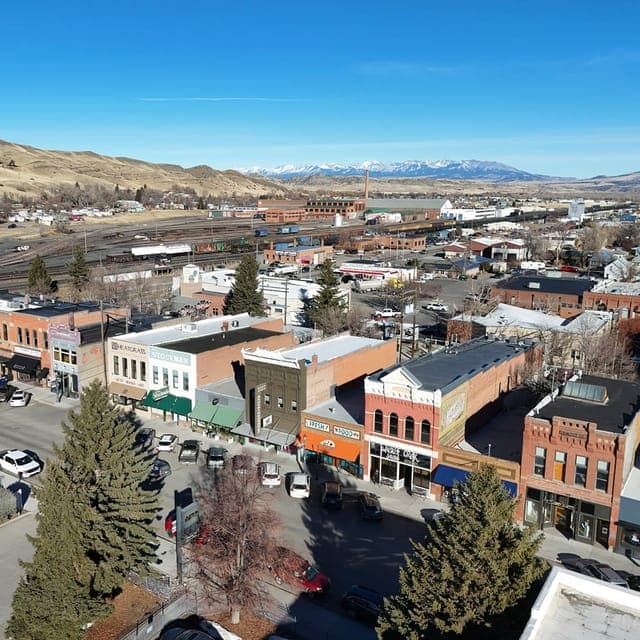
Photo: Wikipedia
Demographics of Montana
Affluence Level in Montana
An upper-middle-class area. Household wealth, education levels, and homeownership run ahead of national benchmarks.
People of Montana
Montana’s 1.1 million residents are among the most ethnically homogenous in the nation, with 84.1% identifying as white and a foreign-born population of just 1.0% — the lowest of any state. The state’s character is defined by a sparse, rural distribution (7.4 people per square mile) and a cultural identity rooted in frontier independence, extractive industries, and a deep Native American presence. Distinctive markers include the state’s seven Indian reservations, a strong ranching and energy economy, and a growing but still small cluster of college-educated professionals in Bozeman and Missoula.
Settlement & growth (pre-1960)
Montana’s human history begins with Indigenous nations who occupied the region for millennia before European contact. The major tribes — the Crow, Northern Cheyenne, Blackfeet, Assiniboine, Gros Ventre, Salish, Kootenai, and Sioux — controlled distinct territories across the plains and Rocky Mountain valleys. The Crow and Blackfeet were among the most powerful, with the Crow aligning with the U.S. Army in the 19th century and securing a large reservation centered on Crow Agency. The Blackfeet Reservation, headquartered in Browning, remains one of the largest in the state. The 1851 Fort Laramie Treaty and subsequent agreements confined these nations to reservations, a process that accelerated after the 1876 Battle of the Little Bighorn near Hardin.
European-American settlement began in earnest with the 1862 gold rush at Grasshopper Creek, which drew prospectors to what became Bannack — Montana’s first territorial capital. The 1864 discovery of gold at Last Chance Gulch created Helena, which grew into a wealthy mining hub and the state capital. The completion of the Northern Pacific Railway in 1883 opened the territory to large-scale homesteading. The 1862 Homestead Act and later the 1909 Enlarged Homestead Act attracted waves of settlers, primarily of Northern European stock: Germans, Scandinavians, Irish, and Scots-Irish took up 160- to 320-acre claims across the eastern plains. Towns like Havre, Glasgow, and Miles City grew as railroad and agricultural centers, with the Great Northern Railway recruiting immigrants directly from Scandinavia and Germany to farm the Hi-Line region.
The copper boom of the 1880s-1910s transformed Butte into a polyglot industrial city. Irish immigrants dominated the mines and labor unions, but Cornish, Italian, Finnish, and Eastern European workers also arrived in large numbers. Butte’s population peaked at over 100,000 in 1917, making it the largest city between Minneapolis and Seattle. The Anaconda Copper Mining Company controlled the economy and politics, creating a strong union tradition that persists in Butte’s identity. Meanwhile, the 1910s-1930s saw a significant influx of German-Russian Mennonites and Hutterites, who established agricultural colonies in central and eastern Montana. Hutterite colonies, concentrated near Lewistown and Denton, remain a distinct communal farming population today.
The Dust Bowl of the 1930s devastated Montana’s homesteaders, driving tens of thousands off the land. The state’s population actually declined between 1930 and 1940, a rare demographic contraction. World War II brought a modest recovery through military bases — Great Falls grew around Malmstrom Air Force Base, and Billings expanded as a regional trade and oil-refining center. The post-war period saw a slow shift from agriculture to energy and services, but Montana remained overwhelmingly rural and white through 1960.
Modern era (post-1965)
The 1965 Hart-Cellar Act had minimal impact on Montana’s demographics. The state’s foreign-born population remained below 2% through the 1990s, and the major immigrant groups of the late 20th century — Mexicans, Vietnamese, Hmong — largely bypassed Montana for coastal and Sun Belt states. The Hispanic population, now 4.4%, grew primarily through domestic migration from the Southwest and Mexico, settling in agricultural areas like the Yellowstone River Valley around Billings and the sugar beet region near Sidney. East/Southeast Asian communities (0.7% of the population) are small and concentrated in college towns: Bozeman and Missoula have modest Vietnamese and Chinese populations tied to university employment and tech sectors. The Indian subcontinent population (0.1%) is negligible, mostly professionals in healthcare and tech in Billings and Bozeman.
The most significant demographic shift since 1965 has been domestic in-migration, not immigration. Starting in the 1990s and accelerating after 2010, Montana attracted a steady stream of out-of-state transplants from California, the Pacific Northwest, and the Mountain West. These newcomers — often white, college-educated, and politically moderate to conservative — have reshaped the state’s growth centers. Bozeman has been the epicenter, its population surging from 27,000 in 2000 to over 55,000 by 2025, driven by Montana State University, outdoor recreation, and tech-adjacent industries. Missoula and Kalispell have seen similar, if less dramatic, growth. This in-migration has raised housing costs, strained infrastructure, and created cultural friction between long-time residents and newcomers — a dynamic often described as “the Californication of Montana.”
Suburbanization has been limited by Montana’s low density. The largest metro area, Billings (population 120,000), has seen modest suburban expansion into Lockwood and the Heights, but the state lacks the sprawling exurbs common in the Sun Belt. The Black population (0.5%) remains tiny and is concentrated in Billings and Great Falls, tied to military bases and the railroad. Native Americans, who make up about 6.5% of the state’s population, are the largest non-white group, with the highest concentrations on the seven reservations — particularly the Crow Reservation near Hardin, the Northern Cheyenne Reservation near Lame Deer, and the Blackfeet Reservation around Browning. Off-reservation Native populations have grown in Billings and Great Falls, driven by economic opportunity and access to services.
The future
Montana’s population is projected to grow slowly, reaching roughly 1.2 million by 2040, driven almost entirely by domestic in-migration. The state is not homogenizing — rather, it is tribalizing into distinct enclaves. The western mountain valleys (Bozeman, Missoula, Kalispell) are becoming more affluent, educated, and politically mixed, while the eastern plains (Miles City, Glendive, Sidney) are aging, shrinking, and remaining culturally conservative and rural. The immigrant population is unlikely to grow significantly; Montana lacks the job base, ethnic networks, and urban density that attract new arrivals. The Hispanic population may rise to 6-7% through natural increase and continued domestic migration, but the state will remain overwhelmingly white for the foreseeable future.
In-migration is changing the cultural identity of western Montana, but it is being absorbed into the state’s existing libertarian-conservative ethos rather than replacing it. Newcomers tend to be drawn to Montana’s gun-friendly laws, low regulation, and outdoor lifestyle — values that align with the state’s traditional identity. The Native American population is young and growing, but remains economically marginalized and geographically isolated on reservations. The next 10-20 years will likely see continued growth in Bozeman and the Flathead Valley, stagnation in the east, and a slow, quiet diversification of the Hispanic and Asian populations in Billings and Missoula.
For someone moving in now, Montana offers a rare combination of low crime, wide-open spaces, and a culturally conservative, self-reliant population — but with the caveat that the state’s best opportunities and amenities are concentrated in a few fast-growing, increasingly expensive mountain towns. The eastern two-thirds of the state remain a world apart: depopulating, agricultural, and deeply traditional. Montana is not becoming a melting pot; it is becoming a collection of distinct, self-selected communities, each with its own trajectory.

Most Diverse Cities in Montana
Most Homogenous Cities in Montana
* Values derived from national, state, county, city and local statistics and may differ in a specific area. Last updated: 2026-04-18T23:38:15.000Z
Narrative content on this page is AI-generated and may contain mistakes. Verify any details that matter before acting on them.
ReloMaps may earn a commission from affiliate links at no extra cost to you.

