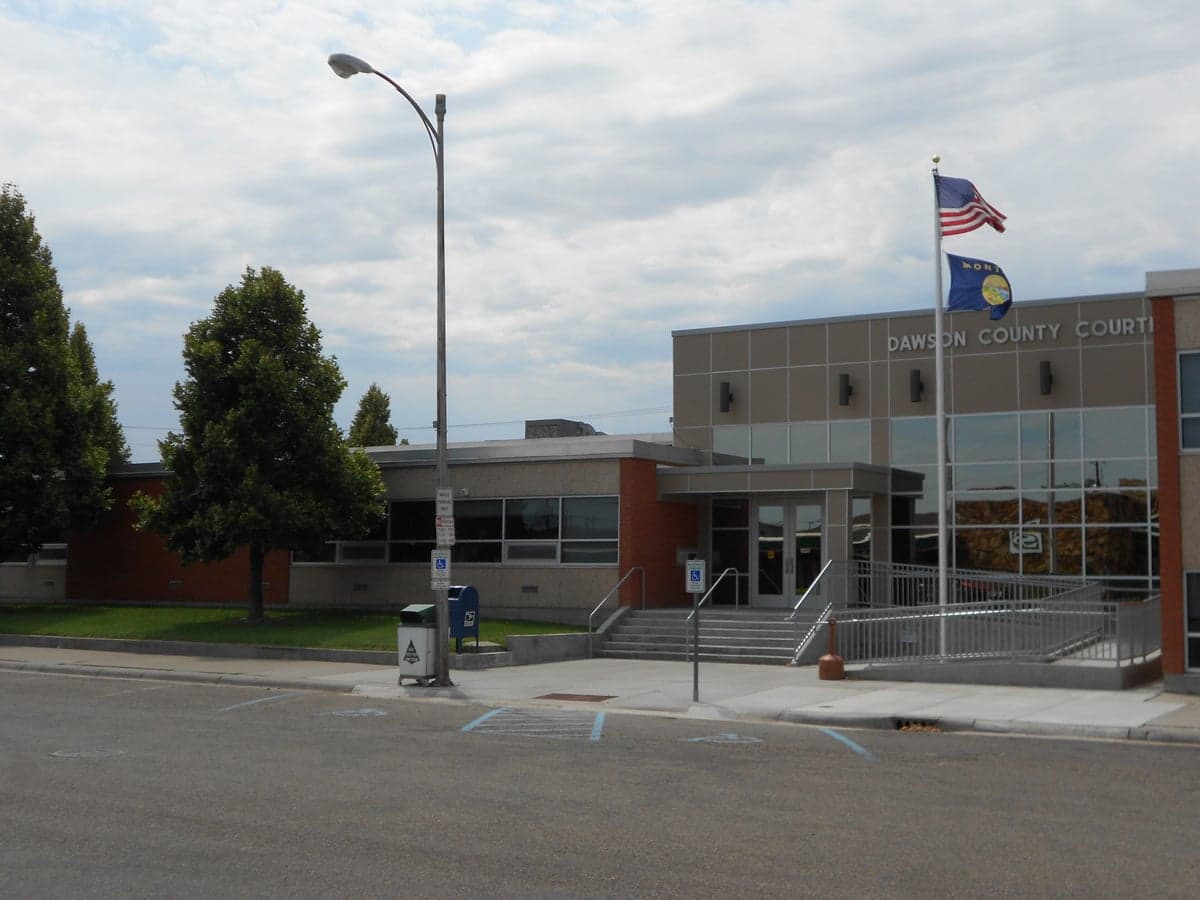
Photo: Wikipedia
Political ClimatePolitical Climate in Dawson County
Showing district-level results — no local-only data available.
Local Political AnalysisPolitical Analysis of Dawson County
Dawson County, Montana, is a reliably conservative area, with a Cook Partisan Voting Index (PVI) of R+15, making it significantly more Republican than the state of Montana as a whole, which sits at R+10. This isn't a new development; the county has voted for the Republican presidential candidate in every election this century, and the margins have only widened. The real story, though, is how this plays out on the ground, from the county seat of Glendive to the smaller communities like Richey and West Glendive, and what it means for the people who live there.
How it compares
The five-point gap between Dawson County's R+15 and Montana's R+10 is substantial in practical terms. While Montana is a red state with a strong libertarian streak, Dawson County is a deep red stronghold where conservative values are the baseline. In Glendive, the largest town and economic hub, you'll find the most political diversity, with a small but noticeable contingent of more moderate or even liberal-leaning residents, often tied to the college (Dawson Community College) or healthcare sectors. However, even in Glendive, the city council and county commission are dominated by conservatives. Drive 20 miles east to Richey, a farming community of under 200 people, and the political landscape is uniformly conservative. The swing precincts, if you can call them that, are in the newer subdivisions on the outskirts of Glendive, where a mix of younger families and oil-and-gas workers can sometimes produce a slightly less Republican vote, but it's a matter of degrees, not a flip. The rural precincts, by contrast, are as solidly red as any in the state.
What this means for residents
For a conservative resident, Dawson County feels like a place where their values are the norm. Local policy reflects this, from a general resistance to new gun control measures to a school board that tends to emphasize traditional curricula. For a liberal or moderate resident, the reality is more about finding your niche. You won't be ostracized, but you'll likely be in the minority in most public discussions. The practical impact is that progressive policy proposals, from zoning changes to environmental regulations, face an uphill battle. The county's economy is heavily tied to agriculture and energy (oil and gas from the Bakken formation), which reinforces a pro-business, limited-government ethos. There's a strong sense of self-reliance here; people expect to solve their own problems rather than look to government, and that sentiment is reflected in the low tax burden and minimal local bureaucracy.
Cultural and policy distinctions
The political climate in Dawson County isn't just about voting patterns; it's woven into daily life. You see it in the prevalence of "God Bless America" signs on Main Street in Glendive and the near-total absence of any visible progressive activism. The local newspaper, the Glendive Ranger-Review, reflects a conservative editorial stance. Policy-wise, the county has been a vocal participant in the state's debates over public lands access, generally favoring local control and resource extraction over federal oversight. The cultural tone is set by the region's history of ranching and farming—practical, independent, and skeptical of outside influence. While the Bakken oil boom brought an influx of workers from more diverse areas, it didn't shift the political needle much; if anything, it reinforced the pro-energy, pro-growth mindset. Looking ahead, the county's political trajectory seems set to stay the course, with the only potential for change being a slow demographic shift as Glendive attracts a few more retirees and remote workers, but that's a whisper, not a wave.

State Political ClimatePolitical Climate in Montana
State Political AnalysisPolitical Environment in the State
Montana has been a reliably Republican state for decades, with a Cook Partisan Voting Index of R+10, but the nature of that conservatism has shifted dramatically in the last ten to fifteen years. The state’s political center of gravity is no longer the old-school, pro-labor, pro-public lands Republicanism of the 1990s; it’s now a more aggressive, culturally conservative, and anti-federal government posture driven by a wave of new arrivals and a deepening urban-rural split. The key story is that while the state votes red at the presidential level by comfortable margins, the internal fight is between a growing, moderate-to-liberal bloc in the western mountain valleys and a deeply conservative, libertarian-leaning majority everywhere else.
Urban vs. rural divide
The political map of Montana is essentially a battle between the fast-growing, amenity-rich corridor along the Rocky Mountain front and the vast, depopulating plains to the east. The Democratic strongholds are shrinking to three main islands: Missoula, Bozeman, and Helena. Missoula County has voted Democratic in every presidential election since 1992, and Gallatin County (Bozeman) flipped blue in 2020 for the first time in decades, driven by an influx of young professionals and tech workers. Meanwhile, the eastern two-thirds of the state—places like Miles City, Glendive, and Sidney—routinely deliver 75-80% of their votes to Republicans. The real action is in the suburbs and exurbs of the growing cities. Billings, the largest city, is a bellwether: it leans Republican but has a sizable moderate contingent, while Kalispell and the Flathead Valley have become a hotbed of the new, more populist conservative movement, with county-level margins shifting rightward by 10-15 points since 2016. The divide isn't just east vs. west; it's high-growth, high-amenity areas versus the rest.
Policy environment
Montana’s policy environment is defined by a low-tax, low-regulation ethos that has been supercharged by the recent Republican supermajority. There is no state sales tax, and the top marginal income tax rate was cut from 6.9% to 5.9% in 2021, with further cuts tied to revenue triggers. Property taxes are relatively low by national standards but are a perennial local political issue, especially in fast-growing counties like Gallatin and Flathead where assessments have soared. The state is a "right-to-work" state and has a strong preemption law that prevents local governments from enacting their own gun control, minimum wage, or anti-discrimination ordinances that exceed state law. Education policy is a flashpoint: the state has a robust school choice movement, with a new Education Savings Account program passed in 2023, but rural districts often oppose it for fear of draining funding from local public schools. Election laws have tightened: the state now requires a photo ID to vote, same-day voter registration was eliminated in 2021, and the legislature has repeatedly tried to restrict mail-in voting, though it remains popular. Healthcare policy is a mixed bag; Montana expanded Medicaid under the Affordable Care Act in 2015, and that expansion was reauthorized in 2023 with a work requirement, a compromise that reflects the state's pragmatic streak.
Recent policy direction
The last four years have seen a dramatic rightward shift in state policy, particularly on cultural and liberty issues. In 2021, the legislature passed a near-total ban on abortion after 20 weeks, and in 2023 it passed a law effectively banning gender-affirming care for minors. On gun rights, Montana became a "Second Amendment Sanctuary State" in 2021, and in 2023 it passed a law prohibiting state and local law enforcement from enforcing federal gun laws that don't have a state equivalent. On property rights, the legislature passed a major "takings" bill in 2021 that requires the state to compensate landowners if a regulation reduces their property value by more than 30%, a direct challenge to environmental land-use rules. On privacy and surveillance, the state banned the use of facial recognition technology by police without a warrant in 2023. On education, the 2023 session passed a Parents' Bill of Rights that requires schools to notify parents of any curriculum related to sexuality or gender identity. On voting, the state passed a law in 2021 requiring a photo ID for all ballots, including mail-in, and banned ballot harvesting. The overall direction is toward maximizing individual liberty on guns and property while restricting it on abortion and transgender issues, and aggressively preempting local control.
Civil unrest & political movements
Montana has a long tradition of anti-government sentiment, but it has become more organized and visible in recent years. The Militia of Montana, based in Noxon, was a national force in the 1990s, and while its influence has waned, the spirit lives on in groups like the Montana Freedom Caucus, which has become a powerful faction within the state legislature. In 2020, protests over the murder of George Floyd in Missoula and Bozeman were large and peaceful, but they were met with counter-protests and a heavy law enforcement presence. The most visible flashpoint in recent years has been the fight over public lands: the "Sagebrush Rebellion" is alive and well, with local officials in counties like Beaverhead and Granite passing resolutions demanding the transfer of federal land to state control. Immigration politics are less of a daily issue than in border states, but the legislature passed a law in 2023 requiring local law enforcement to cooperate with federal immigration authorities. There have been no major election integrity controversies in Montana, though the 2020 election saw a recount in the state auditor's race that affirmed the result. A new resident would notice the prevalence of "Don't Tread on Me" flags and political bumper stickers, but actual civil unrest is rare outside of the occasional protest in Missoula.
Projection
Over the next five to ten years, Montana is likely to become more Republican at the state level but more internally divided. The in-migration from California, Washington, and Oregon is not uniformly liberal; many new arrivals are conservatives fleeing high taxes and regulation in their home states, and they are settling in places like the Flathead Valley and the Bitterroot, reinforcing the rightward shift. However, the growth of Bozeman and Missoula will continue to produce Democratic votes, potentially flipping a state legislative district or two every cycle. The real tension will be between the old-school, pro-business, pro-public lands Republicans and the new, more populist, anti-government faction. Expect continued fights over property taxes as assessments rise, more preemption battles between the state and liberal cities, and a likely push for a state constitutional convention to enshrine gun rights and limit taxation. The state's political trajectory is toward a more polarized, high-stakes version of its current self, with the rural-urban divide becoming the defining feature of every election.
For a new resident, the bottom line is this: if you are a conservative, you will find Montana's state government deeply aligned with your values on taxes, guns, and education, but you should be prepared for local politics in Missoula or Bozeman to feel like a different country. If you are a liberal, you will find the state government hostile to your priorities, but you will have strong community support in the western cities and a real ability to influence local school boards and city councils. The state is not a monolith, and the experience of living here depends almost entirely on which county you choose. The political climate is serious, engaged, and increasingly polarized, but it is also grounded in a shared culture of independence and self-reliance that still cuts across party lines.
* Values derived from national, state, county, city and local statistics and may differ in a specific area. Last updated: 2026-06-17T12:42:32.000Z
Narrative content on this page is AI-generated and may contain mistakes. Verify any details that matter before acting on them.
ReloMaps may earn a commission from affiliate links at no extra cost to you.

