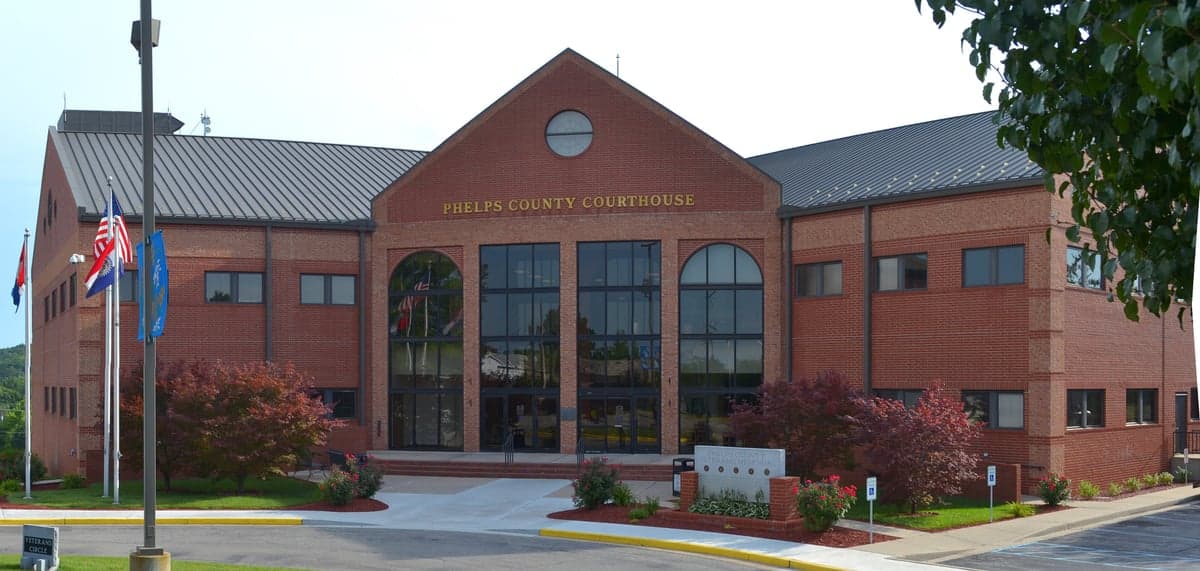
Photo: Wikipedia
Political ClimatePolitical Climate in Phelps County
Showing district-level results — no local-only data available.
Local Political AnalysisPolitical Analysis of Phelps County
Phelps County, Missouri, is a deeply conservative stronghold, carrying a Cook Partisan Voting Index (PVI) of R+27, making it one of the most reliably Republican counties in the state. This isn't a new development; the area has been trending red for decades, but the margin has widened considerably since the 1990s. To put it in perspective, the county votes about 19 points more Republican than the state of Missouri as a whole, which sits at R+8. If you're moving here, you're stepping into a place where the political landscape is overwhelmingly dominated by GOP candidates, though the story isn't quite as simple as a monolithic red wall.
How it compares
Missouri's R+8 rating already marks it as a solidly red state, but Phelps County's R+27 is a whole different ballgame. The difference is stark when you look at presidential elections: while Missouri has occasionally been competitive at the state level (think the 2018 Senate race), Phelps County hasn't been in play for a Democrat in a general election for generations. The county's politics are more akin to the deep-red rural Ozarks than the suburban swing areas of St. Louis or Kansas City. However, there's real variation within the county. Rolla, the county seat and home to Missouri S&T, is the most politically diverse area. While still Republican-leaning overall, the precincts around the university campus and downtown Rolla show a noticeable blue tint, with Democratic candidates occasionally pulling 40-45% of the vote in local races. In contrast, the smaller towns like St. James, Doolittle, and Newburg are overwhelmingly conservative, often voting 75-80% Republican. The unincorporated areas and rural precincts along I-44 are the deepest red, where a Republican primary win is effectively the general election. The swing precincts, if you can call them that, are the newer subdivisions on the outskirts of Rolla, where moderate Republicans and a growing number of transplants from more competitive states can make local races slightly less predictable.
What this means for residents
For conservative residents, Phelps County is a comfortable environment where their values are reflected in local policy and representation. The county commission, school boards, and municipal governments are almost entirely Republican, meaning lower taxes and a limited regulatory environment are the norm. For liberal or moderate residents, the reality is more about finding your niche. The Rolla area, particularly around the university, provides a social and political counterweight. You'll find like-minded folks in local Democratic clubs, at campus events, and in certain downtown businesses. However, it's important to be realistic: you won't see many Democratic campaign signs, and local political discourse is heavily tilted to the right. The practical impact is that policy debates tend to focus on issues like Second Amendment rights, school choice, and limiting government spending, rather than the urban-centric issues dominating state and national news.
Culturally, the county's political lean is deeply intertwined with its rural identity and the strong influence of local churches. There's a palpable sense of self-reliance and skepticism of federal authority. One notable policy distinction is the county's status as a "Second Amendment Sanctuary" area, a symbolic but meaningful gesture that reflects local sentiment. For newcomers, the key is understanding that while the politics are overwhelmingly red, the community is generally welcoming and neighborly on a personal level. Political arguments are rare at the grocery store; the divide is more visible in the types of events that draw crowds and the topics that dominate local Facebook groups. The trajectory is clear: Phelps County will remain a Republican stronghold for the foreseeable future, with the only real political action happening in the GOP primaries and the gradual, slight diversification of Rolla's electorate.

State Political ClimatePolitical Climate in Missouri
State Political AnalysisPolitical Environment in the State
Missouri has been a reliably Republican state for most of the 21st century, with a Cook Partisan Voting Index of R+8, meaning it votes about eight points more Republican than the nation as a whole. Over the last 10 to 20 years, the state has shifted rightward in presidential elections—from a competitive battleground that went for George W. Bush by 7 points in 2004 to a solid red state where Donald Trump won by 15 points in 2016 and 18.5 points in 2020. The driving force has been the exodus of rural and small-town voters from the Democratic coalition, combined with the realignment of white working-class voters in the St. Louis and Kansas City exurbs. However, the state is not a monolith: the two major metro areas remain Democratic strongholds, and a handful of suburban counties have trended the other direction, creating a sharp urban-rural split that defines every statewide election.
Urban vs. rural divide
The political map of Missouri is essentially a tale of two blue islands in a red sea. St. Louis City and Kansas City are the state's most reliably Democratic jurisdictions, routinely delivering 75-80% of their votes to Democratic presidential candidates. Their inner-ring suburbs—like Clayton, University City, and Kansas City's Northland—also lean blue, though less overwhelmingly. The real story is in the fast-growing exurbs and rural counties. St. Charles County, just west of St. Louis, has become a Republican stronghold, voting 60-65% Republican in recent cycles. Greene County (Springfield) and Christian County are deeply red, with the latter often exceeding 75% Republican. The Bootheel and northern Missouri—places like Cape Girardeau, Sikeston, and Kirksville—are solidly Republican, though some of these areas have seen their Democratic minorities shrink to near-irrelevance. The one notable exception is Boone County (Columbia), home to the University of Missouri, which has trended blue and now reliably votes Democratic, making it a small but significant counterweight in mid-Missouri.
Policy environment
Missouri's policy environment is broadly conservative, with a few populist and libertarian streaks. The state has a flat income tax rate of 4.95% (down from 5.4% in 2022, with further cuts triggered by revenue growth), and no estate or inheritance tax. Sales taxes are relatively high, averaging around 8.3% combined state and local, but property taxes are among the lowest in the country—about 0.9% of assessed value. The state is a "right-to-work" state (though that law was repealed by referendum in 2018, only to be effectively reinstated via a 2020 ballot measure that made union dues opt-in). Education policy leans toward school choice: Missouri has charter schools in St. Louis and Kansas City, a robust open enrollment law, and a tax-credit scholarship program for private school tuition. Healthcare policy is mixed—the state expanded Medicaid under the Affordable Care Act via a 2020 ballot initiative, but the legislature has resisted further expansion and has imposed work requirements (currently tied up in court). Election laws have tightened: the state now requires photo ID to vote, limits absentee ballot drop boxes, and bans private funding of election administration. Gun laws are among the most permissive in the nation, with permitless carry (constitutional carry) enacted in 2016 and a "Second Amendment Preservation Act" passed in 2021 that purports to nullify federal gun laws.
Recent policy direction
The last five years have seen Missouri move decisively in a conservative direction on most fronts. On gun and self-defense law, the 2021 Second Amendment Preservation Act (SAPA) is the most aggressive state-level nullification effort in the country, declaring certain federal gun laws "invalid" and prohibiting state and local law enforcement from enforcing them. On parental and education rights, the legislature passed a 2022 law banning instruction on sexual orientation and gender identity in K-3 classrooms (the "Don't Say Gay" bill), and in 2023 expanded it through 12th grade, while also restricting transgender students' participation in sports and access to gender-affirming care for minors. On speech and privacy, Missouri has a broad anti-SLAPP law protecting free speech, but also passed a 2023 law restricting social media platforms from "censoring" political speech (currently blocked by a federal court). On medical and bodily autonomy, abortion is banned at all stages of pregnancy with limited exceptions (rape, incest, and medical emergency), following the 2022 trigger law that took effect after Dobbs. A 2024 ballot initiative to restore abortion access is pending. On property rights, the state has strong eminent domain protections and a 2022 law limiting local governments' ability to regulate short-term rentals. On taxation, the legislature has passed multiple income tax rate cuts, with a path to a 4.5% rate by 2027. On voting and ballot access, the 2022 photo ID law and restrictions on absentee voting have made it harder to vote, though turnout remains relatively high.
Civil unrest & political movements
Missouri has a history of political flashpoints, most notably the 2014 Ferguson protests following the police shooting of Michael Brown, which sparked a national movement and led to federal consent decrees for the St. Louis County Police Department and the city of Ferguson. Since then, the state has seen periodic protests over police brutality, racial justice, and abortion rights, particularly in St. Louis and Kansas City. On the right, the "Second Amendment Preservation Act" has made Missouri a focal point for the gun rights movement, and the state has seen organized opposition to COVID-19 mandates, including a 2021 lawsuit by the attorney general against local health orders. Immigration politics are less visible than in border states, but the legislature has passed laws banning sanctuary cities and requiring law enforcement to cooperate with federal immigration authorities. Election integrity has been a recurring issue: the 2020 election saw Trump's narrow loss in Missouri (he won by 15 points, but some counties saw close races) and subsequent audits found no widespread fraud, but the legislature has nonetheless tightened voting laws. Secession or nullification rhetoric is present but marginal; the SAPA is the most concrete example, and a 2022 bill to allow Missouri to secede from the U.S. was introduced but went nowhere. A new resident would notice the political divide most acutely in the contrast between St. Louis and the rest of the state, but daily life is generally calm, with political activism concentrated in the metro areas and on social media.
Projection
Over the next 5-10 years, Missouri is likely to remain solidly Republican, but the margin may narrow slightly as the St. Louis and Kansas City suburbs continue to trend Democratic and as in-migration from other states brings more moderate voters. The state's population growth is modest (about 0.5% annually), with most growth in the exurbs of St. Louis and Kansas City, and in college towns like Columbia and Springfield. The rural areas are losing population, which will slowly reduce the Republican base. However, the state's political institutions—the legislature, the governorship, and the courts—are firmly in Republican hands, and the party's dominance is likely to persist. The key wildcard is the 2024 abortion rights ballot initiative: if it passes, it could reshape the electorate by mobilizing Democratic-leaning voters and potentially flipping some suburban districts. But even then, the state's overall lean is unlikely to change dramatically. A new resident moving in now should expect a state where conservative policies are the norm, but where the two major metros offer a more liberal environment, and where the political debate is increasingly defined by the urban-rural divide rather than by traditional left-right economic issues.
For a new resident, the bottom line is that Missouri offers a low-tax, gun-friendly, and culturally conservative environment outside of the major cities, with a strong emphasis on local control and limited government. If you lean conservative, you'll find a state that largely aligns with your values, with a legislature that is actively pushing in that direction. If you lean liberal, you'll find a state where your vote in statewide elections is largely symbolic, but where you can still find like-minded communities in St. Louis, Kansas City, and Columbia, and where local elections in those cities can make a real difference. The state's political trajectory is clear, but it's not a monolith—and the urban-rural divide means that where you live within Missouri matters as much as the state's overall lean.
* Values derived from national, state, county, city and local statistics and may differ in a specific area. Last updated: 2026-06-20T19:26:05.000Z
Narrative content on this page is AI-generated and may contain mistakes. Verify any details that matter before acting on them.
ReloMaps may earn a commission from affiliate links at no extra cost to you.

