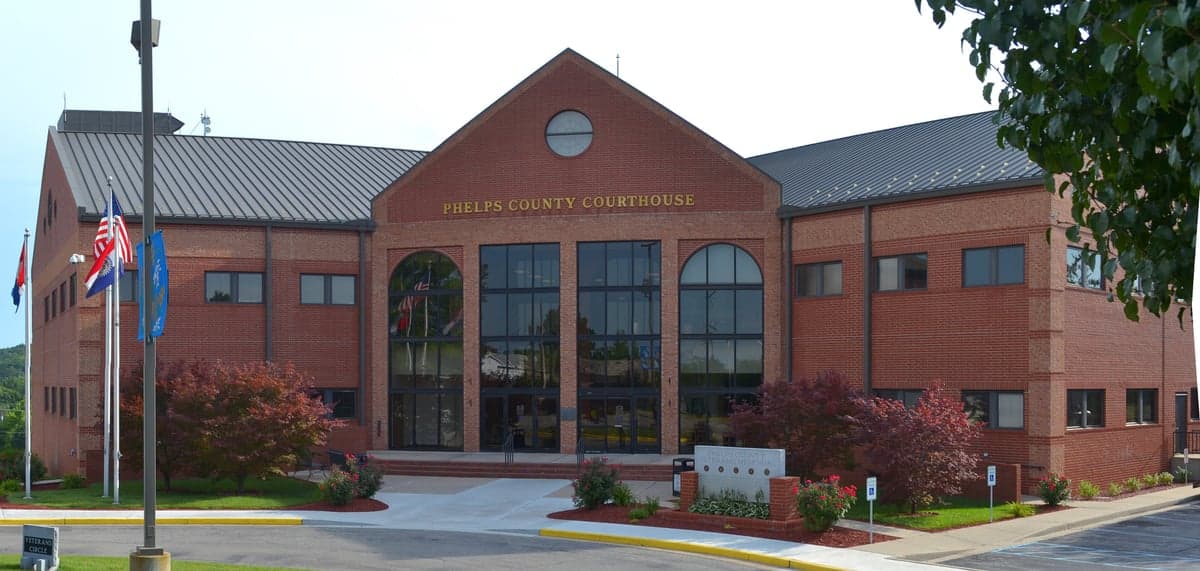
Photo: Wikipedia
Demographics of Phelps County
Affluence Level in Phelps County
A middle-class area roughly in line with national averages across income, home values, education, and employment.
People of Phelps County
Phelps County, Missouri, is home to roughly 44,948 residents, a population that remains predominantly white (85.7%) with a notably low foreign-born share of just 2.8%. The county’s character is shaped by its historic role as a crossroads of the Ozarks, anchored by the city of Rolla, a hub for engineering and higher education that gives the area a modestly college-educated workforce (31.5%). Distinctive identity markers include a strong local pride in the Missouri University of Science and Technology (Missouri S&T), a legacy of German and Scotch-Irish settlement, and a political and cultural leaning that is conservative but tempered by the academic influence of the university.
Settlement & growth (pre-1960)
Before American settlement, the land now comprising Phelps County was inhabited by Osage and Delaware Native nations, who used the region for hunting and seasonal camps. The area was part of the Louisiana Purchase of 1803, and early American explorers and fur traders passed through along the Gasconade and Meramec rivers. Permanent settlement began in earnest in the 1820s and 1830s, with pioneers of primarily Scotch-Irish and English descent moving into the Ozark uplands from Kentucky, Tennessee, and the Carolinas. These early settlers were drawn by cheap land and the promise of subsistence farming, establishing small communities like Newburg, St. James, and Doolittle.
The arrival of the railroad in the 1850s transformed the county. The Southwest Branch of the Pacific Railroad (later the Frisco line) reached the area, and the town of Rolla was platted in 1857 as a station stop. The railroad brought a second wave of settlers: German immigrants, who arrived in the 1850s and 1860s, many of them moving directly from the Old Country or from the German settlements of St. Louis and the Missouri River valley. These Germans established farms and businesses around Rolla and St. James, and their influence is still visible in local Lutheran churches and family names. During the Civil War, Phelps County was deeply divided, with Union and Confederate sympathizers clashing; the county’s population actually declined during the war years.
After the war, the discovery of iron ore and lead in the region spurred a mining boom. The town of St. James became a center for iron mining and smelting, while Newburg grew as a railroad and mining town. The late 19th century also saw the establishment of the Missouri School of Mines (now Missouri S&T) in Rolla in 1870, which began attracting faculty, engineers, and their families from across the country. This institution would become the single most important demographic force in the county for the next century. By 1900, the population was overwhelmingly native-born white, with a small Black community concentrated in Rolla and St. James, many of whom were descendants of freed slaves who had worked in the mines and on railroads. The Dust Bowl and Great Depression of the 1930s brought a modest influx of displaced farmers from Oklahoma and Arkansas, but Phelps County’s population growth remained slow through the 1940s and 1950s, hovering around 20,000.
Modern era (post-1965)
The post-1965 era brought gradual but significant change to Phelps County, driven primarily by the expansion of Missouri S&T and the growth of the U.S. Interstate highway system (I-44 was completed through the county in the 1960s). The Hart-Cellar Act of 1965 had a muted direct effect here compared to coastal regions, but it did open the door for a small but steady stream of international students and faculty at the university. Today, the county’s foreign-born population is just 2.8%, but that figure is concentrated in Rolla, where East/Southeast Asian communities (2.6% of the county’s total) and Indian-subcontinent residents (0.7%) have formed a visible presence. These are almost entirely university-affiliated families — graduate students, researchers, and professors — and they tend to live in neighborhoods near the campus, such as the areas around 10th Street and Bishop Avenue in Rolla.
Domestic migration has been more consequential. Since the 1970s, Phelps County has attracted retirees and families from the Rust Belt and the St. Louis metro area, drawn by lower housing costs, a slower pace of life, and the natural beauty of the Ozarks. The Hispanic population, now 3.0%, grew steadily from the 1990s onward, with many families settling in Rolla and St. James to work in construction, poultry processing, and the service industry. The Black population remains small at 2.0%, with most living in Rolla and a smaller cluster in Newburg. Suburbanization has been modest but real: the unincorporated areas around Rolla, especially along Highway 63 and Highway 68, have seen new subdivisions of single-family homes, while the small towns of Edgar Springs and Doolittle have remained largely static in population. The county’s overall population grew from about 35,000 in 1970 to nearly 45,000 today, a steady but unspectacular increase.
The future
Phelps County is likely to become slightly more diverse over the next 10-20 years, but the pace of change will remain slow. The university will continue to attract international students and faculty, and some of those individuals will stay after graduation, particularly in engineering and tech fields. The East/Southeast Asian and Indian-subcontinent populations will likely grow as a share of the total, but they will remain concentrated in Rolla. The Hispanic population is expected to increase gradually, driven by both domestic migration and natural increase, and may spread into St. James and Newburg as housing affordability in Rolla tightens. The white population, while still the overwhelming majority, will continue to age, and the county will need to attract younger families to offset natural decline. New residential development is most likely along the I-44 corridor and the southern edge of Rolla, where land is available for subdivisions. The cultural identity of the county will remain rooted in its Ozarks heritage and university-town character, but it will become more visibly multicultural in Rolla’s schools and public spaces.
For someone moving in now, Phelps County offers a stable, affordable, and safe environment with a conservative-leaning culture, a strong sense of local history, and the intellectual anchor of Missouri S&T. The population is not changing rapidly, but it is diversifying in small, meaningful ways, particularly in Rolla. New residents will find a community that values tradition, education, and the outdoors, with a demographic profile that is likely to remain predominantly white and native-born for the foreseeable future.

* Values derived from national, state, county, city and local statistics and may differ in a specific area. Last updated: 2026-06-20T19:26:05.000Z
Narrative content on this page is AI-generated and may contain mistakes. Verify any details that matter before acting on them.
ReloMaps may earn a commission from affiliate links at no extra cost to you.

