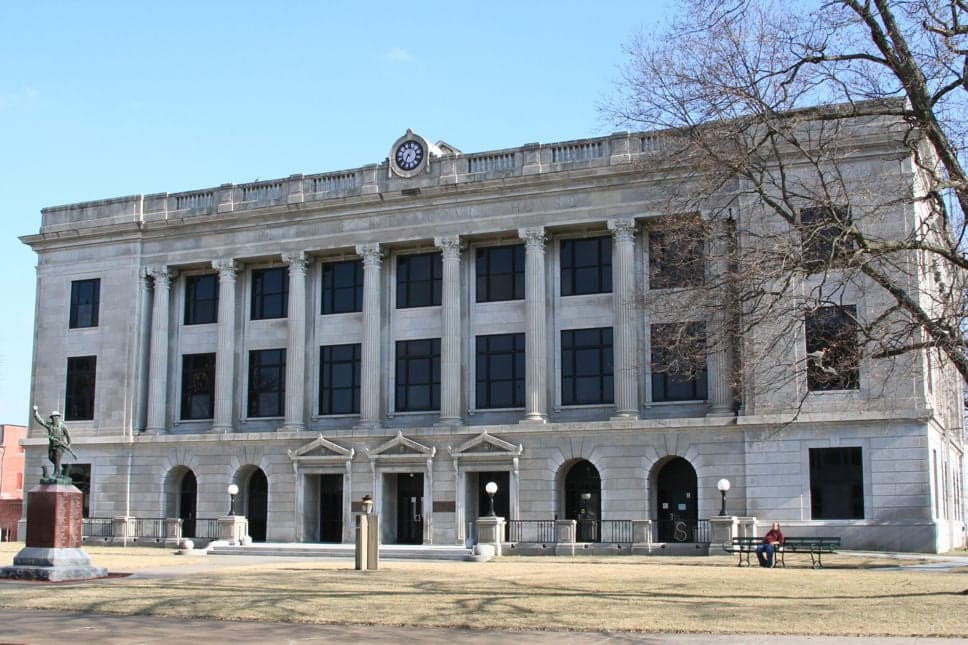
Photo: Wikipedia
Political ClimatePolitical Climate in Pettis County
Showing district-level results — no local-only data available.
Local Political AnalysisPolitical Analysis of Pettis County
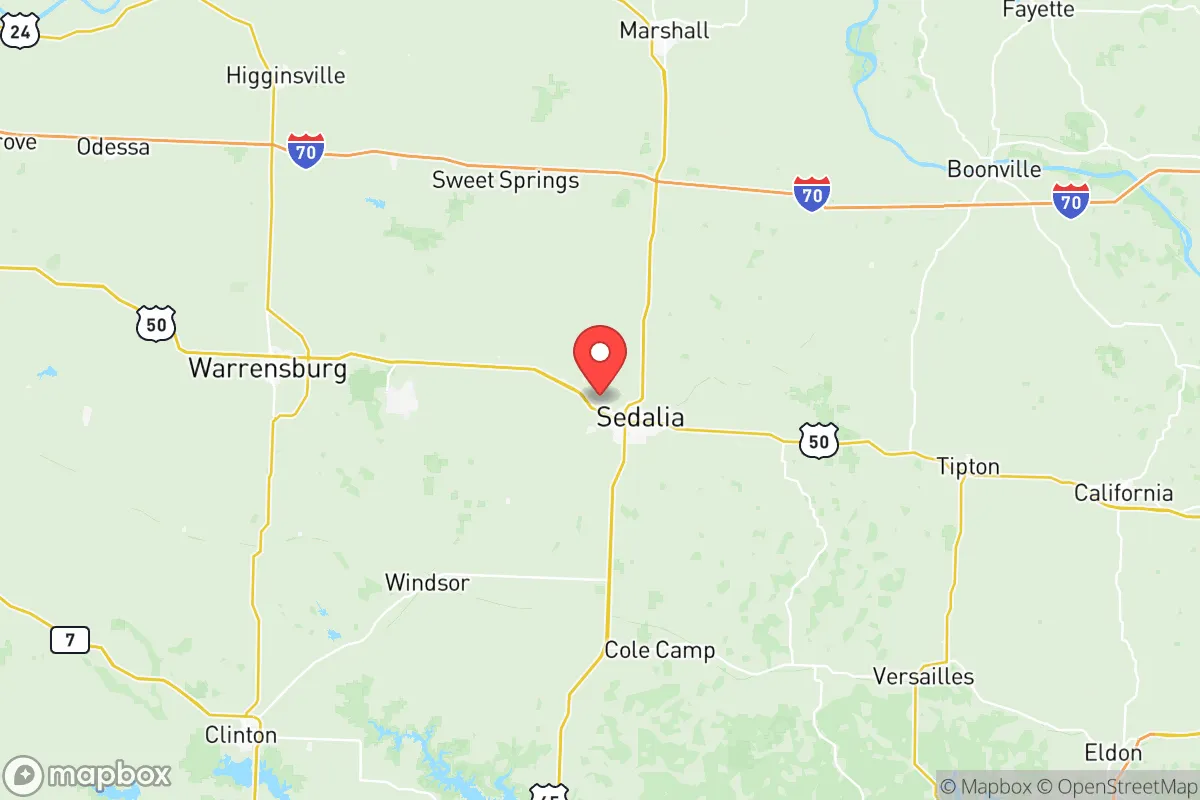
Pettis County is a reliably Republican stronghold, with a Cook PVI of R+21 that makes it significantly more conservative than the state of Missouri as a whole, which sits at R+8. The county has been trending redder over the past decade, driven by rural voters and a growing population of retirees and commuters who work in Whiteman Air Force Base or commute to Kansas City. While the county seat, Sedalia, shows some Democratic-leaning precincts near the State Fair Community College campus and the downtown core, the surrounding towns like La Monte, Smithton, and Green Ridge vote overwhelmingly Republican. The rural precincts east of Sedalia, along Highway 50 toward Otterville, are among the most conservative in the county, often delivering 75-80% of the vote for GOP candidates.
How it compares
Pettis County's R+21 rating is more than double the state's R+8 lean, placing it in the top 15% of Missouri's most Republican counties. This gap has widened since 2016, as the county shifted rightward faster than the state average. In the 2020 presidential election, Pettis County gave Donald Trump 72% of the vote, compared to 57% statewide. The Democratic vote is concentrated in Sedalia's Ward 1 and Ward 2 precincts, where union households and faculty from the college create pockets of blue. However, even those precincts have been trending right: Ward 1 went from 55% Democratic in 2012 to 48% in 2020. The county's trajectory suggests it will remain deeply Republican for the foreseeable future, with no major demographic shifts on the horizon that would alter the balance.
What this means for residents
For conservative residents, Pettis County offers a political environment where their views are the clear majority. Local elected offices, from the county commission to the sheriff, are held by Republicans, and policy decisions reflect that — including lower property tax rates compared to more urban counties and a strong emphasis on Second Amendment rights. For liberal residents, the reality is more isolating. There are no Democratic elected officials at the county level, and progressive candidates rarely run competitive races. Socially, it can be difficult to find like-minded neighbors, though Sedalia's downtown arts scene and the college community provide some refuge. The practical impact is that local policy debates tend to be one-sided, with little public pushback on issues like zoning, school funding, or law enforcement priorities. Both sides should expect the political climate to remain stable, with no major shifts likely in the next decade.
Culturally, Pettis County's politics are shaped by its agricultural roots and military presence. Whiteman Air Force Base, located just south of Knob Noster, brings in a transient population that tends to lean conservative but is less engaged in local politics. The Missouri State Fair, held annually in Sedalia, reinforces the county's rural identity and draws visitors from across the state. Policy-wise, the county has resisted Medicaid expansion implementation and maintains a strong pro-life stance, with no abortion providers in the county. The local school board in Sedalia has seen occasional controversy over curriculum choices, but these debates rarely shift the overall political balance. For anyone moving here, the key takeaway is that Pettis County is a place where conservative values dominate daily life, and newcomers should be comfortable with that reality.

State Political ClimatePolitical Climate in Missouri
State Political AnalysisPolitical Environment in the State
Missouri has been a reliably Republican state for most of the 21st century, carrying a Cook Partisan Voting Index of R+8, but it wasn't always this way. As recently as the 1990s and early 2000s, it was the ultimate bellwether, voting for the winner in every presidential election from 1904 to 2004 except one. That changed decisively after 2008, when the state lurched right, driven by the collapse of the rural Democratic brand and the exodus of moderate voters from the St. Louis and Kansas City metros into increasingly blue enclaves. Today, the state is a solid red stronghold in statewide races, but it's a far more complex patchwork at the local level than the R+8 label suggests.
Urban vs. rural divide
The political map of Missouri is a classic study in geographic polarization. The two major population centers — St. Louis City and County and Kansas City — are deep blue, often delivering 70-80% of their votes to Democratic candidates. These metros are surrounded by deep-red suburbs and exurbs like St. Charles County and Clay County, which have become reliably Republican strongholds. The rest of the state — the Ozarks, the Bootheel, and the rural northern plains — votes overwhelmingly Republican. The real story is in the second-ring suburbs and mid-sized cities. Springfield, the state's third-largest city, is a conservative bastion, while Columbia, home to the University of Missouri, is a liberal island in a red sea. Jefferson City, the capital, leans conservative but is more moderate than the surrounding countryside. The state's political center of gravity has shifted south and west, away from the historically Democratic St. Louis and toward the fast-growing, conservative Springfield and Branson corridor.
Policy environment
Missouri's policy environment is unmistakably conservative. The state has a flat income tax rate of 4.8% (with a scheduled phase-down to 4.5% by 2027), a low corporate tax rate, and no estate tax. It is a right-to-work state (though the law was repealed by ballot initiative in 2018, only to be effectively reinstated by the legislature in 2021), and it has some of the weakest labor union protections in the country. On education, Missouri has a robust charter school presence in Kansas City and St. Louis, and a growing school choice movement, though it has not yet passed a universal voucher program. The state's healthcare landscape is defined by its refusal to expand Medicaid under the ACA until voters forced the issue via a 2020 ballot initiative; the expansion was implemented in 2021. Election laws have tightened: the state now requires a government-issued photo ID to vote, limits absentee voting, and bans ballot drop boxes. Missouri also has some of the most permissive gun laws in the nation, including permitless carry and a "Stand Your Ground" law.
Recent policy direction
The last five years have seen Missouri's legislature push aggressively on cultural and liberty-related issues. In 2021, the state passed a near-total ban on abortion, with no exceptions for rape or incest, which took effect immediately after the Dobbs decision. On gun rights, the Second Amendment Preservation Act (SAPA) was signed in 2021, purporting to nullify federal gun laws — a move that has been partially blocked by federal courts but remains a symbolic flashpoint. On education, the state passed a Parents' Bill of Rights in 2022, requiring schools to notify parents of curriculum changes and allowing them to opt their children out of certain materials. On property rights, Missouri has a strong right-to-farm amendment and has resisted local zoning preemptions. On privacy and surveillance, the state has banned the use of facial recognition technology by law enforcement in most circumstances. On voting, the 2022 election law tightened ID requirements and shortened the absentee voting window. On medical and bodily autonomy, the state has banned gender-affirming care for minors and restricted transgender athletes' participation in school sports. The overall direction is toward a maximalist interpretation of individual liberty on guns and property, combined with a restrictive approach on social and medical issues.
Civil unrest & political movements
Missouri has been a flashpoint for national political movements. The 2014 Ferguson protests, sparked by the police shooting of Michael Brown, put the state at the center of the Black Lives Matter movement and led to a federal consent decree for the Ferguson Police Department. More recently, the state has seen organized opposition to COVID-19 mandates, with rural counties and the attorney general's office challenging mask and vaccine requirements. Immigration politics are less visible here than in border states, but there have been local controversies over sanctuary city policies in St. Louis and Kansas City, which the state legislature has repeatedly tried to preempt. Election integrity has been a major theme since 2020, with the state conducting a controversial audit of St. Louis County's election results and passing the aforementioned voter ID law. There is a small but vocal secessionist movement in rural areas, particularly in the Ozarks, where some counties have passed resolutions calling for a "State of Ozark" or similar breakaway proposals. These are largely symbolic but reflect deep distrust of both St. Louis and Washington.
Projection
Over the next 5-10 years, Missouri is likely to become more, not less, conservative at the state level. The rural population is shrinking, but the exurbs and mid-sized cities like Springfield and Branson are growing, and they vote even more Republican than the rural areas they replace. The Democratic strongholds of St. Louis and Kansas City are losing population, which reduces their political clout. However, the suburbs of those cities — places like St. Charles County and Clay County — are becoming more diverse and could shift toward the center over time, especially if national trends toward suburban moderation continue. The biggest wildcard is in-migration: Missouri is seeing an influx of conservative-leaning retirees and remote workers from Illinois and California, drawn by low taxes and a lower cost of living. This will likely reinforce the state's red tilt. A new resident moving in now should expect a state that remains solidly Republican in statewide races, with a legislature that continues to push conservative cultural policies, but with persistent urban-rural tensions that will keep local politics volatile.
For a new resident, the bottom line is that Missouri offers a low-tax, low-regulation environment with strong protections for gun owners and property rights, but it also comes with a restrictive social policy landscape, particularly on abortion and transgender rights. If you lean conservative, you'll find a state that largely aligns with your values and is trending your direction. If you lean liberal, you'll find vibrant blue cities in St. Louis, Kansas City, and Columbia, but you'll be living in a state where your vote has limited impact on statewide outcomes. Either way, the political climate is stable in its direction, if not always calm in its execution.
* Values derived from national, state, county, city and local statistics and may differ in a specific area. Last updated: 2026-06-22T15:05:42.000Z
Narrative content on this page is AI-generated and may contain mistakes. Verify any details that matter before acting on them.
ReloMaps may earn a commission from affiliate links at no extra cost to you.

