Photo: Wikipedia
Demographics of Pettis County
Affluence Level in Pettis County
A middle-class area roughly in line with national averages across income, home values, education, and employment.
People of Pettis County
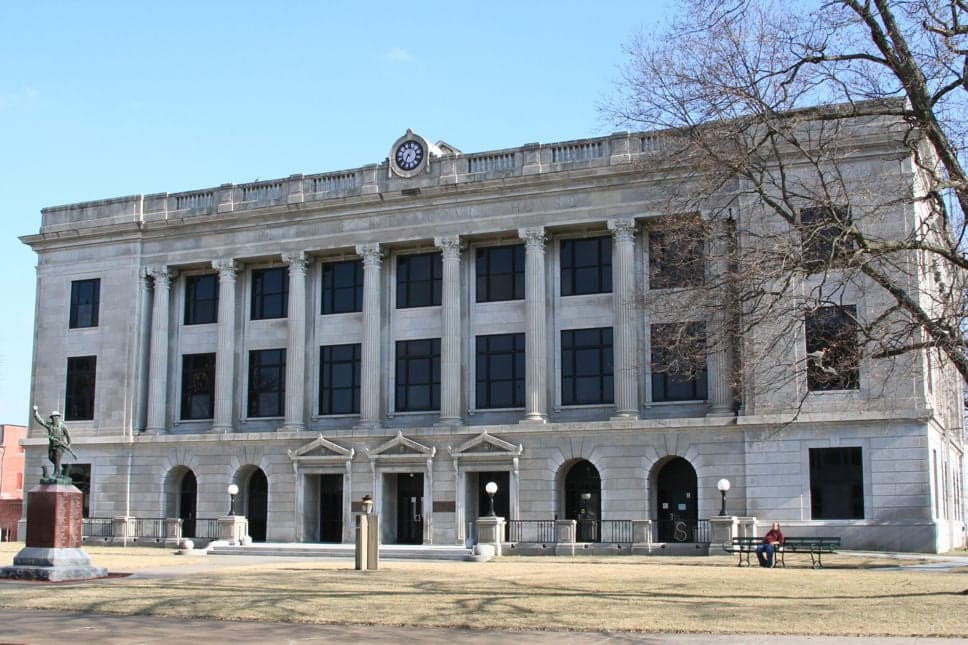
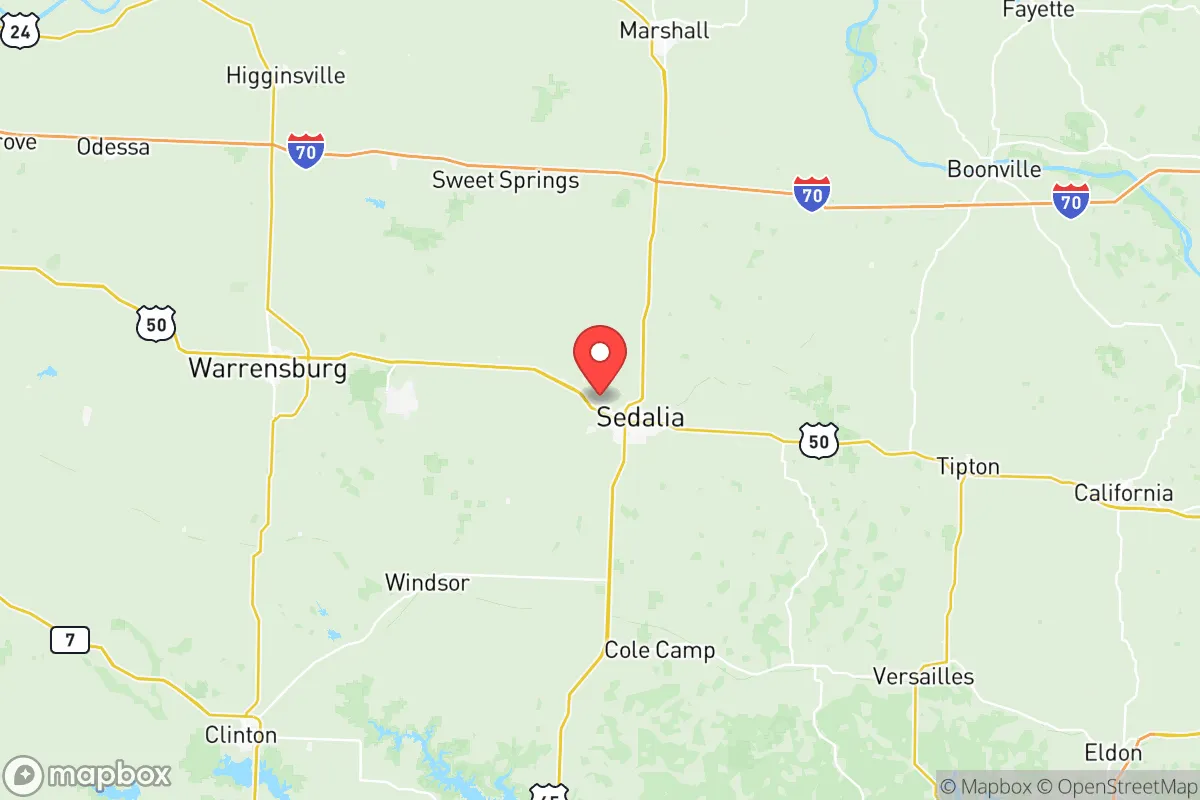
Pettis County, Missouri, is home to roughly 43,200 residents, a population that remains predominantly white (82.6%) with a growing Hispanic minority (9.6%) and small Black (2.5%) and Asian (0.6%) communities. The county's character is shaped by its agricultural and manufacturing roots, centered on the county seat of Sedalia, with a population density of about 53 people per square mile. Distinctive identity markers include a strong connection to the Missouri State Fair, held annually in Sedalia since 1901, and a cultural identity that blends rural Midwestern conservatism with the working-class heritage of the railroad and manufacturing industries that built the area. With a foreign-born population of just 3.8% and a college attainment rate of 18.6%, Pettis County remains a place where native-born, blue-collar values predominate, though demographic shifts are slowly diversifying its historically homogeneous population.
Settlement & growth (pre-1960)
Before American settlement, the land that is now Pettis County was part of the traditional territory of the Osage Nation, who used the area for hunting and seasonal habitation. The Osage were forcibly removed through a series of treaties in the early 19th century, culminating in the 1825 Treaty of St. Louis, which ceded their claims to most of Missouri. The first permanent American settlers arrived in the 1820s and 1830s, primarily of Scots-Irish and English descent, moving westward from Kentucky, Tennessee, and Virginia along the Boone's Lick Trail. These early settlers were drawn by cheap land under the 1820 Land Act and the promise of fertile prairie soil for farming. The county was officially organized in 1833, named after Missouri politician Spencer Darwin Pettis, and the first county seat was established at Georgetown, a small settlement that served as the initial population center.
The most transformative event in Pettis County's early history was the arrival of the Pacific Railroad in the 1860s. The railroad chose Sedalia as a major junction and depot, and the town was platted in 1857, quickly eclipsing Georgetown as the county's economic and population hub. The railroad brought a wave of Irish immigrants in the 1860s and 1870s, who worked as laborers laying track and building the rail yards. Many of these Irish families settled in Sedalia's near-north side, establishing St. Patrick's Catholic Church in 1868 as a cultural anchor. Simultaneously, German immigrants began arriving in the 1850s through the 1880s, drawn by the same railroad construction and the opportunity to farm the rich bottomlands along the Lamine and Petite Saline rivers. German farming communities took root in the rural areas around Smithton, Hughesville, and La Monte, where Lutheran churches and German-language newspapers persisted into the early 20th century.
Following the Civil War, African Americans migrated to Pettis County as part of the broader post-emancipation movement. Many came from the cotton-growing regions of central and western Missouri, seeking work on railroads, in the coal mines that opened around Beaman and Green Ridge, and as farm laborers. Sedalia developed a distinct Black community centered on the west side, with institutions like the Lincoln School (established 1868) and the Scott Joplin House, where the famous ragtime composer lived in the 1890s. The Black population peaked around 1900 at roughly 12% of the county total, before the Great Migration drew many families north to Kansas City and Chicago. The early 20th century also saw a small influx of Italian immigrants, who worked in the coal mines and railroad yards, settling primarily in Sedalia and the mining camp at Beaman. By 1920, the county's population had grown to over 35,000, with Sedalia as the dominant urban center and a network of small farming towns—Windsor, Lincoln, Cole Camp—serving as rural trade hubs.
Modern era (post-1965)
The post-1965 period brought gradual demographic change to Pettis County, though the region did not experience the dramatic immigration-driven transformation seen in coastal or Sun Belt metros. The most significant shift has been the growth of the Hispanic population, which rose from less than 1% in 1980 to 9.6% by the 2020s. This growth is primarily driven by Mexican-origin families who arrived from the 1990s onward, drawn by jobs in Sedalia's meatpacking and food-processing plants, particularly at the Tyson Foods facility (formerly Hudson Foods) and the MFA Oil plant. These workers settled initially in Sedalia's south and east sides, with a growing concentration in mobile home parks and older housing stock near the industrial corridors. A smaller number of Hispanic families have also settled in La Monte and Smithton, where agricultural work in row crops and livestock provides employment.
The Asian population, at 0.6%, is small and consists primarily of East and Southeast Asian communities—Vietnamese and Filipino families—who arrived in the 1980s and 1990s, many as secondary migrants from larger Missouri cities like Kansas City and St. Louis. They work in healthcare (Bothwell Regional Health Center in Sedalia) and manufacturing, with no distinct ethnic enclave but a visible presence in Sedalia's professional and service sectors. The Indian subcontinent population is negligible at 0.1%, represented by a handful of professionals and business owners. The Black population has declined from its historical peak to 2.5%, as outmigration to larger cities continued through the late 20th century, though a stable community remains in Sedalia's west side, anchored by churches like Mount Olive Baptist Church and the George R. Smith College historic site.
Domestic migration patterns have been modest. Pettis County has not experienced the rapid suburbanization seen in Missouri's growth corridors like St. Charles or Boone counties. Instead, the county has seen slow population growth—roughly 3% since 2000—driven by natural increase and Hispanic in-migration, offset by the outmigration of young adults to college towns and urban job centers. The county's population is aging, with a median age of 39.5, slightly above the state average. Suburbanization has been limited to the fringes of Sedalia, where new subdivisions have attracted some commuters who work in the county but prefer newer housing. The rural towns—Green Ridge, Houstonia, Sweet Springs—have generally lost population as young people leave and agricultural consolidation reduces the need for farm labor.
The future
Pettis County is projected to become slightly more diverse over the next 10-20 years, driven primarily by continued Hispanic population growth. The Hispanic share could reach 12-15% by 2040, as younger Hispanic families have higher birth rates and continued migration from Mexico and other Latin American countries fills labor demand in food processing and agriculture. The white population will continue to age and decline slowly, while the Black and Asian shares are likely to remain stable or grow marginally. The foreign-born population, currently 3.8%, may rise to 5-6% as immigrant communities become more established and attract secondary migration from relatives.
New communities are likely to concentrate in Sedalia's south and east sides, where industrial employment is located, and in the unincorporated areas around Beaman and La Monte, where affordable housing and agricultural work are available. The county's cultural identity is evolving from a historically homogeneous, native-born white population toward a more pluralistic community, though change is gradual and unlikely to fundamentally alter the county's conservative, rural character. The Missouri State Fair, the county's largest annual event, increasingly reflects this diversity with Hispanic vendors and performers alongside traditional agricultural exhibits.
For someone moving in now, Pettis County offers a stable, affordable, and community-oriented environment where demographic change is slow enough to be manageable but real enough to bring new cultural influences. The county is becoming a place where the old agricultural and railroad heritage coexists with a newer, more diverse working class, particularly in Sedalia. The key trend to watch is whether the county can retain its young adults and attract new residents from outside the region, or whether slow decline in the rural towns will continue while Sedalia absorbs most of the growth. For families seeking a low-cost, safe, and traditional Midwestern setting with modest diversity, Pettis County represents a middle path—changing, but not transformed.

* Values derived from national, state, county, city and local statistics and may differ in a specific area. Last updated: 2026-06-22T15:05:42.000Z
Narrative content on this page is AI-generated and may contain mistakes. Verify any details that matter before acting on them.
ReloMaps may earn a commission from affiliate links at no extra cost to you.

