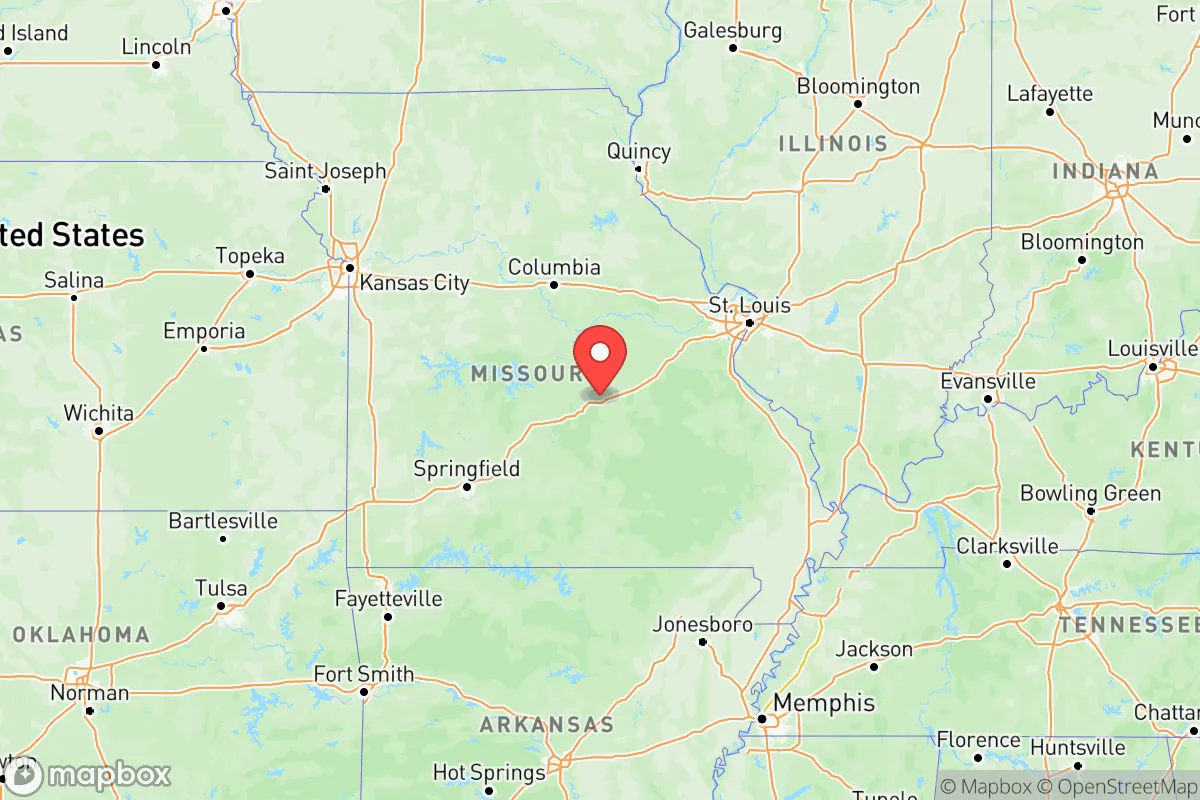
Photo: Wikipedia
Demographics of Missouri
Affluence Level in Missouri
An upper-middle-class area. Household wealth, education levels, and homeownership run ahead of national benchmarks.
People of Missouri
Missouri’s 6.2 million residents today form a state of distinct regional identities, blending Midwestern steadiness with Southern and frontier influences. The population is 76.8% white, 11.0% black, 5.1% Hispanic, and 2.1% foreign-born, with a college attainment rate of 31.9%. This is a state where the urban-rural divide is sharp—St. Louis and Kansas City anchor diverse, growing metro areas, while vast stretches of the Ozarks and northern plains remain predominantly white and older. The people of Missouri are shaped by waves of migration that began with Indigenous nations, followed by French fur traders, Southern settlers, German farmers, and later, African Americans moving north and immigrants from Asia and Latin America.
Settlement & growth (pre-1960)
Long before European contact, Missouri was home to the Mississippian culture, whose largest city—Cahokia—sat just across the Mississippi River from present-day St. Louis. By the time French explorers arrived in the late 1600s, the Osage, Missouri, and Illinois nations dominated the region. The French established Ste. Genevieve around 1735 as a farming and lead-mining settlement, and later St. Louis in 1764 as a fur-trading post. These early French Creole communities left a lasting Catholic and architectural imprint, though their numbers remained small.
The Louisiana Purchase of 1803 opened Missouri to American settlement. The first major wave came from the Upper South—Kentucky, Tennessee, and Virginia—bringing Scots-Irish and English families who practiced slavery and established a plantation economy along the Missouri and Mississippi river bottoms. Boonville and Arrow Rock became early hubs for this Southern-oriented culture. By the Missouri Compromise of 1820, the state entered the Union as a slave state, and its population grew rapidly: from 66,000 in 1820 to nearly 1.2 million by 1860.
A second, distinct wave arrived from Germany after the failed revolutions of 1848. These immigrants were largely educated, anti-slavery, and settled in tight-knit agricultural communities. Hermann on the Missouri River became a center of winemaking, while St. Louis itself absorbed tens of thousands of Germans, who built breweries, churches, and a German-language press. By 1860, one in three St. Louisans was German-born. This German influence remains visible today in the state’s beer culture, Lutheran and Catholic institutions, and the Missouri Rhineland wine region.
After the Civil War, freed African Americans moved from rural plantations into towns and cities. Kansas City and St. Louis saw significant black populations grow, concentrated in neighborhoods like Kansas City’s 18th and Vine district and St. Louis’s Mill Creek Valley. The Great Migration (1910–1970) accelerated this, as Southern blacks fled Jim Crow for industrial jobs in Missouri’s cities. At the same time, Italian, Polish, and Irish immigrants arrived to work in St. Louis’s factories, settling in ethnic enclaves like The Hill in St. Louis, which remains a strong Italian-American neighborhood today.
Rural Missouri also saw a wave of Appalachian migrants during the Great Depression and World War II, drawn to defense plants in St. Louis and Kansas City. The Ozarks, long a sparsely populated region of hill farms and timber camps, began to see growth from retirees and tourists after the construction of the Lake of the Ozarks in the 1930s.
Modern era (post-1965)
The 1965 Hart-Cellar Act reshaped Missouri’s immigration patterns, though the state’s foreign-born share remains low at 2.1%—well below the national average. The most visible post-1965 immigrant group has been East and Southeast Asians, particularly Vietnamese and Chinese. Vietnamese refugees began arriving after 1975, and many settled in St. Louis, where a Vietnamese commercial corridor developed along South Grand Boulevard. Chinese immigrants, often drawn to university and medical jobs, concentrated in the suburbs of St. Louis County and Columbia, home to the University of Missouri.
Hispanic immigration, primarily from Mexico and Central America, grew steadily from the 1990s onward. Kansas City’s Westside neighborhood and St. Louis’s Cherokee Street area became hubs for Mexican-owned businesses and Catholic parishes serving Spanish-speaking congregations. The Hispanic population now stands at 5.1% statewide, with higher concentrations in the Kansas City metro and southwestern Missouri, where meatpacking plants in towns like Monett and Noel attracted immigrant labor.
Domestic migration has been equally transformative. Since the 1970s, Missouri has seen steady out-migration from rural counties and in-migration to its two major metros. St. Louis city lost over 60% of its population between 1950 and 2020, as white flight and suburbanization emptied the urban core. St. Charles County, directly west of St. Louis, grew from 92,000 in 1970 to over 400,000 today, becoming a predominantly white, conservative suburban stronghold. Similarly, Johnson County in Kansas, just across the state line from Kansas City, drew affluent Missourians seeking better schools and lower crime, though Missouri’s own Clay County and Platte County have absorbed significant suburban growth.
The black population, 11.0% of the state, remains heavily concentrated in St. Louis city (where it is nearly 50%) and Kansas City. However, middle-class black families have moved to inner-ring suburbs like Florissant and University City in St. Louis County. The Indian subcontinent population, at 0.7%, is small but growing, concentrated in tech and medical professional communities in St. Louis County and Columbia.
The future
Missouri’s population is slowly diversifying, but the pace is modest compared to coastal states. The white share declined from 84% in 2000 to 76.8% in 2024, driven by Hispanic and Asian growth, as well as an aging white population with low birth rates. The Hispanic share is projected to reach 8–10% by 2040, with continued growth in the Kansas City metro and southwest Missouri. East and Southeast Asian communities will likely grow in St. Louis and Columbia, tied to universities and healthcare. The Indian subcontinent population, while small, is growing faster than any other immigrant group due to H-1B visa holders in tech and medicine.
Rural Missouri will continue to shrink and age. Counties in the Ozarks and northern plains are losing young adults to cities, while retirees move to lake resort areas like the Lake of the Ozarks and Table Rock Lake. The state is not homogenizing; rather, it is tribalizing into distinct zones: diverse, liberal-leaning urban cores and inner suburbs; conservative, white-majority outer suburbs and exurbs; and deeply conservative, older, and shrinking rural areas. Immigrant communities are assimilating into the broader culture, but ethnic enclaves in St. Louis and Kansas City remain distinct.
In-migration from other states is modest—Missouri gains slightly more domestic migrants than it loses, primarily from Illinois, California, and Texas. These newcomers tend to be retirees seeking lower costs or remote workers drawn to the Ozarks. They are being absorbed into existing cultural patterns rather than transforming them.
For someone moving to Missouri now, the state offers a choice of distinct lifestyles: the diverse, opportunity-rich metros of St. Louis and Kansas City; the fast-growing, family-oriented suburbs of St. Charles and Clay counties; the quiet, low-cost rural towns; or the recreational retirement zones of the Ozarks. The state’s population is becoming slightly more diverse and more urban, but its essential character—a blend of Midwestern pragmatism, Southern tradition, and frontier independence—remains intact.

Most Diverse Cities in Missouri
Most Homogenous Cities in Missouri
* Values derived from national, state, county, city and local statistics and may differ in a specific area. Last updated: 2026-04-18T23:36:58.000Z
Narrative content on this page is AI-generated and may contain mistakes. Verify any details that matter before acting on them.
ReloMaps may earn a commission from affiliate links at no extra cost to you.

