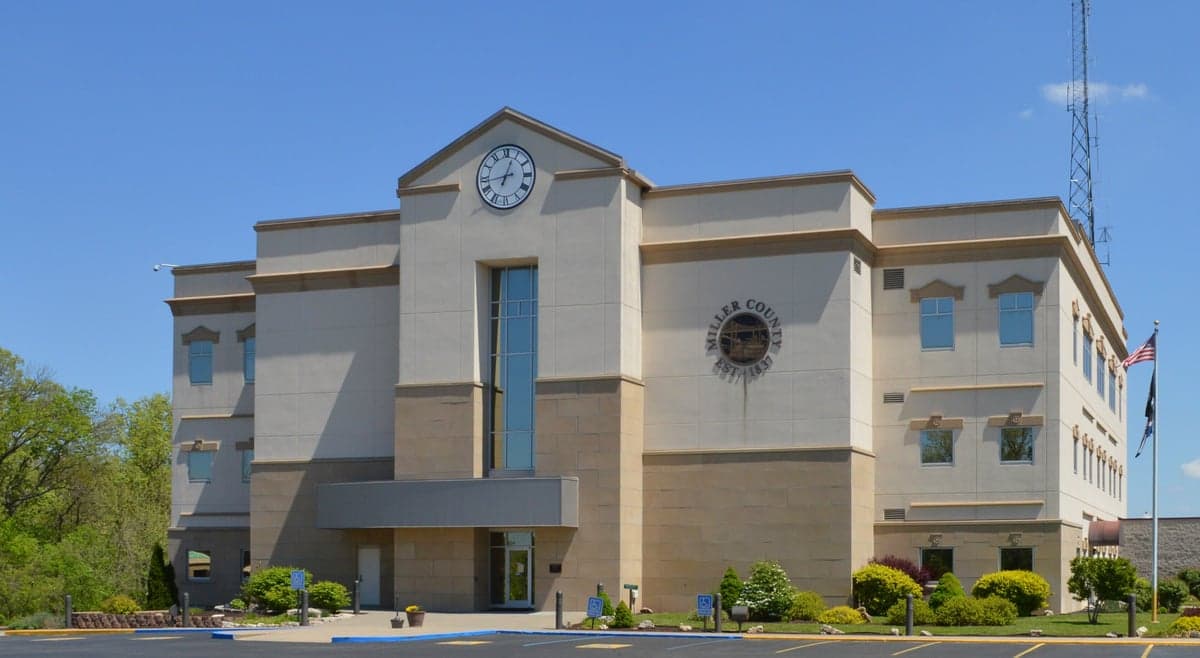
Photo: Wikipedia
Political ClimatePolitical Climate in Miller County
Showing county-level results — no local-only data available.
Lean and PVI are calculated from this county’s 2020 and 2024 presidential results, Cook-style.
Political rankings in Missouri
- Most Conservative Cities in Missouri
- Most Liberal Cities in Missouri
- Best Liberal-Leaning Towns in the Midwest
- Safest Liberal-Leaning Towns in the Midwest
- Safest Conservative-Leaning Towns in the Midwest
- Affordable Small Towns for Conservatives
- Most Affordable Liberal-Leaning Small Towns in the U.S.
- Safest Conservative-Leaning Cities in the U.S.
- Most Conservative Counties in Missouri
- Most Liberal Counties in Missouri
Local Political AnalysisPolitical Analysis of Miller County
Miller County, Missouri, is a deeply Democratic stronghold with a Cook Partisan Voting Index (PVI) of D+12, making it one of the most reliably blue areas in the state. This stands in stark contrast to the rest of Missouri, which carries a PVI of R+8, reflecting a statewide Republican lean. The county has held this Democratic tilt for decades, though the margin has narrowed slightly in recent presidential cycles as national trends have reshaped local voting patterns. In practice, this means that while Democrats consistently win here, the GOP has made inroads in the more rural, exurban pockets, particularly around the Lake of the Ozarks region.
How it compares
The political divide between Miller County and the rest of Missouri is stark. While the state as a whole has shifted rightward—voting for Donald Trump by double digits in 2020 and 2024—Miller County has remained a Democratic outlier. The county's D+12 rating means it votes about 20 points more Democratic than the state average. This is not a purple area; it's a blue island in a red sea. The most Democratic precincts are in the county seat of Tuscumbia and the smaller towns of Brumley and Ulman, where union ties and older manufacturing roots still hold sway. Conversely, the more Republican-leaning areas are around Lake Ozark and Osage Beach, where tourism and second-home owners have brought in more conservative voters. The swing precincts—places like St. Elizabeth and Iberia—tend to flip based on local economic concerns and candidate quality, but they still lean blue overall.
What this means for residents
For conservative residents, living in Miller County means being in the minority locally but part of the majority statewide. You'll find that local elections—county commission, school board, sheriff—are almost always won by Democrats, and the local party infrastructure is robust. That said, conservative voices are not silenced; they just have to work harder to be heard in local government. For liberal residents, the county provides a comfortable political home base, but you'll feel the weight of state-level policies that often run counter to local preferences. For example, while Miller County voters consistently support abortion rights and expanded Medicaid, the state legislature has enacted restrictions on both. The practical effect is that local officials often find themselves at odds with Jefferson City, leading to a kind of quiet resistance—like the county commission passing symbolic resolutions against state preemption laws.
Culturally, Miller County is more rural and working-class than the state as a whole, with a strong sense of community self-reliance. You won't find the same level of partisan animosity here as in the suburbs of St. Louis or Kansas City. People tend to judge you more by your character and your family name than by your bumper stickers. The biggest policy distinction is around land use and development: the county has been slower to adopt the pro-growth, pro-development policies favored by the state's Republican leadership, particularly around the Lake of the Ozarks. This has created a tension between residents who want to preserve the county's quiet, rural character and those who see economic opportunity in more aggressive tourism and housing development. Looking ahead, the county's Democratic lean is likely to persist, but expect the margin to continue shrinking as the Lake area grows and as younger, more conservative families move in from other parts of the state.

State Political ClimatePolitical Climate in Missouri
State Political AnalysisPolitical Environment in the State
Missouri is a solidly Republican state with a Cook PVI of R+8, meaning it typically votes about eight points more Republican than the national average. Over the past 10-20 years, the state has shifted rightward, driven by the exodus of rural and suburban voters from the Democratic coalition and the realignment of working-class white voters. However, this isn't a monolith: the state’s two major metros—St. Louis and Kansas City—remain Democratic strongholds, while the rest of the state, from the Bootheel to the northern plains, votes overwhelmingly red. The result is a deeply polarized state where statewide races are rarely competitive, but local control and ballot initiatives can produce surprising outcomes.
Urban vs. rural divide
The political map of Missouri is a textbook case of the urban-rural split. St. Louis City and County and Kansas City (Jackson County) are the Democratic anchors, delivering margins of 60-80% for Democratic candidates. These metros are home to the state’s diverse, college-educated, and union-heavy populations. In contrast, the sprawling suburbs of St. Charles County (west of St. Louis) and Cass County (south of Kansas City) have become reliably Republican, often voting 60-70% for GOP candidates. The rural areas—the Ozarks around Springfield, the Bootheel in the southeast, and the northern plains along the Iowa border—are deeply red, with many counties voting 75-85% Republican. A key bellwether is Boone County (Columbia), home to the University of Missouri; it leans Democratic but is surrounded by conservative rural counties, making it a microcosm of the state’s divide. The 2020 presidential election saw Trump win Missouri by 15 points, with St. Louis and Kansas City accounting for nearly all of Biden’s votes.
Policy environment
Missouri’s policy environment is conservative but with populist and libertarian streaks. The state has a flat income tax rate of 4.95% (as of 2025), with a phased-in reduction to 4.5% by 2027. Sales taxes are moderate, but local jurisdictions can add their own, pushing combined rates above 10% in some cities. Property taxes are low, especially in rural areas. The state is a right-to-work state (though the law was repealed by ballot initiative in 2018, the legislature has since passed a new version), and it has some of the weakest labor protections in the Midwest. Education policy is a battleground: Missouri has a robust charter school system in St. Louis and Kansas City, but rural districts are struggling with consolidation and funding. The state has a school choice program (the Missouri Empowerment Scholarship Accounts) that provides tax credits for private school tuition. Healthcare is a mixed bag: Missouri did not expand Medicaid until 2021, when voters approved it via ballot initiative, overriding years of legislative opposition. Election laws are restrictive: the state requires a government-issued photo ID to vote, has strict absentee ballot rules, and has purged voter rolls aggressively. Gun laws are among the most permissive in the nation: constitutional carry (no permit needed to carry a concealed firearm) became law in 2017, and the state has a Second Amendment Preservation Act (SAPA) that purports to nullify federal gun laws, though it has been partially struck down in court.
Recent policy direction
Over the last five years, Missouri has moved decisively to the right on nearly every front. In 2021, the legislature passed a six-week abortion ban (triggered by the Dobbs decision), with no exceptions for rape or incest. A 2024 ballot initiative to restore abortion access failed narrowly, but the issue remains alive. On guns, the Second Amendment Preservation Act (2021) was a direct challenge to federal authority, though federal courts have blocked key provisions. The state also passed a parental rights bill (2022) that restricts classroom discussion of sexual orientation and gender identity, similar to Florida’s “Don’t Say Gay” law. On taxes, the legislature passed a series of income tax cuts, with the goal of eventually eliminating the income tax entirely. Property rights were strengthened with a 2022 law limiting eminent domain for economic development. On voting, the state passed a voter ID law (2022) and tightened absentee ballot rules, making it harder to vote by mail. The state has also taken a hard line on immigration, with a 2023 law requiring local law enforcement to cooperate with federal immigration authorities and banning sanctuary city policies. On privacy, Missouri passed a biometric privacy law (2023) that restricts how companies collect and use facial recognition data, but it has not addressed broader digital privacy concerns. The overall direction is toward less regulation, lower taxes, and more local control, but with a strong emphasis on cultural conservatism.
Civil unrest & political movements
Missouri has a history of high-profile civil unrest, most notably the Ferguson protests in 2014, which erupted after the police shooting of Michael Brown and sparked a national movement against police brutality. The St. Louis region remains a flashpoint for racial justice activism, with ongoing protests and legal battles over policing and municipal court fines. On the right, the Missouri Freedom Caucus has become a powerful force in the state legislature, pushing for more aggressive conservative policies and often clashing with the more moderate Republican leadership. The state has seen a rise in Second Amendment sanctuary resolutions, with dozens of counties declaring themselves “sanctuary counties” for gun rights. Immigration politics are less visible than in border states, but there have been localized protests over the placement of refugee resettlement agencies in St. Louis and Kansas City. Election integrity controversies have been muted compared to states like Arizona or Georgia, but the 2020 election saw Trump’s campaign challenge the results in St. Louis, and the state legislature has since passed laws to “restore confidence” in elections. A new resident would notice the political divide most acutely in the suburbs: a drive from Clayton (liberal St. Louis suburb) to Wildwood (conservative exurb) is a 20-minute journey that crosses a cultural chasm.
Projection
Over the next 5-10 years, Missouri is likely to become even more Republican, but with internal tensions. The St. Louis and Kansas City metros will continue to grow and diversify, but their political influence is diluted by the state’s rural-heavy legislative map. In-migration is modest, with most newcomers coming from other Midwestern states (Illinois, Kansas) and a small but growing number from the West Coast. These newcomers tend to be more moderate or conservative, reinforcing the state’s rightward tilt. The biggest wildcard is the abortion debate: if a future ballot initiative to restore abortion access passes, it could mobilize Democratic voters and shift the political calculus, but the legislature is likely to fight it with procedural hurdles. The tax cut trajectory will continue, with the income tax possibly eliminated by 2030, which will attract retirees and remote workers but strain state services. The rural-urban divide will deepen, with rural areas losing population and political power, while the suburbs become the key battleground. A new resident moving in now should expect a state that is reliably conservative on most issues, but with periodic surprises from ballot initiatives and local elections. The political climate is stable but polarized—you won’t see the kind of rapid shifts happening in Arizona or Georgia, but you will see a steady, grinding conservative consolidation.
For a new resident, the bottom line is this: if you lean conservative, you’ll find a state that largely aligns with your values on taxes, guns, and education, with a government that is actively pushing in your direction. If you lean liberal, you’ll find strongholds in St. Louis, Kansas City, and Columbia where you can live comfortably, but you’ll have little influence on statewide policy. The practical takeaway is that Missouri is a place where your local community matters more than the state government—choose your county and city carefully, and you can find a political environment that suits you, whether that’s the progressive energy of University City or the conservative stability of Nixa.
* Values derived from national, state, county, city and local statistics and may differ in a specific area. Last updated: 2026-11-10T10:52:16.000Z
Narrative content on this page is AI-generated and may contain mistakes. Verify any details that matter before acting on them.
ReloMaps may earn a commission from affiliate links at no extra cost to you.

