Photo: Wikipedia
Demographics of Miller County
Affluence Level in Miller County
A below-average socioeconomic profile. Incomes, home values, and educational attainment trail the U.S., with higher poverty and unemployment.
People of Miller County
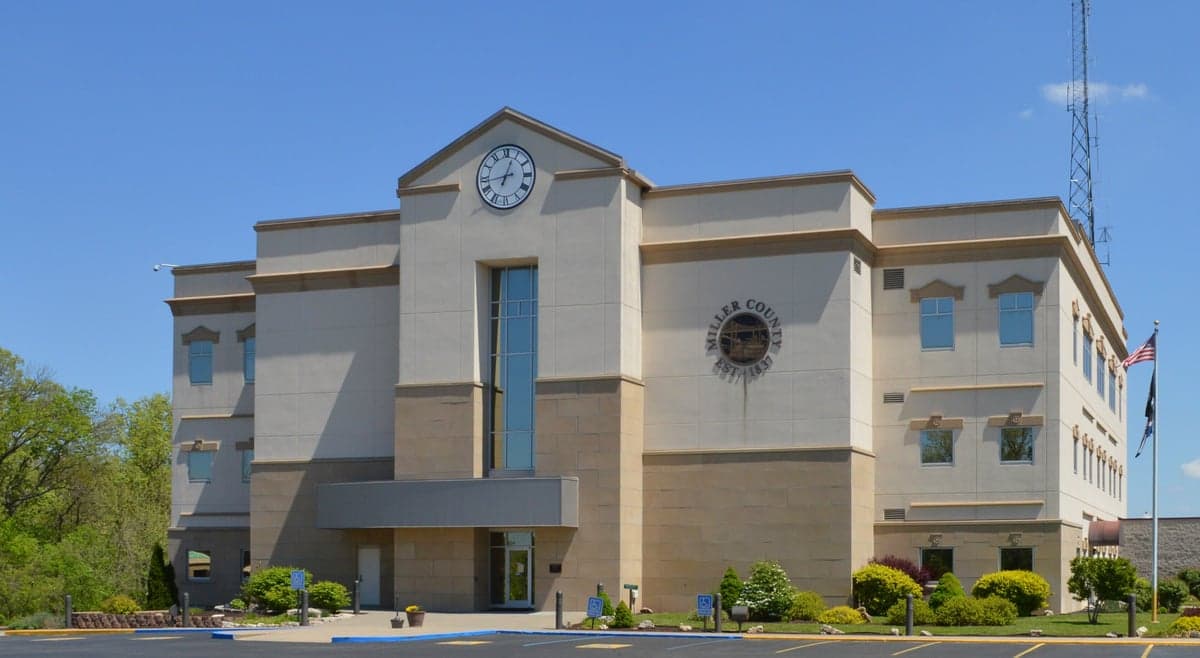
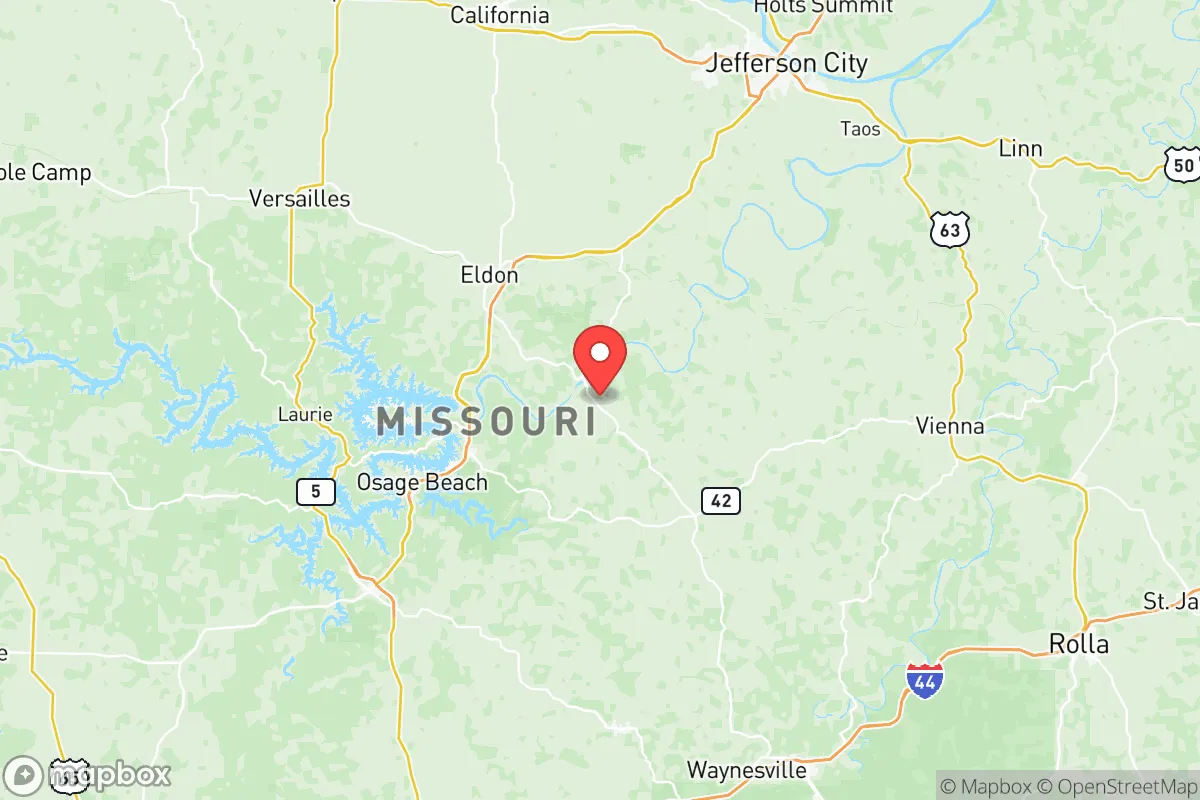
Miller County, Missouri, is a predominantly white, rural community of just over 25,000 residents, where 93.7% of the population identifies as white and less than 1% are foreign-born. The county’s character is defined by its Ozark foothills setting, a strong tradition of local governance, and a population that is older and less formally educated than the state average, with only 21.0% holding a college degree. Its people are concentrated in the county seat of Tuscumbia, the largest town of Eldon, and the Lake of the Ozarks communities of Lake Ozark and Osage Beach, giving the county a split identity between agricultural heritage and lakeside recreation.
Settlement & growth (pre-1960)
Before American settlement, the area that became Miller County was part of the traditional territory of the Osage Nation, who used the region for hunting and seasonal camps along the Osage River and its tributaries. The Osage were forcibly removed through treaties in the early 1800s, opening the land to Euro-American settlers. The county was formally organized in 1837 from portions of Cole and Pulaski counties, named after Missouri Congressman John Miller. The earliest white settlers were primarily of Scots-Irish and English stock, migrating from Kentucky, Tennessee, and Virginia via the Boone’s Lick Road and the Missouri River corridor. They were drawn by cheap land under the Preemption Act of 1841 and later the Homestead Act of 1862, establishing small subsistence farms in the rugged, forested hills around what is now Tuscumbia, the county seat since 1837.
The arrival of the railroad in the 1870s and 1880s transformed the county’s settlement pattern. The Missouri Pacific Railroad built a line through the northern part of the county, spurring the founding of Eldon in 1882 and St. Elizabeth in 1883. Eldon quickly grew into the county’s largest town, attracting a wave of German Catholic immigrants who established St. Elizabeth as a distinct ethnic enclave. These German families came directly from the Old Country and from earlier settlements in the St. Louis area, drawn by railroad construction jobs and the promise of fertile bottomland along the Osage River. By 1900, Miller County’s population had reached 15,187, with the German Catholic community in St. Elizabeth and the surrounding Taos area forming a culturally distinct block that maintained German-language church services well into the 20th century.
The next major demographic shift came with the construction of Bagnell Dam on the Osage River from 1929 to 1931, creating the Lake of the Ozarks. The dam project brought thousands of construction workers, many of them transient laborers from the Ozarks and the Dust Bowl states of Oklahoma and Arkansas. When the dam was completed, many of these workers stayed, settling in the new lakefront communities of Lake Ozark (founded 1931) and Osage Beach (incorporated 1935). The lake transformed Miller County from a purely agricultural economy into a tourism and recreation hub, attracting seasonal residents and retirees from St. Louis, Kansas City, and Chicago. This period also saw the arrival of a small number of African American families who worked in service roles at the lake’s resorts and hotels, though the county’s black population never exceeded 2% and remains at just 1.2% today.
Modern era (post-1965)
The 1965 Hart-Cellar Act had minimal direct impact on Miller County, as the county’s foreign-born population remains negligible at 0.8%. Unlike many parts of Missouri that saw new immigration from Latin America and Asia, Miller County’s demographic story in the post-1965 era is primarily one of domestic migration and suburbanization. The most significant change has been the growth of the Lake of the Ozarks region as a second-home and retirement destination. From the 1970s onward, Lake Ozark and Osage Beach experienced a building boom as affluent white retirees from St. Louis, Chicago, and the Kansas City suburbs purchased lakefront properties. This influx raised the county’s median age and income levels, particularly in the lake towns, while the southern and eastern parts of the county—around Tuscumbia and Iberia—remained poorer and more dependent on agriculture and manufacturing.
The Hispanic population, now at 2.1%, began to grow slowly in the 1990s and 2000s, driven by labor demand in the lake’s hospitality industry and in construction. These families are concentrated in Eldon and Lake Ozark, where they work in restaurants, hotels, and home-building trades. The East/Southeast Asian population, at 0.4%, is tiny and largely consists of a few families who own or manage lakefront businesses, with no distinct ethnic enclave forming. The Indian subcontinent population is effectively zero. The county’s black population, at 1.2%, is concentrated in Eldon and Tuscumbia, with many families tracing their roots to the post-dam service economy rather than to any later migration wave.
Suburbanization has been limited compared to Missouri’s major metro areas, but the northern edge of the county along Highway 54 has seen steady development as a bedroom community for Jefferson City, 30 miles to the north. Lake Ozark and Osage Beach have grown into year-round communities, though their populations still swell dramatically during summer weekends. The county’s population has grown slowly but steadily, from 19,028 in 1970 to 25,081 in 2020, with most growth occurring in the lake corridor.
The future
Miller County is likely to remain overwhelmingly white and native-born for the foreseeable future. The foreign-born share, at 0.8%, is one of the lowest in Missouri, and there are no signs of significant new immigration. The Hispanic population may continue to grow slowly as the lake’s tourism economy expands, but it is unlikely to exceed 5% in the next decade. The county’s population growth will depend on continued domestic in-migration of retirees and remote workers drawn to the Lake of the Ozarks, as well as spillover from Jefferson City’s suburban expansion. Eldon and Lake Ozark will likely absorb most of this growth, while the southern towns of Iberia and Tuscumbia may see population stagnation or decline.
The county’s cultural identity is evolving from a purely rural, agricultural community into a hybrid of lakeside resort culture and traditional Ozarks conservatism. The influx of out-of-state retirees and second-home owners has introduced more politically moderate and economically diverse voices, particularly in Osage Beach and Lake Ozark, but the county as a whole remains solidly conservative. The educational attainment gap—only 21.0% college-educated, well below the national average—may widen as better-educated newcomers concentrate in the lake towns while the rural population ages and younger residents leave for college and jobs in larger cities.
For someone moving to Miller County now, the area offers a low-cost, low-density lifestyle with strong community ties in its small towns and easy access to Lake of the Ozarks recreation. The population is homogeneous and likely to remain so, with limited racial or ethnic diversity beyond a small Hispanic workforce. The county is becoming more oriented toward tourism and retirement services, less toward farming and manufacturing, and its future growth will be shaped by how well it balances lakefront development with the preservation of its rural character.

* Values derived from national, state, county, city and local statistics and may differ in a specific area. Last updated: 2026-11-10T10:52:16.000Z
Narrative content on this page is AI-generated and may contain mistakes. Verify any details that matter before acting on them.
ReloMaps may earn a commission from affiliate links at no extra cost to you.

