
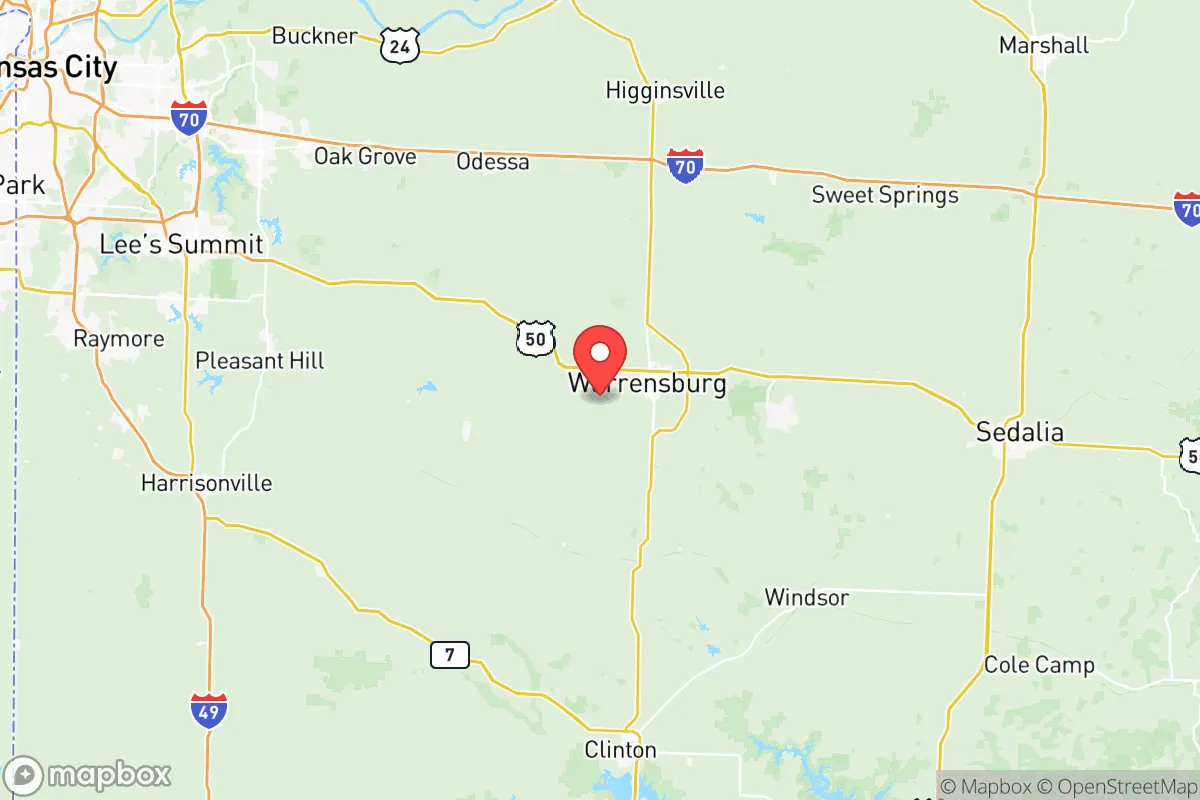
Photo: Wikipedia
Personal Sovereignty in Johnson County
Strong independent fundamentals that actively favor personal liberty and low regulation.
What does Personal Sovereignty tell us?
Personal Sovereignty measures your capacity for self-reliance and independence with minimal government friction. Higher scores mean fewer barriers between you and the way you want to live... but it assumes you have the space you need and good neighbors.
What does this tell us?
Personal Sovereignty measures your capacity for self-reliance and independence with minimal government friction. Higher scores mean fewer barriers between you and the way you want to live... but it assumes you have the space you need and good neighbors.
State Policy
Energy independence: Importer (15% of energy produced in-state)
Personal Liberty
Homesteading

Personal Liberty Analysis
Johnson County, Missouri, offers a notably high degree of personal sovereignty, particularly for those who value limited government interference in daily life, self-defense, and property rights. The county’s regulatory environment is generally light-touch, with local governance in towns like Warrensburg, Holden, and Knob Noster leaning toward a hands-off approach that prioritizes individual autonomy over collective mandates. This creates a living environment where residents can expect fewer bureaucratic hurdles compared to more heavily regulated urban centers in the state, such as Kansas City or St. Louis.
Tax burden and regulatory posture in Johnson County
Missouri’s state-level tax structure is already favorable to personal sovereignty, with a flat income tax rate of 4.95% and a state sales tax of 4.225%. Johnson County adds a local sales tax of roughly 1.5% to 2.5%, depending on the municipality—Warrensburg, for example, levies a combined rate of about 8.225%, while unincorporated areas are slightly lower. Property taxes are among the lowest in the nation, with effective rates around 0.8% of assessed home value, meaning a $250,000 home incurs roughly $2,000 annually. The county’s regulatory posture is similarly restrained: there are no county-wide zoning ordinances in unincorporated areas, allowing for greater flexibility in land use. However, incorporated towns like Holden and Knob Noster do enforce basic building codes and setback requirements, though these are far less stringent than in suburban Kansas City. Business licensing is straightforward, with no county-level occupational taxes, and the permitting process for home-based enterprises is minimal, making it a practical choice for entrepreneurs seeking low regulatory overhead.
Self-defense and gun law specifics in Johnson County
Missouri is a constitutional carry state, and Johnson County fully reflects that ethos. No permit is required to carry a concealed firearm for any law-abiding adult 19 or older (18 with military service), and open carry is legal without a license. The county sheriff’s office in Warrensburg issues concealed carry permits for reciprocity purposes, but there is no mandatory training requirement for in-state carry. Stand-your-ground laws are in full effect, with no duty to retreat in any place where a person has a legal right to be. Johnson County’s gun culture is robust: the Warrensburg Gun Club and several private ranges in rural areas near Leeton and Chilhowee see active participation. Local law enforcement is generally supportive of Second Amendment rights, and there are no county-level restrictions on magazine capacity or firearm types. For those concerned about self-defense in the home, Missouri’s Castle Doctrine provides legal protection for the use of deadly force against intrudents, with no requirement to retreat within one’s residence.
Self-reliance and homesteading viability in Johnson County
Homesteading and off-grid living are highly viable in Johnson County, particularly in its unincorporated areas and smaller towns. Lot sizes vary widely: in rural zones near Kingsville and Centerview, parcels of 5 to 40 acres are common, with many properties already featuring wells, septic systems, and solar panels. Zoning is minimal—unincorporated land has no county-wide zoning, so residents can build sheds, barns, or tiny homes without extensive permitting. Off-grid feasibility is strong: Missouri law does not require connection to municipal water or power if a property has its own well and septic, and solar installations are permitted without special county approval. However, incorporated towns like Warrensburg and Holden do require building permits for new structures, and septic systems must pass county health inspections. Rainwater collection is legal and unregulated at the state level, and livestock—including chickens, goats, and cattle—is allowed on parcels of 1 acre or more in unincorporated areas. For those seeking maximum self-reliance, the rural stretches between Leeton and Chilhowee offer the least regulatory friction, with many properties already set up for off-grid living.
Personal liberties in Johnson County: parental rights, medical autonomy, speech, and property
Parental rights are strongly protected in Johnson County, reflecting Missouri’s broader legal framework. The state’s “Parents’ Bill of Rights” (SB 49, 2022) ensures parents have the right to direct their children’s education, healthcare, and religious upbringing, and local school districts in Warrensburg, Holden, and Knob Noster generally defer to parental authority on medical decisions and curriculum opt-outs. Medical autonomy is similarly robust: Missouri has no state-level vaccine mandates for adults, and the county’s health department does not enforce any local mandates beyond federal requirements. COVID-era restrictions were minimal in Johnson County, with no county-wide mask or business closure orders. Free speech is protected under the First Amendment, and local government meetings in Warrensburg and Holden are generally open, with public comment periods. Property rights are strong: Missouri’s “right to farm” law (Article I, Section 35 of the state constitution) protects agricultural operations from nuisance lawsuits, and Johnson County has no county-level rent control or landlord licensing. Eminent domain is rarely used for private development, and property owners in unincorporated areas face few restrictions on land use, including the right to build fences, hunt on their own land, or operate a home business.
Overall, Johnson County offers a level of personal sovereignty that ranks among the highest in Missouri, particularly for those who prioritize self-defense, low taxes, and minimal regulation. Compared to more restrictive counties in the Kansas City metro or St. Louis region, Johnson County’s unincorporated areas and smaller towns provide a tangible sense of autonomy that aligns with a self-reliant lifestyle. For individuals and families seeking a place where government stays out of daily life—from carrying a firearm to building a homestead—Johnson County delivers a practical, low-friction environment that is increasingly rare in modern America.

* Values derived from national, state, county, city and local statistics and may differ in a specific area. Last updated: 2026-06-29T07:31:34.000Z
Narrative content on this page is AI-generated and may contain mistakes. Verify any details that matter before acting on them.
ReloMaps may earn a commission from affiliate links at no extra cost to you.

