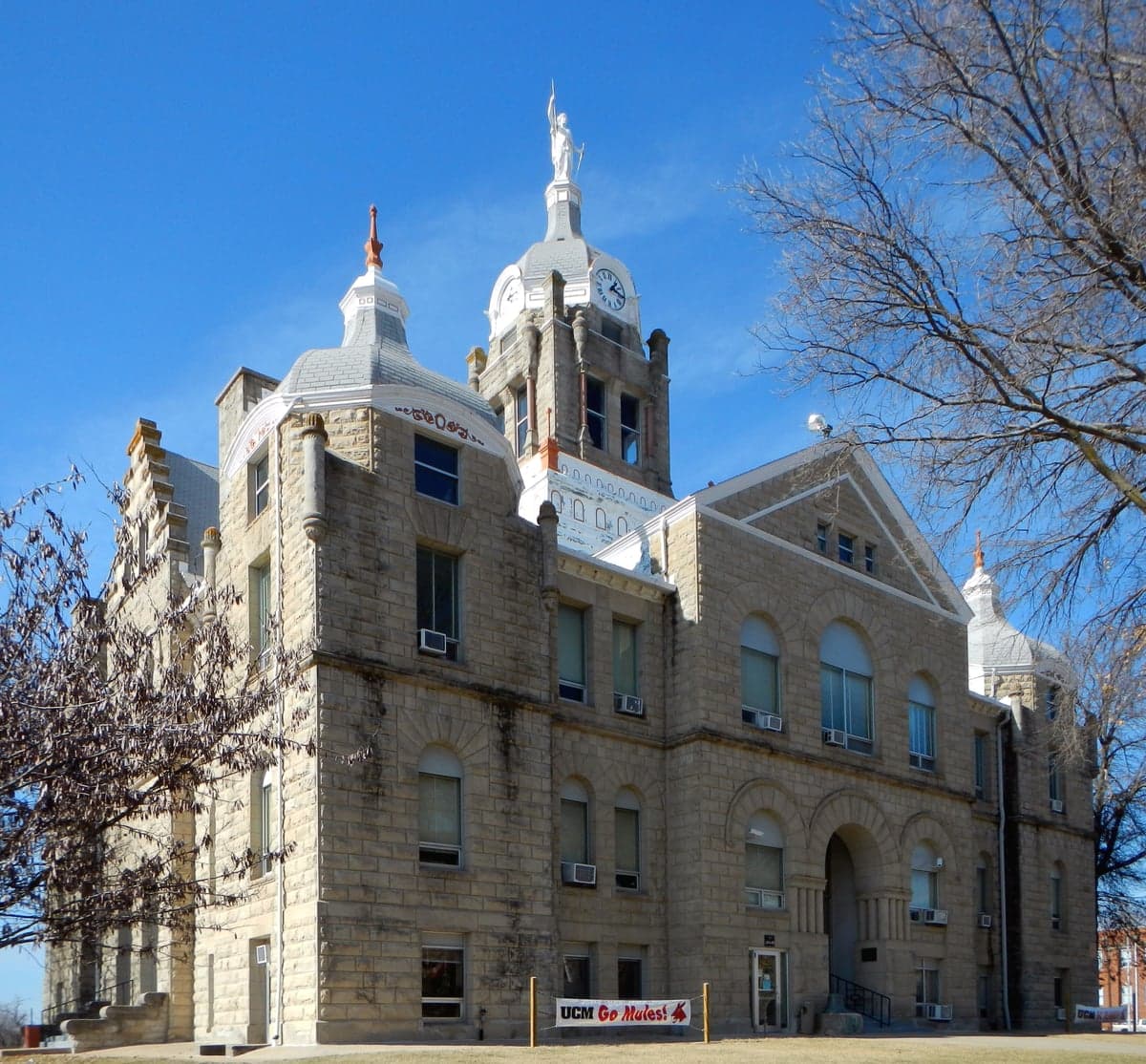
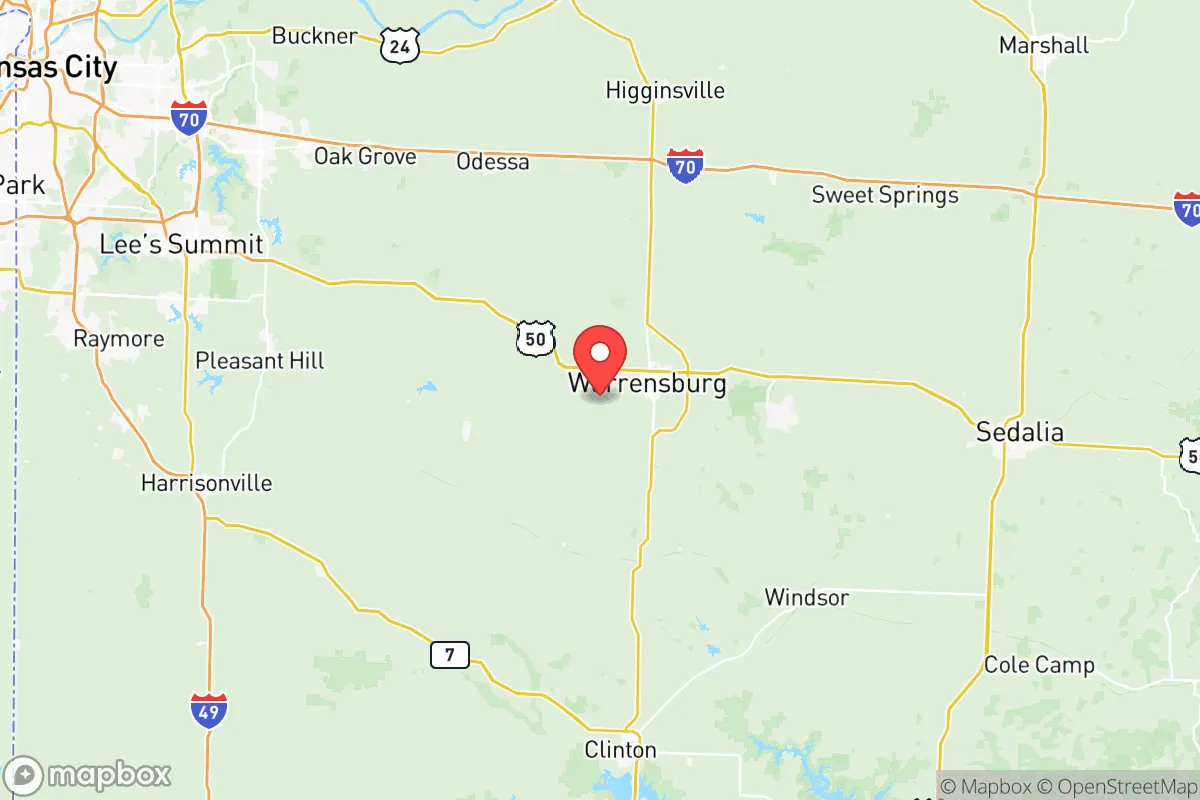
Photo: Wikipedia
Demographics of Johnson County
Affluence Level in Johnson County
A middle-class area roughly in line with national averages across income, home values, education, and employment.
People of Johnson County
Today, Johnson County, Missouri is home to roughly 54,300 residents, a population that remains predominantly white (84.3%) and native-born (only 1.8% foreign-born), with a modest but growing Hispanic community (5.0%) and small Black (3.7%) and East/Southeast Asian (1.2%) populations. The county’s character is shaped by its position as a rural-to-suburban transition zone—anchored by the college town of Warrensburg (home to the University of Central Missouri) and the agricultural hub of Holden—while bedroom communities like Knob Noster and Leeton increasingly absorb commuters drawn to the Kansas City metro area’s southern edge. Distinctive markers include a strong military presence from Whiteman Air Force Base near Knob Noster, a conservative-leaning political culture, and a population that values self-reliance, local schools, and outdoor recreation along the Blackwater River and Lake Jacomo.
Settlement & growth (pre-1960)
Before American settlement, the land that became Johnson County was part of the ancestral territory of the Osage Nation, who controlled much of western Missouri and used the area for hunting bison and elk. The Osage were forcibly removed through treaties in the 1820s and 1830s, opening the region to Euro-American settlers. The first wave of permanent settlers arrived in the 1830s and 1840s, primarily Scots-Irish and English families from Kentucky, Tennessee, and Virginia, drawn by the promise of cheap land under the Preemption Act of 1841 and later the Homestead Act of 1862. These early pioneers established the county seat of Warrensburg in 1836, naming it after a local landowner, and quickly spread into the fertile bottomlands around the Blackwater and Lamine rivers.
The second major wave came with the expansion of the Missouri Pacific Railroad in the 1850s and 1860s, which connected Warrensburg to Sedalia and Kansas City. This rail link spurred the founding of new towns like Holden (platted in 1857) and Knob Noster (established 1860), both of which became shipping points for grain, livestock, and timber. German immigrants, though fewer than in neighboring counties like Cole or Osage, arrived in modest numbers during the 1860s and 1870s, settling around Concordia and the rural areas south of Warrensburg, where they established small farms and Lutheran churches. The post-Civil War period also saw a small influx of freed African Americans, who concentrated in Warrensburg’s “Black Bottom” neighborhood and worked as sharecroppers, railroad laborers, and domestic servants. By 1900, the county’s population had reached 27,000, with agriculture—especially corn, wheat, and hog farming—dominating the economy.
The early 20th century brought two transformative developments. First, the establishment of the State Normal School (now the University of Central Missouri) in Warrensburg in 1871 began drawing students and faculty from across the state, gradually shifting the county’s economic center from farming to education. Second, the construction of Whiteman Air Force Base in 1942 (originally Sedalia Army Air Field) near Knob Noster injected a permanent military population into the county. The base, which became home to B-52 bombers during the Cold War and later the B-2 Spirit stealth bomber, attracted service members and civilian contractors from across the United States, diversifying the local population beyond its rural roots. By 1960, the county’s population had grown to 28,981, still overwhelmingly white and native-born, but with a growing suburban fringe along the U.S. 50 corridor toward Kansas City.
Modern era (post-1965)
The 1965 Hart-Cellar Act had a muted effect on Johnson County compared to coastal or urban areas, as the county’s foreign-born population remains just 1.8% in 2026—far below the national average. However, the post-1965 era brought significant domestic migration and suburbanization. The expansion of Whiteman Air Force Base during the 1980s and 1990s, including the arrival of the B-2 stealth bomber program, drew a steady stream of military families from across the country, many of whom settled in Knob Noster and the surrounding area. This military influx brought modest racial and ethnic diversity, including Black and Hispanic service members, though the county’s overall demographics shifted slowly.
The most notable demographic change since 1965 has been the growth of the Hispanic population, which rose from under 1% in 1990 to 5.0% today. This wave is largely driven by Mexican and Central American immigrants and their U.S.-born children, who work in agriculture (especially poultry processing and crop farming), construction, and service industries. The Hispanic community is concentrated in Warrensburg and the rural areas south of Holden, where several small meatpacking and food-processing plants have operated since the 1990s. Meanwhile, the East/Southeast Asian population (1.2%) includes a mix of Vietnamese and Filipino families, many connected to the military or the University of Central Missouri’s international student programs. The Indian subcontinent population (0.4%) is small but growing, primarily professionals and academics associated with the university or regional healthcare facilities.
Suburbanization accelerated after 2000, as rising housing costs in Kansas City pushed families south along the U.S. 50 and Route 13 corridors. Towns like Warrensburg and Knob Noster have seen new subdivisions and retail development, while unincorporated areas near the Cass County line have become popular for commuters seeking larger lots and lower taxes. The county’s population grew by 12% between 2000 and 2020, with the fastest growth in the northern tier near Whiteman Air Force Base and the eastern edge toward Holden. Despite this growth, the county remains less diverse than the Kansas City metro area as a whole, with a white population of 84.3% compared to the metro’s 68%.
The future
Johnson County’s population is projected to continue growing slowly, reaching roughly 60,000 by 2040, driven by continued suburban spillover from Kansas City and the steady presence of Whiteman Air Force Base. The Hispanic share is expected to rise to 8-10% over the next two decades, as younger families and agricultural workers settle in Warrensburg and Holden, while the Black and East/Southeast Asian populations will likely grow modestly through military assignments and university recruitment. The county’s cultural identity is evolving from a purely rural, agricultural community into a hybrid of college town, military base town, and exurban bedroom community—a shift that brings both opportunities and tensions over land use, school funding, and local governance.
For someone moving in now, Johnson County offers a relatively affordable, safe, and family-oriented environment with strong schools in Warrensburg and Knob Noster, ample outdoor recreation, and a conservative-leaning political climate. The county is becoming slightly more diverse and suburban, but it remains a place where native-born, white, and military-connected residents dominate the social and civic fabric. Newcomers will find a community that values tradition, self-sufficiency, and neighborliness, with the University of Central Missouri and Whiteman Air Force Base serving as the twin anchors of economic and cultural life.

* Values derived from national, state, county, city and local statistics and may differ in a specific area. Last updated: 2026-06-29T07:31:34.000Z
Narrative content on this page is AI-generated and may contain mistakes. Verify any details that matter before acting on them.
ReloMaps may earn a commission from affiliate links at no extra cost to you.

