Photo: Wikipedia
Political ClimatePolitical Climate in Buchanan County
Showing district-level results — no local-only data available.
Local Political AnalysisPolitical Analysis of Buchanan County
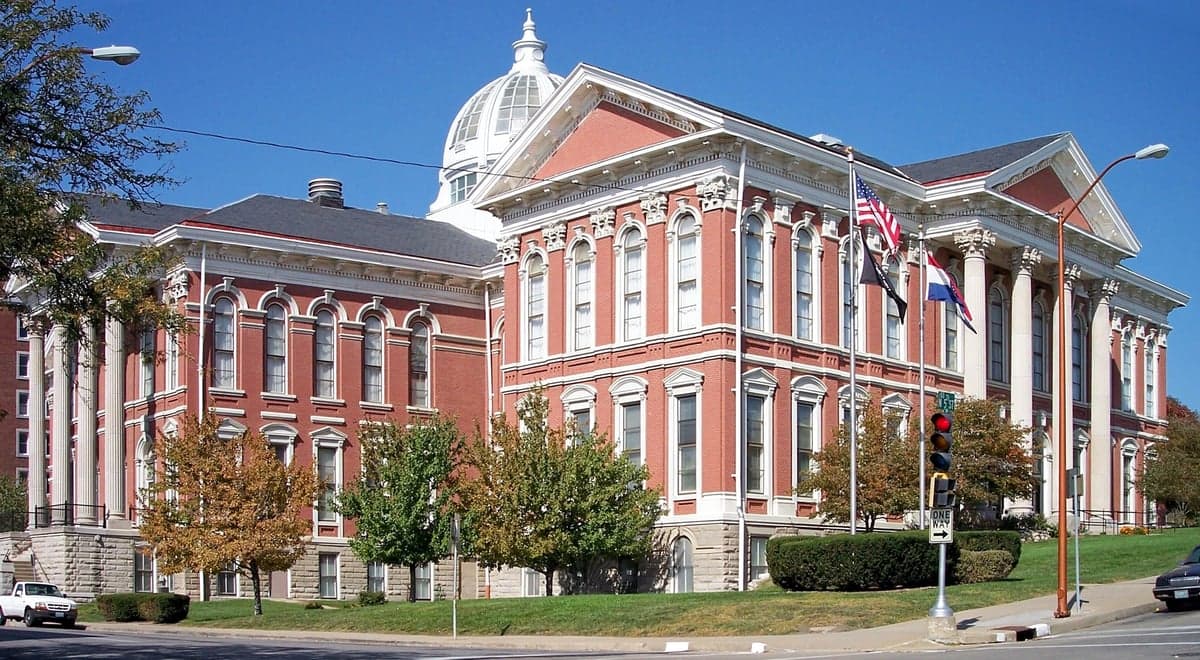
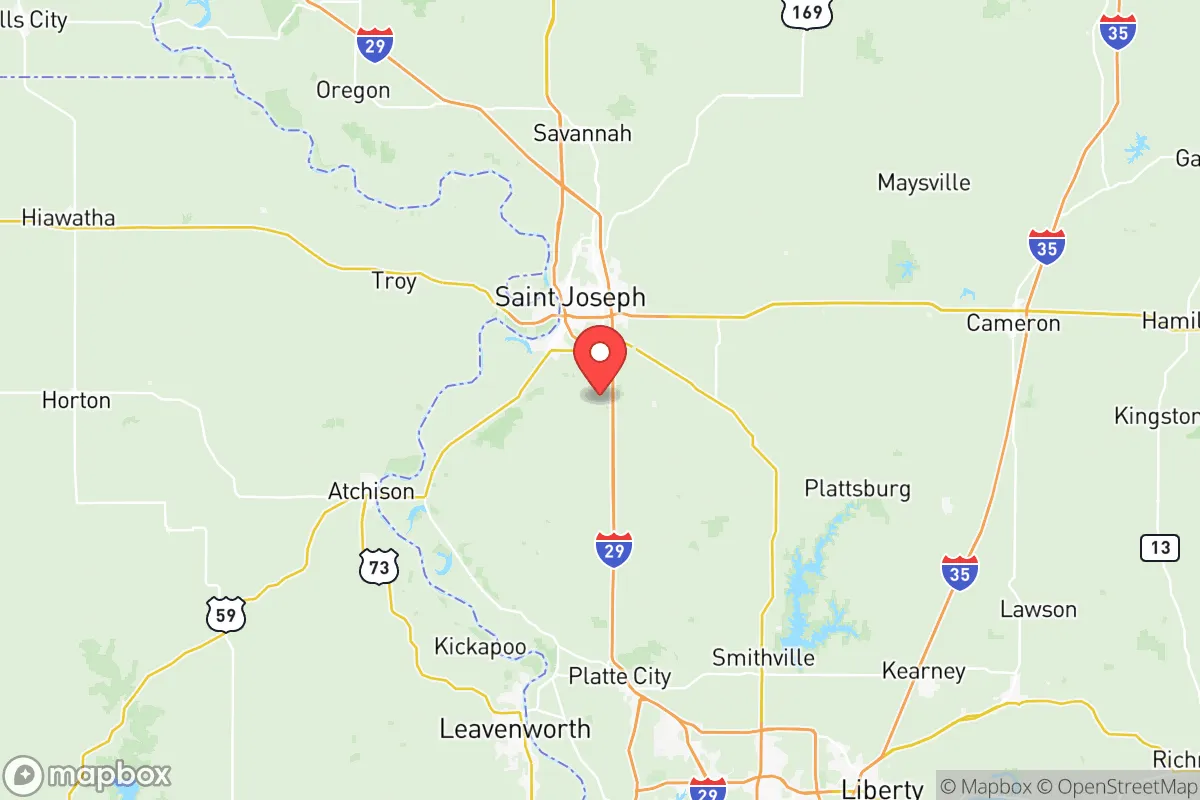
Buchanan County, Missouri, is a solidly Republican area with a Cook Partisan Voting Index (PVI) of R+19, making it significantly more conservative than the state of Missouri as a whole, which sits at R+8. This isn't a recent shift; the county has been a GOP stronghold for decades, though the margin has widened in the last two presidential cycles. The real story here is the internal divide: the city of St. Joseph, which holds the bulk of the county's population, is a classic blue island in a red sea, while the surrounding rural towns and unincorporated areas vote overwhelmingly Republican.
How it compares
The R+19 PVI means Buchanan County votes about 11 points more Republican than the state average. In practice, that translates to a countywide vote of roughly 65-70% for the GOP presidential candidate, compared to Missouri's 58-60%. But that countywide number masks a sharp urban-rural split. St. Joseph's core precincts, particularly around the Missouri Western State University campus and the downtown area, often vote Democratic by 10-15 points. In contrast, towns like Agent, Rushville, and DeKalb routinely deliver 80%+ Republican margins. The swing precincts are in the suburban fringe of St. Joseph—places like the neighborhoods near the East Hills Shopping Center and the newer developments along the I-29 corridor—where races are often decided by a few hundred votes. This dynamic is more pronounced than in many other R+8 counties across the state, where the urban centers are smaller and less influential.
What this means for residents
For conservative residents, the county's lean means local elections are rarely competitive outside of the Republican primary. The county commission, sheriff, and most municipal offices in the smaller towns are reliably GOP. Policy-wise, this translates to a low-tax, limited-government approach at the county level, with minimal zoning restrictions and a strong emphasis on Second Amendment rights. For liberal residents, the reality is more nuanced. St. Joseph's city council often has a Democratic majority or a strong minority, so progressive policies on housing, public transit, and social services can advance within city limits. However, statewide and countywide offices are a long shot. The practical effect is that a liberal resident can feel politically at home in St. Joseph's downtown coffee shops and arts scene, but will encounter a very different atmosphere driving 15 minutes into the countryside. The county's political culture is also notably more traditional and church-oriented than the state's fast-growing suburban corridors like St. Charles or Boone County.
One cultural distinction that sets Buchanan County apart from the rest of Missouri is its deep-rooted identity as a former industrial and railroad hub. The decline of manufacturing in St. Joseph has created a more populist, working-class conservative streak than the libertarian-leaning conservatism found in the Ozarks. You'll hear more talk about union jobs and the old Swift & Company plant than about tax cuts for small businesses. This gives the local GOP a slightly different flavor—more focused on economic nostalgia and less on social issues than in some other parts of the state. For newcomers, the key takeaway is that Buchanan County is not a monolith: it's a place where a Democratic mayor can coexist with a Republican county commission, and where the political conversation is still shaped by the memory of a bustling river town that once rivaled Kansas City. The trajectory is toward deeper red, but the blue core of St. Joseph ensures the county remains politically interesting, if not competitive, for the foreseeable future.

State Political ClimatePolitical Climate in Missouri
State Political AnalysisPolitical Environment in the State
Missouri is a solidly Republican state with a Cook PVI of R+8, but it’s not a monolith—it’s a state where the rural-urban split is as sharp as a plow blade. Over the last 20 years, the state has shifted from a competitive purple state to a reliable red one, driven by the exodus of rural voters from the Democratic Party and the consolidation of conservative power in the legislature. The old Show-Me State adage holds: you can see the political divide clearly from the interstate, with St. Louis and Kansas City anchoring the blue, while the rest of the state—from the Bootheel to the northern plains—votes deep red.
Urban vs. rural divide
The political map of Missouri is a tale of two cities and a whole lot of countryside. St. Louis City and County are the state’s Democratic strongholds, delivering margins of 70-80% for statewide Democrats, while Kansas City and its inner-ring suburbs like Independence and Raytown provide the other major blue bloc. These two metros alone account for roughly 40% of the state’s vote, but they’re increasingly isolated. The rest of the state—places like Springfield, Joplin, Cape Girardeau, and Jefferson City—vote Republican by 20-40 points. The suburbs have been the real story: St. Charles County, just west of St. Louis, flipped from competitive to reliably red in the 2010s, while Clay County (north of Kansas City) has moved from purple to light red. The rural counties, like Texas County and Dallas County, now vote 80%+ Republican, a shift that’s made the state’s overall lean more durable than its PVI suggests.
Policy environment
Missouri’s policy environment is aggressively conservative, with a low-tax, low-regulation posture that’s been baked in for decades. The state has a flat income tax of 4.8% (down from 5.4% in 2022, with a trigger to drop to 4.5% by 2027), no estate tax, and a sales tax cap of 8.5% in most areas. Property taxes are among the lowest in the nation, averaging 0.9% of home value. Education policy is a flashpoint: the state has a robust charter school system in St. Louis and Kansas City, but rural districts are underfunded and rely heavily on local levies. Healthcare is a mixed bag—Missouri expanded Medicaid in 2021 via ballot initiative (over legislative opposition), but the state has some of the strictest abortion laws in the country, banning the procedure at conception with no exceptions for rape or incest. Election laws are restrictive: voter ID is required, absentee voting requires a notary (or a witness for mail-in), and the state purges inactive voters regularly. The regulatory environment is business-friendly, with right-to-work laws (repealed by ballot in 2018, but the legislature keeps trying to reinstate them) and minimal environmental oversight.
Recent policy direction
The last five years have seen Missouri’s legislature push a hard-right agenda, with a focus on cultural and liberty issues that matter to relocators. Gun and self-defense law: Missouri passed a permitless carry law in 2017, and in 2021 enacted a Second Amendment Preservation Act (SAPA) that declares federal gun laws unenforceable—a move that’s been challenged in court but remains on the books. Parental and education rights: The 2022 “Parents’ Bill of Rights” (HB 2410) requires schools to notify parents of any curriculum changes and allows them to opt their kids out of sex ed. Speech and privacy: There’s no state-level shield law for journalists, but the state has a strong open records law. Medical and bodily autonomy: Abortion is banned at conception, but the state has a medical marijuana program (legalized in 2018) and is considering a ballot measure to legalize recreational use in 2024. Property rights: Eminent domain is tightly restricted after a 2006 constitutional amendment, and the state has a strong “right to farm” law that limits nuisance lawsuits against agricultural operations. Taxation: The income tax is on a glide path to 4.5%, and the legislature is debating a flat 4% rate. Voting and ballot access: The 2022 voter ID law (SB 631) tightened requirements, and the state has a 27-day early voting window (no-excuse absentee) that’s relatively generous for a red state.
Civil unrest & political movements
Missouri has a history of visible political flashpoints. The 2014 Ferguson protests (after the Michael Brown shooting) were a national catalyst for the Black Lives Matter movement, and St. Louis continues to see periodic protests over police shootings and racial justice. On the right, the state has a strong Second Amendment sanctuary movement, with over 100 counties passing resolutions against federal gun laws. Immigration politics are less heated than in border states, but the legislature has passed bills banning sanctuary cities and requiring law enforcement to cooperate with ICE. There’s been no serious secession talk, but the SAPA law is a form of nullification rhetoric that resonates with rural voters. Election integrity controversies flared after 2020, with the state conducting a forensic audit of St. Louis County’s results (which found no widespread fraud). A new resident would notice the political divide most in the media: St. Louis and Kansas City have liberal newspapers and TV stations, while the rest of the state gets conservative talk radio and Fox News.
Projection
Over the next 5-10 years, Missouri is likely to become even more Republican, but with a twist. The rural population is aging and shrinking, while the suburbs of St. Louis and Kansas City are growing—and those suburbs are trending slightly more moderate. St. Charles County is now the state’s third-largest county and is solidly red, but its voters are more pragmatic than the rural base. Meanwhile, Boone County (home to Columbia and the University of Missouri) is becoming a blue-leaning island, and Greene County (Springfield) is staying red but with a growing libertarian streak. The big demographic shift is in-migration: people are moving to the Ozarks (around Branson and Table Rock Lake) and to the Lake of the Ozarks region, and these newcomers tend to be conservative retirees or remote workers. The state’s PVI of R+8 might actually tighten to R+6 or R+7 as the suburbs moderate, but the legislature will remain firmly in GOP hands due to gerrymandering. A relocator moving in now should expect a state that’s reliably red on taxes, guns, and culture, but with a growing urban-rural tension that will keep the politics interesting.
For a new resident, the bottom line is this: if you’re conservative, you’ll find a state that aligns with your values on taxes, guns, and education, with a legislature that’s actively pushing those priorities. If you’re liberal, you’ll find strong communities in St. Louis, Kansas City, and Columbia, but you’ll be swimming against the current in statewide elections. The practical takeaway is that Missouri offers a low-cost, low-regulation environment that’s great for families and businesses, but the political climate is increasingly polarized—so pick your county carefully, because the experience of living in St. Louis County versus rural Texas County is night and day.
* Values derived from national, state, county, city and local statistics and may differ in a specific area. Last updated: 2026-07-10T00:26:37.000Z
Narrative content on this page is AI-generated and may contain mistakes. Verify any details that matter before acting on them.
ReloMaps may earn a commission from affiliate links at no extra cost to you.

