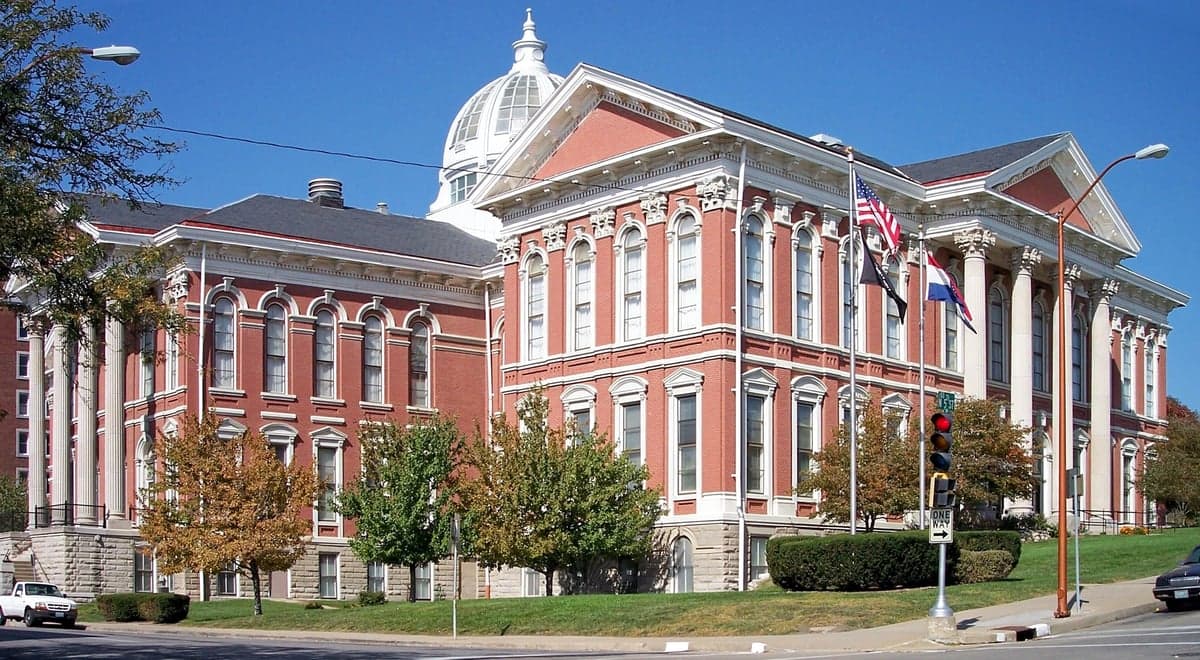
Photo: Wikipedia
Demographics of Buchanan County
Affluence Level in Buchanan County
A below-average socioeconomic profile. Incomes, home values, and educational attainment trail the U.S., with higher poverty and unemployment.
People of Buchanan County
Buchanan County, Missouri, is a predominantly white, working-to-middle-class community of 83,855 residents, anchored by the city of St. Joseph and shaped by a history of river trade, industrial booms, and steady domestic migration. The county’s population is notably less diverse than the national average, with a foreign-born share of just 1.9%, and its cultural identity remains rooted in Midwestern pragmatism, a legacy of 19th-century settlement, and a modest but growing Hispanic presence. For those considering a move here, the county offers a stable, affordable environment where the population is slowly aging and suburbanizing, with a character that is more insular and traditional than the fast-growing metros to the east and south.
Settlement & growth (pre-1960)
Before American settlement, the land that is now Buchanan County was part of the traditional territory of the Osage Nation, who controlled much of present-day western Missouri and used the Missouri River valley for hunting and seasonal camps. French fur traders and trappers passed through the area in the 1700s, but no permanent European settlements were established during the colonial period. The region was acquired by the United States in the 1803 Louisiana Purchase, and the first permanent American settlers—primarily of English, Scots-Irish, and German stock—began arriving in the 1820s and 1830s, drawn by cheap land under the Preemption Act of 1841 and later the Homestead Act of 1862.
The defining event for Buchanan County’s population was the founding of St. Joseph in 1843 by Joseph Robidoux, a French-American fur trader. The city quickly became a major jumping-off point for westward expansion, particularly during the California Gold Rush of 1849, when thousands of emigrants passed through. The completion of the Hannibal and St. Joseph Railroad in 1859 made St. Joseph the western terminus of rail service east of the Missouri River, fueling a boom in trade, manufacturing, and population. By 1860, the county had over 15,000 residents, many of them German and Irish immigrants who worked in the railroad yards, packing plants, and riverfront industries. The German community was especially concentrated in the southern part of St. Joseph and in the small farming towns of Rushville and De Kalb, where they established churches, breweries, and mutual-aid societies.
The post-Civil War era saw continued growth driven by the meatpacking industry. St. Joseph became a national center for livestock processing, with the Swift and Armour plants employing thousands of workers. This attracted a new wave of immigrants: Poles, Italians, and Eastern European Jews arrived between 1880 and 1910, settling in the city’s near-north side neighborhoods like Mound City and Easton. The African American population also grew during this period, as freed slaves and their descendants moved north from the Mississippi Delta for industrial jobs. By 1900, Black residents made up about 8% of the county’s population, concentrated in St. Joseph’s South Side and the rural community of Faucett.
The Great Depression and World War II slowed immigration but did not halt it. The Dust Bowl of the 1930s brought a small number of displaced farmers from Oklahoma and Arkansas, known as “Okies,” who settled in the county’s agricultural areas like Gower and Edgerton. The post-war period saw a suburbanization trend, with families moving from St. Joseph’s urban core to newer developments in Country Club Village and Lake Contrary. By 1960, the county’s population had peaked at roughly 93,000, driven by the baby boom and the expansion of manufacturing at plants like the St. Joseph Lead Company and the Quaker Oats mill.
Modern era (post-1965)
The 1965 Hart-Cellar Act, which ended national-origin quotas and opened immigration from Asia and Latin America, had a relatively muted effect on Buchanan County compared to coastal or Sun Belt regions. The county’s foreign-born population today stands at just 1.9%, far below the national average of 13.7%. The most significant demographic shift since 1965 has been the growth of the Hispanic population, which rose from less than 1% in 1970 to 7.0% today. This wave began in the 1990s, driven by labor demand in the meatpacking and poultry-processing industries. Many of these new residents are of Mexican and Central American origin, and they have concentrated in St. Joseph’s Midtown and South End neighborhoods, as well as in the smaller industrial town of Elwood just across the Kansas border.
The African American population has declined slightly from its mid-20th-century peak, now at 5.6%, as manufacturing jobs contracted and many Black families moved to larger Midwestern cities like Kansas City or Chicago. The remaining Black community is concentrated in St. Joseph’s East Side and the historic South Side neighborhoods. East and Southeast Asian residents (0.9%) and Indian-subcontinent residents (0.3%) are present in very small numbers, mostly professionals and students associated with Missouri Western State University in St. Joseph. The county has not seen the formation of distinct Asian or Indian enclaves; these populations are dispersed across the city and suburbs.
Domestic migration has been the dominant force shaping the county since 1965. The decline of heavy industry in the 1970s and 1980s led to a population drop from 93,000 in 1960 to 82,000 in 1990. Since then, the county has stabilized, with modest growth driven by retirees and commuters seeking lower housing costs relative to Kansas City, which is about 50 miles south. Suburbanization has continued, with new subdivisions sprouting in St. Joseph’s northern and western edges, as well as in the unincorporated areas around Amazonia and Blythedale. The county’s college-educated share is 23.3%, below the national average of 33.7%, reflecting the area’s industrial and agricultural economic base.
The future
Buchanan County’s population is projected to remain relatively flat over the next 10–20 years, with slow growth of 0.5–1% per decade, according to the Missouri Economic Research and Information Center. The county is becoming slightly more diverse, driven by continued Hispanic in-migration for food-processing and construction jobs, but the pace is slow. The white share is expected to decline from 80.7% to around 75% by 2040, while the Hispanic share may reach 10–12%. The Black and Asian shares are likely to remain stable or grow marginally, as younger residents leave for larger metros and are not replaced by new immigration.
The most notable trend is the aging of the population. The median age in Buchanan County is 38.7, slightly above the national median, and the share of residents over 65 is expected to rise from 16% to 22% by 2040. This will increase demand for healthcare services and senior housing, particularly in St. Joseph and the retirement-friendly communities of Lake Contrary and Rushville. New residential development is concentrated in the northern and western fringes of St. Joseph, where land is cheaper and schools are perceived as stronger, while the urban core continues to lose population.
Culturally, the county is likely to remain a conservative, family-oriented area with a strong sense of local identity. The growing Hispanic community is integrating into existing neighborhoods and schools, but the county has not seen the kind of rapid ethnic change that has reshaped many suburban counties. For a newcomer, Buchanan County offers a stable, low-cost environment where the population is slowly diversifying but remains overwhelmingly white and native-born, with a pace of change that is gradual rather than disruptive.
Buchanan County is becoming a quieter, older, and slightly more diverse version of its 20th-century self—a place where the river-and-railroad heritage still shapes daily life, but where the future is defined more by stability than by transformation. For someone moving in now, the county offers affordable housing, a slower pace, and a community where neighbors have often known each other for decades, but with fewer job opportunities and less cultural variety than a major metro area.

* Values derived from national, state, county, city and local statistics and may differ in a specific area. Last updated: 2026-07-10T00:26:37.000Z
Narrative content on this page is AI-generated and may contain mistakes. Verify any details that matter before acting on them.
ReloMaps may earn a commission from affiliate links at no extra cost to you.

