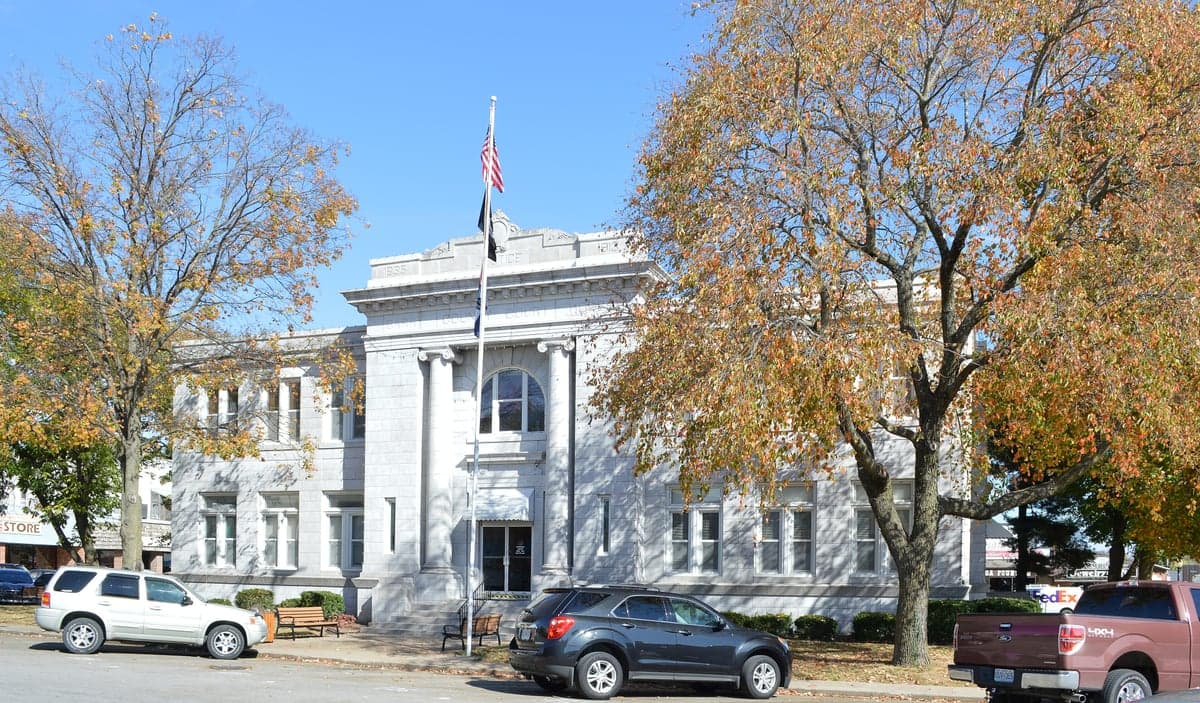
Photo: Wikipedia
Political ClimatePolitical Climate in Barry County
Showing county-level results — no local-only data available.
Lean and PVI are calculated from this county’s 2020 and 2024 presidential results, Cook-style.
Political rankings in Missouri
- Most Conservative Cities in Missouri
- Most Liberal Cities in Missouri
- Best Liberal-Leaning Towns in the Midwest
- Safest Liberal-Leaning Towns in the Midwest
- Safest Conservative-Leaning Towns in the Midwest
- Affordable Small Towns for Conservatives
- Most Affordable Liberal-Leaning Small Towns in the U.S.
- Safest Conservative-Leaning Cities in the U.S.
- Most Conservative Counties in Missouri
- Most Liberal Counties in Missouri
Local Political AnalysisPolitical Analysis of Barry County
Barry County, Missouri, is one of the most reliably Republican counties in the state, with a Cook Partisan Voting Index (PVI) of R+32—meaning it votes about 32 points more Republican than the national average. That’s a full 24 points redder than Missouri as a whole, which sits at R+8. The county hasn’t voted for a Democratic presidential candidate since 1964, and in 2024, Donald Trump carried it by roughly 80% of the vote. The political trajectory here is steady: the county has been getting redder over the past two decades, driven by an influx of retirees and remote workers from more liberal areas who often shift rightward after settling in, plus a strong local culture of gun rights and evangelical Christianity.
How it compares
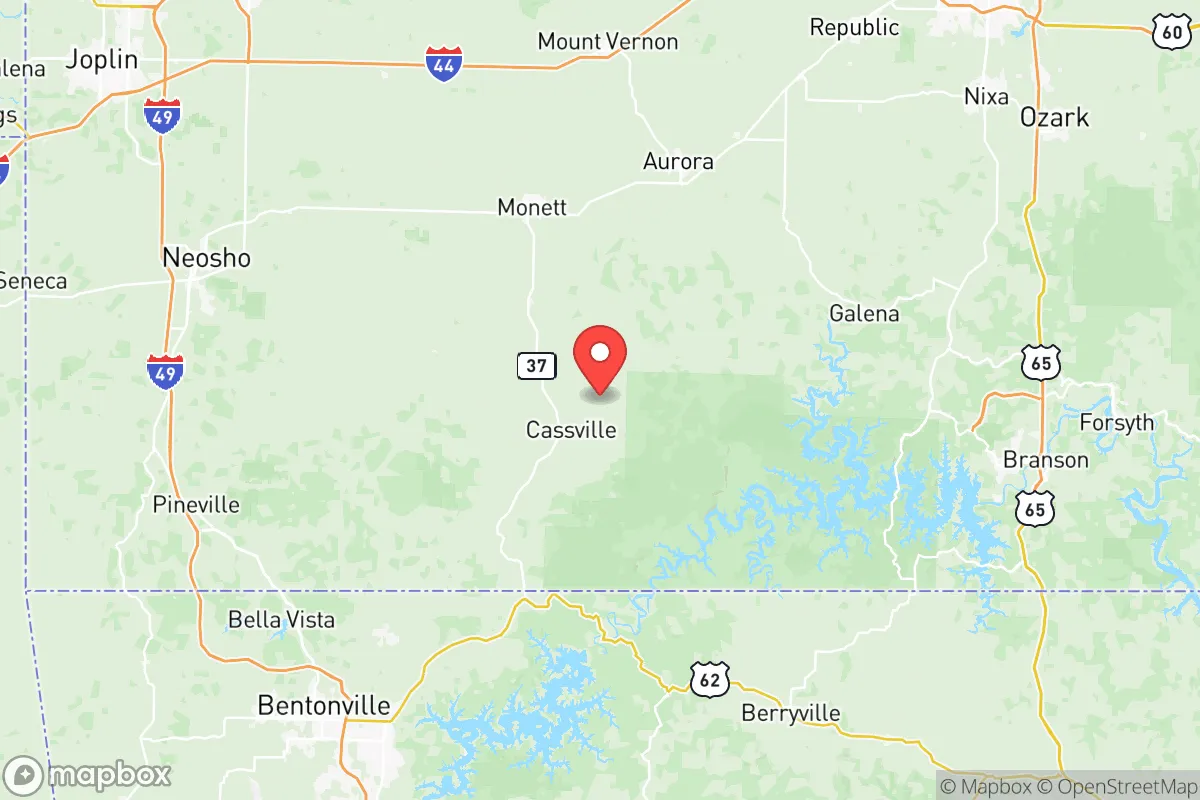
The gap between Barry County and the rest of Missouri is stark. While the state as a whole is solidly red, Barry County’s R+32 PVI puts it in the same league as the deepest-red rural counties in the Ozarks, like neighboring Stone or Taney. The state’s R+8 rating reflects the moderating influence of suburbs around St. Louis and Kansas City, plus college towns like Columbia. Barry County has none of that. The largest town, Cassville (pop. ~3,200), is a conservative stronghold where the county courthouse and local GOP headquarters anchor civic life. Monett, the other sizable town (pop. ~9,000), is more politically mixed—its growing Hispanic population (about 20% of the town) and a few manufacturing plants create small pockets of Democratic-leaning precincts, but even Monett voted about 70% for Trump in 2024. The only precincts that ever show a hint of blue are around the tiny community of Purdy, where a handful of union-affiliated workers at the local poultry plants sometimes push precinct results to 60-40 Republican instead of 80-20. Everywhere else—Washburn, Seligman, Exeter—is deep, deep red.
What this means for residents
For conservative residents, Barry County is a comfortable place to live politically. Local elections are decided in Republican primaries, and the county commission, sheriff, and school boards are uniformly GOP. Tax policy reflects that: the county has no property tax for general revenue (only for roads and schools), and sales taxes are low. For liberal residents, the reality is different. They are a distinct minority, and while there’s no open hostility, they often keep their politics private. There’s no local Democratic Party infrastructure to speak of—the county party is essentially inactive. Socially, this means that progressive viewpoints on issues like gun control or abortion are rarely heard in public forums. The practical effect is that conservative values shape everything from school curriculum (the local school board in Cassville recently debated a policy on library book content) to zoning (very little regulation, which developers and landowners appreciate).
Culturally, Barry County stands apart from the rest of Missouri in its fierce independence. The area has a strong tradition of self-reliance, rooted in its Ozark hill-country heritage. You see it in the prevalence of “No Trespassing” signs, the popularity of the annual Barry County Fair, and the near-total absence of ride-sharing or public transit. The county is also a Second Amendment sanctuary, with a resolution passed in 2020 vowing to resist any “unconstitutional” gun laws. For newcomers, the biggest adjustment isn’t the politics itself—it’s how openly and casually politics is woven into daily life. A conversation at a Cassville diner can shift from fishing to the latest statehouse bill without missing a beat. That’s just how it is here, and it’s not changing anytime soon.

State Political ClimatePolitical Climate in Missouri
State Political AnalysisPolitical Environment in the State
Missouri is a solidly Republican state with a Cook PVI of R+8, but that number masks a deeply divided political landscape that has shifted rightward over the past two decades. The state was a classic bellwether for much of the 20th century, voting for the winner in every presidential election from 1904 to 2004 except 1956. However, since 2008, Missouri has voted for the Republican candidate by increasing margins, with Donald Trump carrying the state by 18.5 points in 2020 and by a similar margin in 2024. This trajectory is driven by the exodus of rural and suburban voters from the Democratic coalition, combined with the state's slow population growth in its urban cores. For a relocator, this means you're moving to a state where conservative values dominate state policy, but where you'll find starkly different political realities depending on whether you settle in St. Louis, Kansas City, or the Ozarks.
Urban vs. rural divide
The political map of Missouri is a textbook example of the urban-rural split. The two major metropolitan areas—St. Louis and Kansas City—are Democratic strongholds. St. Louis City and County, along with Jackson County (Kansas City), consistently deliver 60-70% of their votes to Democratic candidates. These areas are home to the state's most diverse populations, major research universities (Washington University, University of Missouri-Kansas City), and a concentration of white-collar professionals. In contrast, the rest of the state is overwhelmingly Republican. The rural Ozarks, including counties like Christian, Taney, and Stone near Branson, routinely vote 75-80% Republican. The key battlegrounds are the suburban "collar counties" around the metros. St. Charles County, just west of St. Louis, has become a reliably Republican stronghold, while Clay and Platte counties north of Kansas City lean Republican but are more competitive. A notable recent shift is in Boone County, home to Columbia and the University of Missouri, which has trended Democratic and now reliably votes blue in statewide races, creating a small blue island in the middle of the state. The state's 8th Congressional District, covering southeast Missouri, is one of the most Republican districts in the country, while the 1st District (St. Louis City and northern suburbs) is one of the most Democratic.
Policy environment
Missouri's policy environment is shaped by a Republican supermajority in the state legislature and a conservative governor. The state has a flat income tax rate of 4.8%, which is being phased down to 4.5% by 2027, and a relatively low state sales tax of 4.225% (though local add-ons can push it over 10% in some cities). Property taxes are among the lowest in the nation, averaging about 0.8% of home value. The state is a "right-to-work" state (though the law was repealed by ballot initiative in 2018, the political sentiment remains anti-union). On education, Missouri has a robust charter school system in St. Louis and Kansas City, and a growing school choice movement, including a tax-credit scholarship program. The state has some of the most permissive gun laws in the country, including permitless carry for adults 19 and older and a "Stand Your Ground" law. Election laws have been tightened in recent years, with a voter ID requirement passed in 2022 and restrictions on ballot harvesting. Healthcare policy is mixed: the state expanded Medicaid under the Affordable Care Act via a 2020 ballot initiative, but the legislature has resisted further expansions and has restricted abortion access heavily.
Recent policy direction
The last five years have seen Missouri move decisively to the right on a broad range of issues. In 2022, the state passed one of the nation's most restrictive abortion laws, banning the procedure at conception with no exceptions for rape or incest (a narrow exception for medical emergencies was added later). On gun rights, the 2021 "Second Amendment Preservation Act" (SAPA) attempted to nullify federal gun laws, though parts of it were struck down by federal courts. On education, the 2023 "Parents' Bill of Rights" law requires schools to notify parents of any curriculum involving sexual orientation or gender identity and prohibits instruction on these topics in grades K-3. The state has also passed laws restricting transgender athletes' participation in school sports and banning gender-affirming care for minors. On property rights, Missouri is a "right-to-farm" state with strong protections for agricultural operations against nuisance lawsuits. On taxes, the legislature has passed multiple rounds of income tax cuts, with a goal of eventually eliminating the income tax entirely. On voting, the state passed a voter ID law and banned ballot drop boxes, though mail-in voting remains available with an excuse. On surveillance, Missouri has a relatively weak privacy framework, with no comprehensive data privacy law, though a bill is pending.
Civil unrest & political movements
Missouri has a history of high-profile civil unrest, most notably the 2014 Ferguson protests following the shooting of Michael Brown, which sparked the national Black Lives Matter movement. The state has seen ongoing protests in St. Louis over police brutality and racial justice, as well as counter-protests from groups like the Proud Boys and other far-right organizations. The immigration debate is less intense here than in border states, but there have been flashpoints, such as the 2023 controversy over a proposed immigrant detention center in St. Louis County. The state has no sanctuary city policies, and several counties have passed resolutions declaring themselves "Second Amendment sanctuaries." Election integrity has been a major issue since 2020, with the state's Republican attorney general launching investigations into voter fraud (though few cases have been prosecuted). The "nullification" rhetoric around SAPA was a significant political movement, with some rural sheriffs refusing to enforce federal gun laws. A new resident would notice the political polarization most acutely in the St. Louis region, where city-county tensions are high and where you'll see competing protests on issues like abortion and gun rights.
Projection
Over the next 5-10 years, Missouri is likely to become even more Republican at the state level, driven by continued rural depopulation and the out-migration of younger, more liberal residents from St. Louis and Kansas City to other states. The state's population growth is slow (about 0.3% annually), and the growth that does occur is concentrated in the conservative exurbs like St. Charles County and the Springfield area. The Democratic strongholds in St. Louis and Kansas City will likely become more isolated and less influential in statewide elections. However, there is a wild card: the growing Hispanic population in the Kansas City area and the increasing diversity of the St. Louis suburbs could eventually shift the political calculus, but this is a slow-moving trend. The state's tax-cutting trajectory will likely continue, with the income tax potentially being phased out entirely by the early 2030s. On social issues, expect further restrictions on abortion and transgender rights, and continued battles over school curriculum and library books. A relocator moving in now should expect to find a state that is increasingly conservative on both fiscal and social issues, with a political culture that values local control and individual liberty (as defined by the conservative majority).
For a new resident, the bottom line is that Missouri offers a low-tax, low-regulation environment with strong protections for gun owners and a conservative social agenda. If you're a conservative, you'll find your values reflected in state law and a welcoming political culture in most of the state outside the urban cores. If you're a liberal, you'll find like-minded communities in St. Louis, Kansas City, and Columbia, but you'll be living under a state government that is actively working against many of your policy preferences. The key practical takeaway is to choose your location carefully: the political reality of living in St. Louis County is fundamentally different from living in the Ozarks, even though both are in the same state. The state's trajectory is clear, and it's moving in a conservative direction that shows no signs of reversing.
* Values derived from national, state, county, city and local statistics and may differ in a specific area. Last updated: 2026-11-12T10:03:35.000Z
Narrative content on this page is AI-generated and may contain mistakes. Verify any details that matter before acting on them.
ReloMaps may earn a commission from affiliate links at no extra cost to you.

