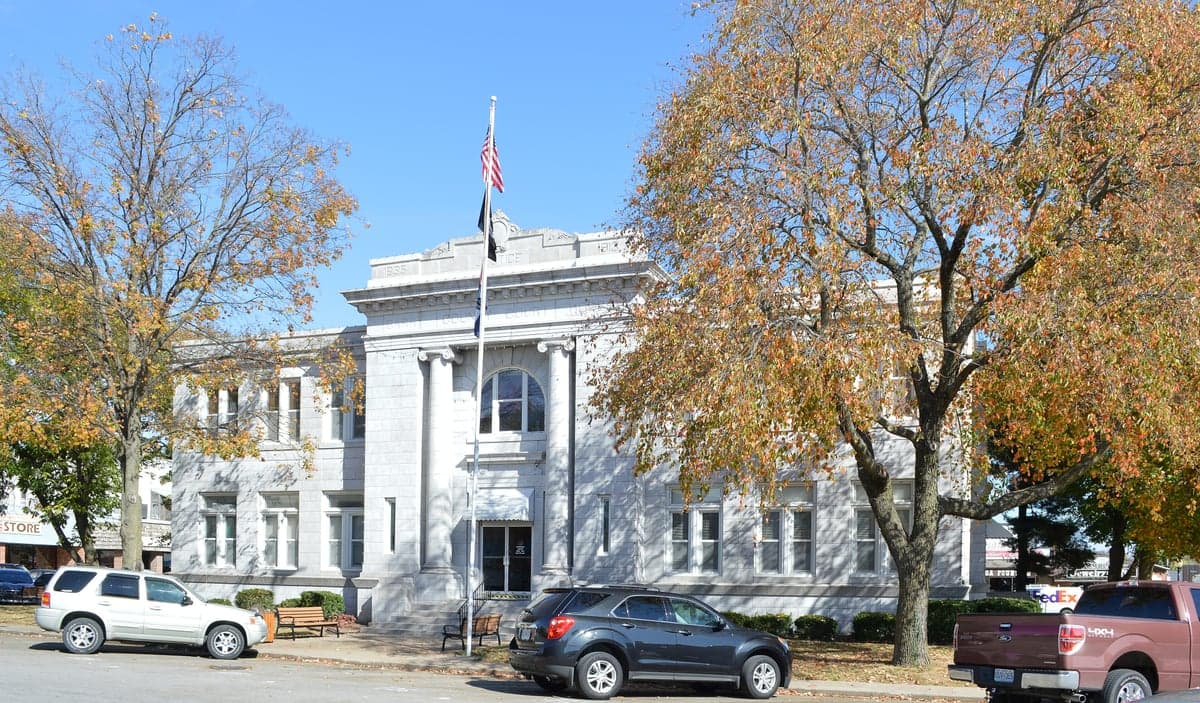
Photo: Wikipedia
Demographics of Barry County
Affluence Level in Barry County
A below-average socioeconomic profile. Incomes, home values, and educational attainment trail the U.S., with higher poverty and unemployment.
People of Barry County
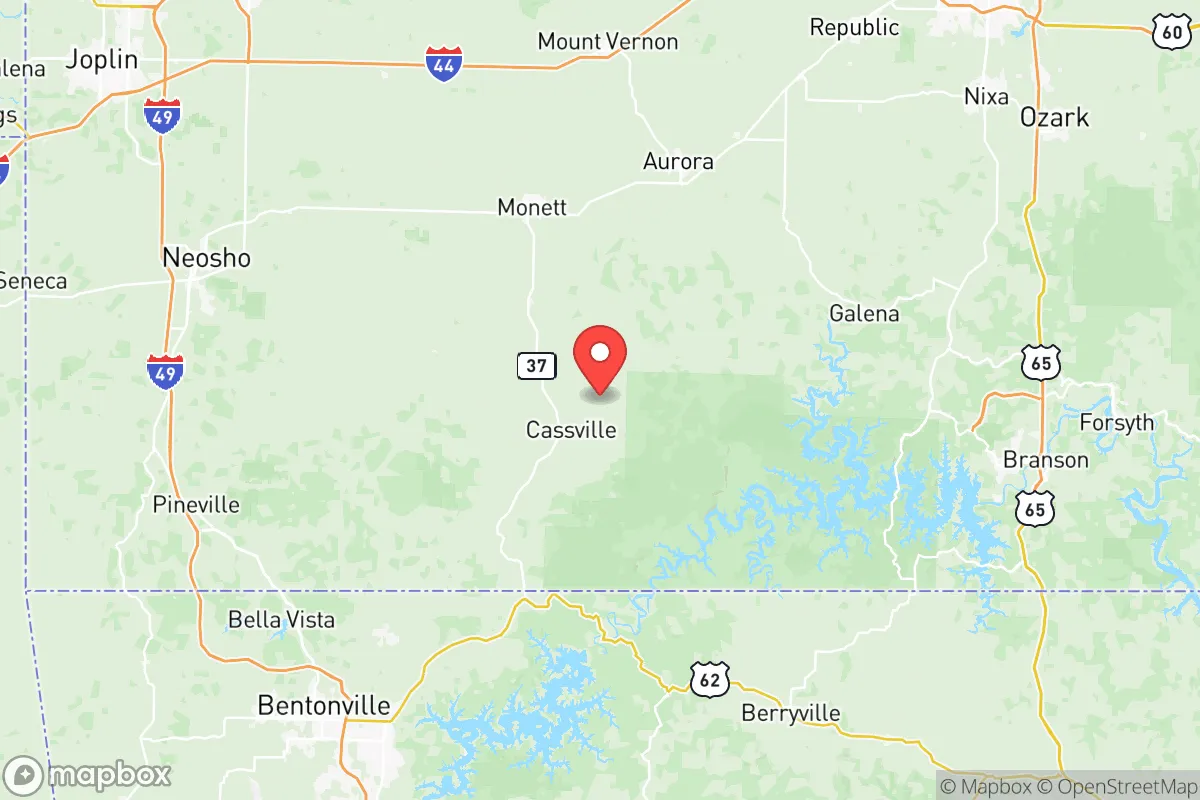
The people of Barry County, Missouri, today number 34,831 and are characterized by a strong, predominantly white (80.4%) population with a growing Hispanic minority (10.0%) and very small Asian (1.7%), Black (0.3%), and Indian (0.1%) communities. With only 2.4% foreign-born and a low 13.4% college attainment rate, the county retains a distinctly rural, working-class identity rooted in its Ozarks heritage. The population is spread across small towns like Cassville (the county seat), Monett, and Shell Knob, with a cultural character shaped by generations of family farms, faith communities, and a self-reliant, conservative ethos.
Settlement & growth (pre-1960)
Before American settlement, the area now known as Barry County was part of the traditional territory of the Osage Nation, who used the region for hunting and seasonal camps. The Osage were forcibly removed through treaties in the early 1800s, opening the land to Euro-American settlers. The first permanent white settlers arrived in the 1820s and 1830s, primarily Scots-Irish and English families migrating from Kentucky, Tennessee, and the Upper South. They were drawn by cheap land under the Preemption Act of 1841 and later the Homestead Act of 1862, establishing subsistence farms along the White River and its tributaries. These early settlers founded the county seat of Cassville in 1845, naming it after Lewis Cass, and built the first courthouse in 1846.
The next major wave came after the Civil War, when the region saw an influx of German and Swiss immigrants in the 1870s and 1880s. These families were attracted by the railroad expansion of the St. Louis–San Francisco Railway (the Frisco), which reached Monett in 1870 and Purdy in 1881. The railroad created a market for local timber, fruit, and dairy, and the German settlers brought skills in cheese-making and orchard cultivation. Monett became a thriving railroad town and commercial hub, while smaller settlements like Washburn and Seligman grew as agricultural service centers. By 1900, Barry County's population had reached 25,000, nearly all native-born whites of Northern European descent, with a tiny Black population (under 1%) and no significant Asian or Hispanic presence.
The early 20th century brought little demographic change. The county's population peaked at around 28,000 in 1910 and then declined slowly as young people left for industrial jobs in St. Louis, Kansas City, and Chicago. The Dust Bowl and Great Depression of the 1930s hit the Ozarks hard, but the construction of Table Rock Lake (completed 1958) and the creation of the Mark Twain National Forest brought a modest tourism and retirement economy. Towns like Shell Knob and Eagle Rock on the lake's shores began attracting retirees and vacation-home buyers from the Midwest, but the county remained overwhelmingly white, rural, and native-born through the 1960s.
Modern era (post-1965)
The 1965 Hart-Cellar Act had minimal direct impact on Barry County. Unlike urban areas that saw large-scale immigration from Asia and Latin America, Barry County's foreign-born population remains just 2.4% today. The most significant demographic shift since 1965 has been the growth of the Hispanic population, which rose from negligible levels in 1970 to 10.0% by 2020. This growth is almost entirely driven by domestic migration of Mexican-American families from Texas, California, and the Southwest, drawn by jobs in poultry processing and manufacturing. The Monett area, home to a major Tyson Foods plant (formerly Hudson Foods), has become the county's Hispanic hub, with a visible Spanish-speaking community, tiendas, and a Catholic church offering Spanish-language masses. Smaller Hispanic populations have also settled in Cassville and Purdy, where poultry and dairy operations provide steady employment.
The Asian population (1.7%) is a more recent phenomenon, concentrated almost entirely in Monett, where a small but established community of Vietnamese and Filipino families works in manufacturing and healthcare. The Indian-subcontinent population (0.1%) is negligible, consisting of a handful of professionals at CoxHealth clinics or regional businesses. The Black population (0.3%) has remained tiny and stable, with no significant Great Migration-era settlement and little recent growth. Domestic migration from the Rust Belt and coastal states has been modest, with most newcomers being retirees from the Midwest or remote workers seeking lower costs. Suburbanization has been limited; the county lacks a major city, and most growth has occurred in unincorporated areas around the lakes and along Highway 37.
The county's racial and ethnic composition today is thus a story of a white majority (80.4%) that is slowly shrinking, a Hispanic minority that is growing and becoming more visible, and very small Asian and other communities that remain niche. The college-educated share (13.4%) is well below the national average, reflecting the county's blue-collar economy and limited higher-education infrastructure. The population has grown modestly from 34,010 in 2000 to 34,831 in 2020, a rate far slower than the booming suburbs of nearby Springfield or Benton County, Arkansas.
The future
Barry County's population is projected to remain stable or grow slowly over the next 10–20 years, with the Hispanic share likely rising to 12–15% as younger families settle in Monett and Cassville. The white population will continue to age and decline slightly, while the Asian and Black populations are expected to remain small, barring a major employer relocation. The county's cultural identity is evolving from a nearly all-white, Protestant, agrarian society to a more diverse but still predominantly white and conservative community. Newcomers are likely to be retirees from the Midwest, remote workers from the coasts, and Hispanic families seeking affordable housing and steady work in food processing. The county's low cost of living, natural beauty, and conservative values will continue to attract a specific type of migrant, but the lack of high-skilled jobs and higher education will limit demographic diversification.
For someone moving in now, Barry County offers a quiet, rural lifestyle with a strong sense of community, low crime, and affordable land, but with limited ethnic diversity, few professional opportunities, and a population that is older and less educated than the national average. The county is becoming slightly more Hispanic and slightly less white, but it remains one of the most homogenous counties in the Missouri Ozarks, and that character is likely to persist for the foreseeable future.

* Values derived from national, state, county, city and local statistics and may differ in a specific area. Last updated: 2026-11-12T10:03:35.000Z
Narrative content on this page is AI-generated and may contain mistakes. Verify any details that matter before acting on them.
ReloMaps may earn a commission from affiliate links at no extra cost to you.

