
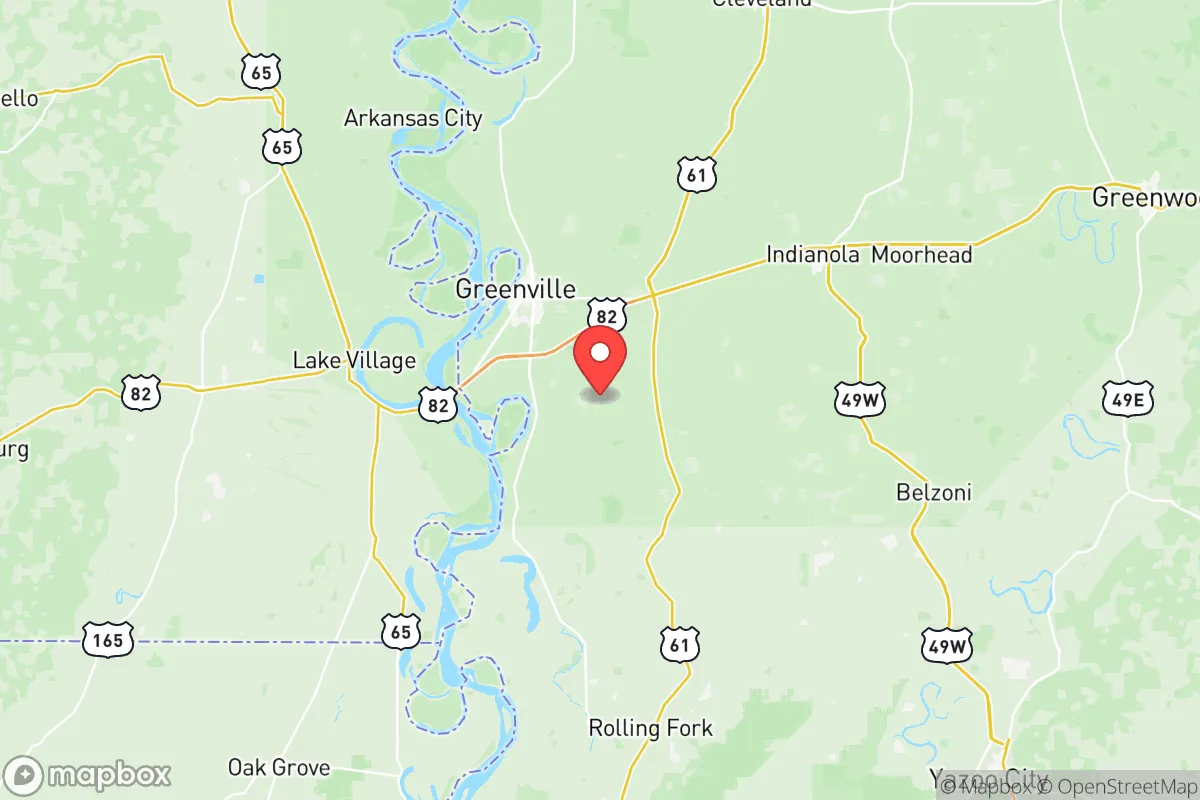
Photo: Wikipedia
Political ClimatePolitical Climate in Washington County
Showing district-level results — no local-only data available.
Local Political AnalysisPolitical Analysis of Washington County
Washington County is a Democratic stronghold in the Deep South, carrying a Cook PVI of D+11 that stands in stark contrast to the rest of Mississippi, which leans R+11. This isn't a recent shift; the county has been reliably blue for decades, driven largely by the African American majority in the Delta region. The political center of gravity is Greenville, the county seat, where Democratic candidates routinely win by wide margins. However, the county isn't a monolith. The smaller, more rural communities like Leland and Arcola show more competitive races, with pockets of Republican support, particularly in precincts around the agricultural areas and along the Highway 82 corridor. The overall trajectory is a slow, subtle rightward creep in the county's white, rural precincts, but the core Democratic vote in Greenville and the surrounding black-majority areas remains solid, keeping the county's overall lean firmly blue.
How it compares
The political gulf between Washington County and the rest of Mississippi is one of the widest in the state. While Mississippi as a whole voted for Donald Trump by 11 points in 2024, Washington County voted for Joe Biden by a similar margin. This isn't a case of a purple county trending blue; it's a deeply entrenched Democratic stronghold in a deeply Republican state. The contrast is most visible in state legislative races. The county's state house and senate districts are held by Democrats, while the surrounding counties—like Bolivar to the north and Sunflower to the east—are represented by Republicans. The county's Cook PVI of D+11 is a statistical outlier in a state where the average county leans R+15 or more. This means that for a conservative resident, living in Washington County means being in a political minority locally, but part of the statewide majority. For a liberal resident, it's the opposite: local politics align with their views, but state-level policies often feel imposed from Jackson.
What this means for residents
For conservatives in Washington County, the practical reality is that local government—from the county board of supervisors to the school board—is controlled by Democrats. This can feel isolating, but it also means that conservative voices are often heard as a loyal opposition, not a rubber stamp. For liberals, the local political climate is comfortable, but the state-level dynamic is a constant source of friction. Issues like Medicaid expansion, voting access, and education funding are debated locally with a progressive bent, but the state legislature in Jackson often overrides or preempts those local decisions. The county's Democratic lean also means that federal funding for programs like the Delta Regional Authority and community health centers is a consistent political priority, with local officials often at odds with the state's Republican leadership over how those funds are allocated.
One cultural distinction that sets Washington County apart is the enduring influence of the civil rights movement and the legacy of the Mississippi Delta's blues and literary traditions. Greenville's annual Mississippi Delta Blues Festival and the presence of the Greenville Arts Council reflect a community that values its progressive cultural heritage. This isn't just a political identity; it's woven into the fabric of daily life. The county's political climate also shapes its approach to economic development, with a focus on public-private partnerships and community-based initiatives rather than the tax-incentive-heavy approach favored in more conservative parts of the state. For anyone moving here, the key takeaway is that Washington County offers a politically distinct experience within Mississippi—a place where the local conversation is often at odds with the state's, but where that tension is part of the region's character.

State Political ClimatePolitical Climate in Mississippi
State Political AnalysisPolitical Environment in the State
Mississippi has been a reliably red state for over half a century, with a Cook Partisan Voting Index of R+11, meaning it votes roughly 11 points more Republican than the national average. The state hasn't voted for a Democratic presidential candidate since Jimmy Carter in 1976, and that trend has only hardened in recent cycles—Donald Trump carried the state by 16 points in 2024, and Republicans now hold every statewide office and supermajorities in both legislative chambers. But scratch the surface and you'll find a political landscape that's anything but uniform: a deep-ruby rural base, a handful of blue urban islands, and a growing suburban middle ground that's starting to shift.
Urban vs. rural divide
The political geography of Mississippi is stark and unchanging. The state's two largest metros, Jackson and the Mississippi Gulf Coast, anchor opposite ends of the spectrum. Jackson, the capital and largest city, is a reliably blue stronghold—Hinds County gave Biden 68% in 2020—driven by a majority-Black population and a strong union and educator presence. The Coast around Biloxi and Gulfport leans red but is more competitive, thanks to a mix of military retirees, casino workers, and defense contractors; Harrison County went +12 for Trump in 2024, closer to the national average than the rest of the state. The real Republican engine is the northeastern hill country around Tupelo and Oxford, and the Delta flatlands west of I-55. DeSoto County, just south of Memphis, is the state's fastest-growing and most reliably red suburb—it gave Trump 67% in 2024. Meanwhile, the Pine Belt around Hattiesburg and the Golden Triangle (Columbus, Starkville, West Point) lean red but show occasional Democratic blips in local races, especially when education funding is on the ballot. The only significant geographic shift in the last decade is the slow blueing of the College Town corridor—Starkville (Oktibbeha County) and to a lesser extent Oxford (Lafayette County) have moved left as university populations have grown; Oktibbeha went from +22 R in 2012 to +9 R in 2024.
Policy environment
Mississippi's policy posture is unapologetically conservative, with a low-tax, low-service model. The state has a flat 4.7% income tax, set to phase down to zero by 2032 under HB 531 (2023), making it one of the few states on a path to full abolition of income tax. Sales taxes are high—7% statewide, plus local add-ons that can push it to 8% or more in cities like Jackson and Gulfport. Property taxes are among the lowest in the nation by effective rate, thanks to a 10-mill cap on school taxes for owner-occupied homes, which keeps housing costs low but also starves local school funding. Education policy leans toward school choice: Mississippi has a limited private school voucher program for special-needs students and a thriving charter school sector in Jackson, though traditional public schools in rural areas remain underfunded. Healthcare is where the state's conservatism hits hardest: Mississippi has not expanded Medicaid under the ACA, leaving roughly 100,000 adults in the coverage gap; the state also imposes a six-week abortion ban (the "Heartbeat Bill," 2018) and a near-total ban post-Dobbs, with no exceptions for rape or incest. Election laws are among the most restrictive in the South: strict photo ID is required, no-excuse absentee voting does not exist, and Mississippi is one of only a handful of states that still requires a separate runoff for general elections if no candidate clears 50%—a system that disproportionately affects competitive races.
Recent policy direction
The last three years have seen Mississippi double down on cultural and fiscal conservatism. On gun rights, the state in 2023 removed the requirement for a permit to carry a concealed handgun (constitutional carry), joining about half the country. On education, the 2024 "Parents' Bill of Rights" (HB 1632) guarantees parents the right to review curriculum and opt their children out of any lesson they object to, and bans any discussion of "gender identity" or "sexual orientation" in K-6 classrooms. On speech, Mississippi in 2024 passed a law prohibiting public colleges from requiring "diversity statements" in admissions or hiring (SB 2076), a direct response to faculty activism. On property rights, the state strengthened eminent domain protections for landowners (HB 1265, 2023), making it harder for cities to seize land for private development. On medical and bodily autonomy, the post-Dobbs ban on nearly all abortions remains in full force, and the 2024 "Women's Bill of Rights" (SB 2300) legally defines "woman" as "an individual whose biological sex is female at birth," affecting eligibility for female-only spaces and sports. On voting, Mississippi continues to resist no-excuse absentee voting and early voting expansion; a 2024 effort to allow early voting died in committee.
Civil unrest & political movements
Mississippi has a quieter surface than many states, but tensions bubble beneath it. The most visible flashpoints in recent years have been around race and policing: Jackson saw sustained protests in 2020 after the killing of George Floyd, and the city's water crisis in 2022—when the main treatment plant failed—became a national symbol of infrastructure neglect, with state (Republican) and city (Democratic) officials trading blame. The Delta has periodic economic protests, with farm workers and low-wage laborers calling for better conditions; a 2023 strike at a poultry plant in Morton drew national attention. On the right, the "Magnolia State Tea Party" movement remains active, particularly in DeSoto County and the Gulf Coast, pushing for further tax cuts and school vouchers. Immigration politics are less volatile here than in border states—Mississippi has a small foreign-born population (just 2.5%)—but a 2024 law requiring local law enforcement to cooperate with ICE (HB 1130) passed along party lines. Secessionist rhetoric occasionally surfaces in rural areas (a 2023 resolution in five northern counties floated "nullification" of federal gun laws), but it hasn't gained traction. Election integrity controversies flared after 2020, particularly around the state's use of paper ballots and hand-counting in small precincts; a 2024 audit found no evidence of widespread fraud, but the issue remains a live constituency in Republican primaries.
Projection
Over the next 5-10 years, Mississippi is likely to remain firmly Republican, but the margins may shrink slightly as the College Town corridor blueing continues and the Jackson metro suburbia diversifies. The pending phaseout of the income tax will further entrench the state's low-tax appeal, potentially attracting retirees and remote workers from higher-cost states—especially around the Coast and Desoto County. Expect continued fights over education funding as the school choice movement pushes for universal vouchers, and over Medicaid expansion, which could come if Republicans see it as a humanitarian or economic necessity (the state's hospital closure rate is among the highest in the nation). The big wildcard is whether the Jackson water crisis and related urban infrastructure issues galvanize enough suburban moderate and Black voters to flip a few state legislative seats; Demographics alone won't flip the state, but they could make the governor's race competitive if a moderate Republican faces a scandal. Politically, Mississippi will remain a test bed for post-Roe abortion restrictions, parental rights in education, and the next phase of tax-cutting experiments.
What this means for a new resident: If you lean conservative, you'll find a state that largely aligns with your values on taxes, guns, education, and abortion—Mississippi is one of the easiest places to live according to that worldview. If you lean liberal, you'll experience a constant headwind: your vote in statewide races won't count much, access to reproductive care is nearly eliminated, and the public school system is chronically underfunded. The practical tradeoff is cost of living—low housing costs and no income tax by 2032—versus limited public services and a restrictive legal environment on social issues. If you're moving to Oxford or Starkville, you'll find more political diversity and a slightly more liberal local culture; if you're heading to Desoto County or the Coast, the politics will be as conservative as the décor.
* Values derived from national, state, county, city and local statistics and may differ in a specific area. Last updated: 2026-07-02T02:32:50.000Z
Narrative content on this page is AI-generated and may contain mistakes. Verify any details that matter before acting on them.
ReloMaps may earn a commission from affiliate links at no extra cost to you.

