
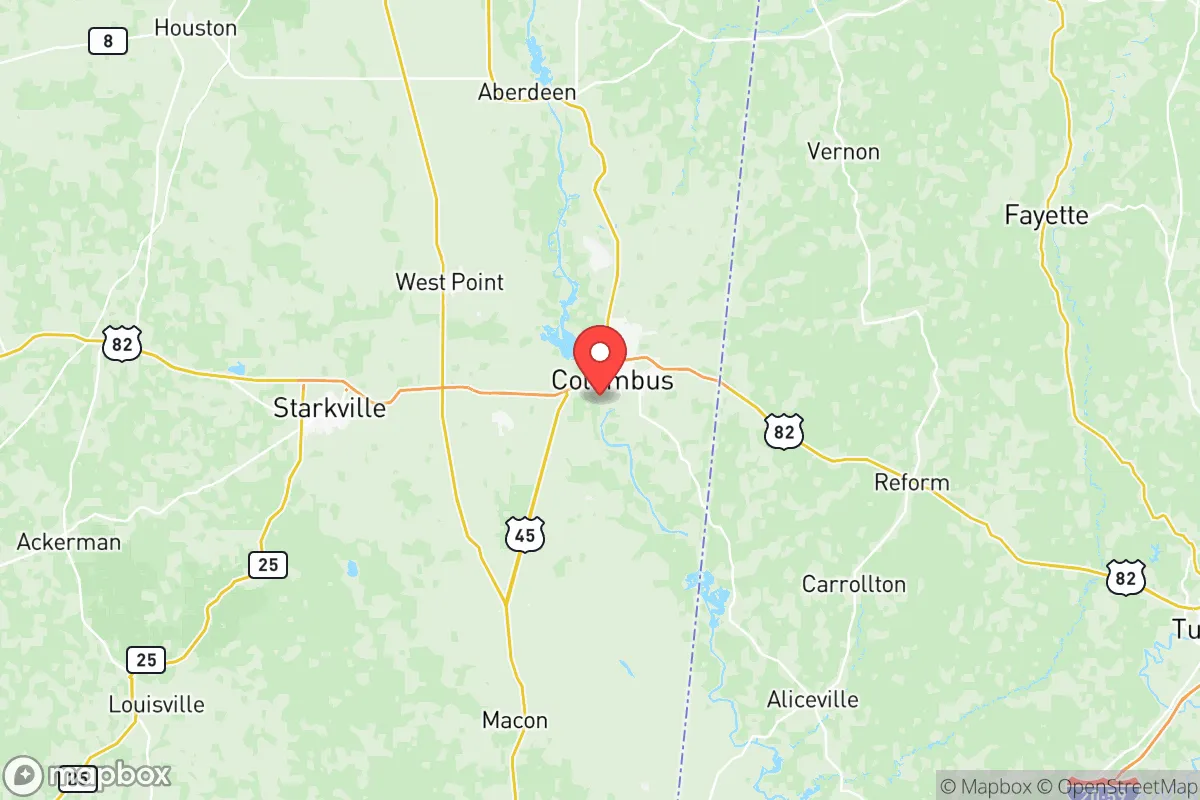
Photo: Wikipedia
Personal Sovereignty in Lowndes County
Viable for self-reliance. Generally workable, though some barriers may limit total independence.
What does Personal Sovereignty tell us?
Personal Sovereignty measures your capacity for self-reliance and independence with minimal government friction. Higher scores mean fewer barriers between you and the way you want to live... but it assumes you have the space you need and good neighbors.
What does this tell us?
Personal Sovereignty measures your capacity for self-reliance and independence with minimal government friction. Higher scores mean fewer barriers between you and the way you want to live... but it assumes you have the space you need and good neighbors.
State Policy
Energy independence: Importer (50% of energy produced in-state)
Personal Liberty
Homesteading

Personal Liberty Analysis
Lowndes County, Mississippi offers a personal sovereignty environment that leans heavily toward individual autonomy, shaped by Mississippi’s broad preemption laws, low tax burden, and a cultural preference for self-reliance. Unlike more regulated metro areas in the Southeast, Lowndes County residents face minimal local interference in daily life, from firearm ownership to property use. The county’s regulatory posture is generally light-touch, though specific municipalities like Columbus and Caledonia impose slightly more structure than unincorporated areas. For a relocation reader prioritizing personal freedom, this corner of eastern Mississippi ranks among the more hands-off jurisdictions in the region.
Tax burden and regulatory posture in Lowndes County
Mississippi’s state-level tax structure is among the most favorable for personal sovereignty. There is no state income tax on Social Security benefits, and the state’s flat income tax rate is 4.0% as of 2026, with a phase-down to 3.99% scheduled. Property taxes in Lowndes County are notably low: the average effective property tax rate hovers around 0.72% of assessed value, roughly half the national average. For a $200,000 home, that translates to about $1,440 annually. Sales tax in Columbus is 8.0% (state plus local), while unincorporated areas and smaller towns like Steens or Artesia see a 7.0% rate. Regulatory posture is business-friendly: no county-level zoning in unincorporated areas, meaning property use is largely unrestricted unless you’re inside Columbus city limits, where a zoning ordinance applies. Permitting for home construction is straightforward, with no county-wide building codes outside municipal jurisdictions. The state’s right-to-work status and lack of prevailing wage laws further reduce bureaucratic friction for self-employed individuals and small contractors.
Self-defense and gun law specifics in Lowndes County
Mississippi is a constitutional carry state, meaning no permit is required to carry a concealed firearm for anyone legally allowed to possess one. Lowndes County fully aligns with this posture. Open carry is legal without a permit. The state preempts all local firearm ordinances, so cities like Columbus, Caledonia, and New Hope cannot enact their own gun restrictions. Stand-your-ground law applies with no duty to retreat in any place where the individual has a legal right to be. Castle doctrine protections extend to vehicles and occupied structures. For those seeking formal training, a Mississippi Enhanced Carry Permit (which requires a class) is available and recognized in 38 states via reciprocity. The county sheriff’s office in Lowndes County processes permits efficiently, with typical turnaround under 30 days. Gun culture is deeply embedded: the Columbus Air Force Base area and surrounding rural communities host regular shooting sports events, and firearm sales at local dealers like Columbus Gun & Pawn are brisk. No waiting periods, no firearm registration, and no magazine capacity restrictions exist at the state level.
Self-reliance and homesteading viability in Lowndes County
Lowndes County is a strong candidate for homesteading and off-grid living, particularly outside municipal boundaries. Unincorporated areas have no minimum lot size requirements for agricultural use, though residential subdivisions in areas like Steens or Artesia typically see parcels of 1–5 acres. Zoning is absent county-wide, so raising livestock, keeping chickens, or operating a small farm is unrestricted. Rainwater collection is legal and encouraged—Mississippi has no state-level restrictions on cisterns or rainwater harvesting. Off-grid solar is feasible: net metering is available through the Tennessee Valley Authority (TVA) for grid-tied systems, but going fully off-grid is legal with no permit required for standalone solar arrays under 20 kW. Septic systems require a county health department permit (about $200), but composting toilets are allowed with proper design. Well drilling is permitted with a simple registration. The growing season runs 220+ days, and soil quality in the Black Prairie region is fertile for row crops and pasture. For those seeking a self-sufficient lifestyle, the areas around Caledonia and Steens offer affordable land—typically $3,000–$6,000 per acre—with easy access to Columbus for supplies. The county’s rural character means noise ordinances are lax, and burning debris or operating machinery is generally unrestricted outside city limits.
Personal liberties in Lowndes County: parental rights, medical autonomy, speech, and property
Mississippi law strongly protects parental rights. The state’s Parents’ Bill of Rights (SB 2682, 2023) affirms that parents have the fundamental right to direct their children’s education, healthcare, and religious upbringing. Lowndes County school districts, including the Lowndes County School District and Columbus Municipal School District, generally defer to parental authority on curriculum objections and medical decisions. Homeschooling is straightforward: parents file a simple notice of intent with the state, and no standardized testing is required. Medical autonomy is more limited—Mississippi has not expanded Medicaid and maintains strict regulations on alternative medicine—but the state does not mandate COVID-19 vaccines for adults or children, and no local health orders in Lowndes County have restricted personal medical choices since 2021. Free speech protections are robust; the state has no anti-SLAPP law, but local government in Columbus and Caledonia rarely engages in content-based restrictions. Property rights are strong: eminent domain is limited to public use projects, and the state’s “private property rights protection act” requires compensation for regulatory takings. No county-level rental registration or rent control exists. For those who value minimal government intrusion into family and personal decisions, Lowndes County presents a permissive environment relative to more regulated states in the Northeast or West Coast.
Overall, Lowndes County ranks among the more sovereignty-friendly areas in the Southeast, comparable to neighboring Noxubee County or Monroe County but with better infrastructure access. The combination of constitutional carry, no county zoning outside cities, low property taxes, and strong parental rights creates an environment where personal autonomy is the default rather than the exception. For a conservative-leaning individual or family seeking a place where government stays out of daily life, Lowndes County delivers a consistently light regulatory touch across nearly every dimension of personal sovereignty.

* Values derived from national, state, county, city and local statistics and may differ in a specific area. Last updated: 2026-06-30T04:39:33.000Z
Narrative content on this page is AI-generated and may contain mistakes. Verify any details that matter before acting on them.
ReloMaps may earn a commission from affiliate links at no extra cost to you.

