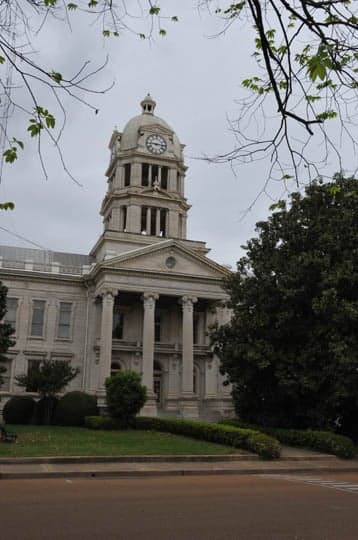
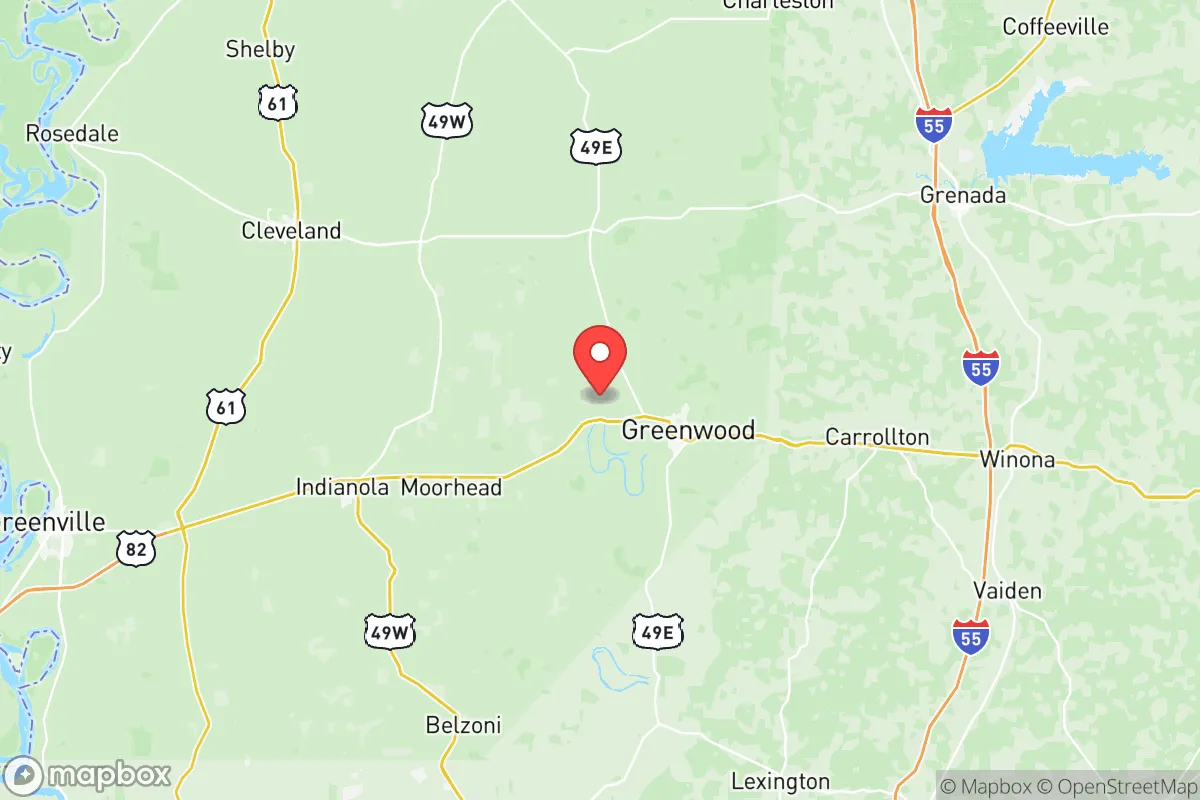
Photo: Wikipedia
Political ClimatePolitical Climate in Leflore County
Showing district-level results — no local-only data available.
Local Political AnalysisPolitical Analysis of Leflore County
Leflore County, Mississippi, is a political outlier in a deeply red state, carrying a Cook Partisan Voting Index of D+11 while the state of Mississippi as a whole sits at R+11. That 22-point gap makes the county one of the most reliably Democratic areas in the Magnolia State, driven largely by the majority-Black population in the county seat of Greenwood and the surrounding Mississippi Delta region. Over the past three presidential cycles, Leflore has voted Democratic by comfortable margins — Biden won it by roughly 20 points in 2020, and Hillary Clinton carried it by a similar spread in 2016 — but turnout has been inconsistent, and the county's overall political influence is muted by its relatively small population of about 28,000.
How it compares
Mississippi's statewide R+11 rating reflects a solid Republican lean, with most rural and suburban counties voting red by double digits. Leflore County flips that script entirely. The contrast is starkest when you compare Greenwood, which leans heavily Democratic, with the smaller, more rural communities scattered across the county. For instance, the town of Itta Bena — home to Mississippi Valley State University — also trends blue, though with lower turnout than Greenwood. Meanwhile, precincts in the eastern part of the county, around the community of Money and near the Tallahatchie River, have shown more competitive margins, occasionally swinging toward Republican candidates in local races. The county's Democratic lean is not a recent development; it has been a consistent feature since the post-Reconstruction era, though the coalition has shifted from a white-dominated Democratic machine to a Black-led progressive base. That said, voter apathy and economic disenfranchisement keep turnout below the state average, which tempers the county's electoral punch in statewide contests.
What this means for residents
For conservative residents, living in a D+11 county means their votes are often drowned out in local elections, but they still see their values reflected in state-level policy — from abortion restrictions to gun laws — because Mississippi's Republican supermajority controls Jackson. For liberal residents, the county offers a rare pocket of political alignment in a red state, but that doesn't translate to much local policy power: Leflore County struggles with poverty, infrastructure, and education funding, issues that don't get much attention from the state legislature. Practically, this means a conservative family in the county might feel politically isolated at the local level but comfortable with state laws, while a progressive family might feel at home in Greenwood's civic life but frustrated by the lack of state investment in the Delta. The county's Democratic lean also shapes its representation: Leflore is part of Mississippi's 2nd Congressional District, represented by Democrat Bennie Thompson, one of the most senior Black members of Congress, which gives the area a direct line to federal funding and civil rights advocacy.
Culturally, Leflore County's political identity is inseparable from its history as the heart of the Delta blues and a focal point of the Civil Rights Movement — the murder of Emmett Till in nearby Money in 1955 still echoes in local politics and community organizing. Policy-wise, the county has been a testing ground for economic development initiatives like the Greenwood Leflore Hospital expansion and the Viking Range Corporation's presence, but these efforts are often undercut by state-level resistance to expanding Medicaid or increasing public school funding. For anyone moving here, the political climate is less about partisan bickering and more about navigating the gap between local needs and state priorities — a reality that shapes everything from road maintenance to healthcare access.

State Political ClimatePolitical Climate in Mississippi
State Political AnalysisPolitical Environment in the State
Mississippi is one of the most reliably Republican states in the country, with a Cook Partisan Voting Index of R+11, meaning it votes about 11 points more Republican than the national average in presidential elections. The state hasn't voted for a Democratic presidential candidate since Jimmy Carter in 1976, and the GOP now holds every statewide office and supermajorities in both legislative chambers. Over the last 20 years, the shift has been decisive: white voters in the Delta and Pine Belt consolidated behind the GOP, while the state's large Black population (roughly 38% of residents) remains overwhelmingly Democratic, creating one of the most racially polarized electorates in America.
Urban vs. rural divide
The political map of Mississippi is a study in contrasts. The state's only reliably Democratic stronghold is the Jackson metro area (Hinds County), which has voted blue by double digits in every recent cycle. The Mississippi Gulf Coast, anchored by Biloxi and Gulfport, leans Republican but is more competitive than the rest of the state — Harrison County voted for Trump by about 20 points in 2024, closer than the statewide margin. The northeastern corner around Tupelo and Oxford is reliably red, though Lafayette County (home to the University of Mississippi) has been trending purple as younger and more educated voters move in. The Delta region — places like Greenville and Clarksdale — is deeply Democratic due to its majority-Black population, but those areas have shrinking populations and declining political clout. The fastest-growing parts of the state, like the DeSoto County suburbs of Memphis (Southaven, Olive Branch), are overwhelmingly Republican and drive the state's rightward trajectory.
Policy environment
Mississippi's policy posture is among the most conservative in the nation. The state has no income tax on wages — the individual income tax was phased out entirely as of 2026, leaving only a 7% corporate income tax and a 7% sales tax on most goods. Property taxes are low by national standards, with no state-level property tax and local rates averaging around 0.8% of assessed value. The state is a right-to-work state with weak labor unions and no minimum wage above the federal $7.25. Education policy is dominated by school choice: Mississippi has a robust charter school law, a voucher-like Education Scholarship Account program for students with disabilities, and a new universal school choice program passed in 2024 that allows any family to use state funds for private school tuition. Healthcare is a flashpoint — the state has not expanded Medicaid under the Affordable Care Act, leaving roughly 75,000 residents in the coverage gap, and the state's maternal mortality rate is the highest in the nation. Election laws require a government-issued photo ID to vote, and early voting was expanded in 2024 to allow in-person absentee voting up to 14 days before an election without an excuse.
Recent policy direction
The last five years have seen Mississippi accelerate its conservative policy agenda across multiple fronts. On gun rights, the state enacted permitless carry in 2023, allowing any adult who can legally possess a firearm to carry it openly or concealed without a license. Stand-your-ground laws have been on the books since 2006, and the state has a strong castle doctrine. On education and parental rights, the 2024 universal school choice law is the biggest shift — it lets families use roughly $7,000 per child in state funding for private school, homeschooling expenses, or tutoring. The same year, the legislature passed a Parents' Bill of Rights requiring schools to notify parents about any changes to a child's mental or physical health and prohibiting instruction on sexual orientation or gender identity in K-3 classrooms. On medical and bodily autonomy, Mississippi has one of the strictest abortion bans in the country — triggered by the Dobbs decision, the law prohibits abortion at conception with no exceptions for rape or incest, only to save the mother's life. The state also banned gender-affirming care for minors in 2023. On voting and ballot access, the 2024 early voting expansion was a notable shift — Mississippi was one of the last states without any early voting, and the new law allows two weeks of in-person absentee voting without an excuse. Property rights remain strong: the state has no statewide zoning and relatively weak eminent domain powers. On privacy and surveillance, Mississippi has no comprehensive data privacy law, and law enforcement can access cell phone location data without a warrant in emergencies.
Civil unrest & political movements
Mississippi's political activism is quieter than in many states, but there are visible flashpoints. The Jackson water crisis of 2022-2023 — when the capital city's water system failed for weeks — became a national story and a rallying point for civil rights and environmental justice groups, who argued the state had neglected a majority-Black city's infrastructure. Protests in Jackson were frequent but small, drawing a few hundred people. On the right, the state has seen organized opposition to critical race theory and LGBTQ-inclusive policies in schools, with groups like Mississippi Parents Matter pushing for the 2024 Parents' Bill of Rights. Immigration politics are less heated than in border states — Mississippi's foreign-born population is only about 2.5% — but the state has seen a few high-profile immigration enforcement actions, including a 2019 raid at a Koch Foods plant in Morton that detained nearly 700 workers. There is no sanctuary city movement in Mississippi; all local law enforcement cooperates with federal immigration authorities. Election integrity controversies have been minimal — the state's 2020 and 2024 elections ran smoothly with no major disputes, though the legislature tightened absentee ballot rules in 2021. Secession and nullification rhetoric is rare and mostly confined to fringe groups; the state officially retired its Confederate-themed state flag in 2020 after a public referendum, a move that passed with 73% support and signaled a shift in mainstream political culture.
Projection
Over the next 5-10 years, Mississippi is likely to become even more Republican, but the nature of that conservatism may evolve. The state's population is growing slowly — about 0.3% annually — and that growth is concentrated in the suburban Memphis counties (DeSoto) and the Gulf Coast (Ocean Springs, Long Beach), both of which are solidly red. The Black population, which makes up the Democratic base, is shrinking as a share of the total due to out-migration from the Delta. The biggest wild card is the Jackson metro: if the city's population decline continues — Jackson lost about 10% of its residents between 2020 and 2025 — the state's only Democratic stronghold will have less political weight. On policy, expect continued movement on school choice (possibly expanding to universal vouchers), further tax cuts (the corporate income tax may be phased out), and no movement on Medicaid expansion. The state's cultural conservatism on abortion and LGBTQ issues is unlikely to soften, but the early voting expansion suggests a pragmatic streak that could lead to more election access reforms. For a new resident, the Mississippi of 2035 will look much like the Mississippi of 2025 — deeply conservative, low-tax, and culturally traditional — but with a more suburban, less rural character and a slightly more professionalized state government.
For someone moving to Mississippi, the bottom line is straightforward: you'll be living in one of the most conservative states in the country, with low taxes, weak regulation, and a government that prioritizes school choice, gun rights, and traditional social values. If that aligns with your politics, you'll find a welcoming environment where your vote carries weight and your values are reflected in state law. If you're on the left, you'll be in a clear minority — but you'll find like-minded communities in Jackson, Oxford, and parts of the Gulf Coast, and the state's low cost of living and slower pace of life may still appeal. Either way, Mississippi's political direction is stable and predictable: it will stay red, stay conservative, and stay the course.
* Values derived from national, state, county, city and local statistics and may differ in a specific area. Last updated: 2026-06-15T19:31:49.000Z
Narrative content on this page is AI-generated and may contain mistakes. Verify any details that matter before acting on them.
ReloMaps may earn a commission from affiliate links at no extra cost to you.

