
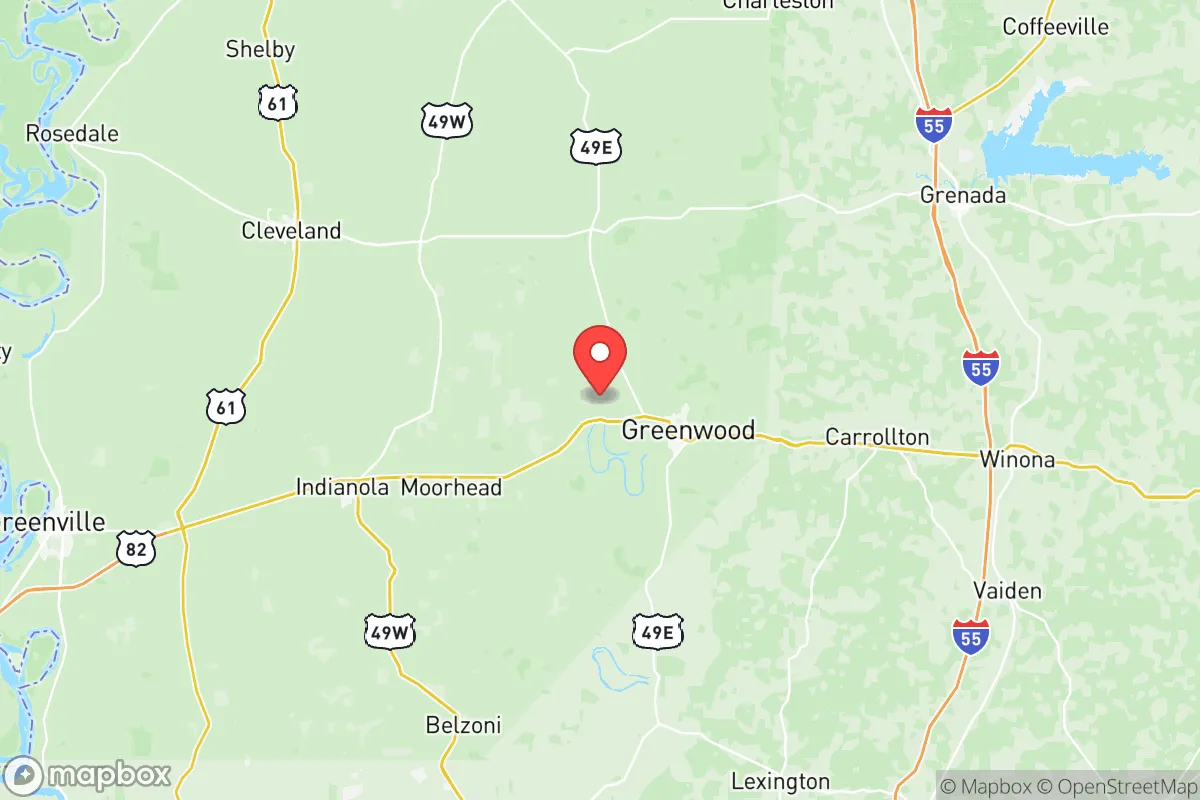
Photo: Wikipedia
Demographics of Leflore County
Affluence Level in Leflore County
A low-income area with significant economic hardship. Household wealth and educational attainment are well below national averages.
People of Leflore County
Today, the people of Leflore County, Mississippi are predominantly Black (74.5%), with a White population of 21.0% and a small Hispanic community of 3.1%. The county is home to roughly 27,432 residents, a figure that has declined steadily over the past several decades, and it remains one of the most rural and economically challenged areas in the Mississippi Delta. The population is concentrated in the county seat of Greenwood, along with smaller towns like Itta Bena and Sidon, and the region’s identity is deeply tied to its agricultural heritage, the legacy of the Civil Rights Movement, and a strong sense of place among long-standing families.
Settlement & growth (pre-1960)
Long before European settlement, the area that is now Leflore County was home to the Choctaw people, who established villages along the Yazoo River and its tributaries. The county itself is named after Greenwood Leflore, a Choctaw chief who became a wealthy planter after the tribe’s removal under the Treaty of Dancing Rabbit Creek in 1830. That treaty forced most Choctaw to relocate to Oklahoma, opening the rich alluvial soil of the Delta to white settlers and their enslaved labor force.
From the 1830s through the Civil War, the population of Leflore County grew rapidly as cotton planters moved into the region, bringing thousands of enslaved Black people to work the plantations. By 1860, the county’s population was already majority Black, a pattern that would persist for the next century and a half. After Emancipation, many freedmen remained in the area as sharecroppers and tenant farmers, settling in rural communities and small towns like Greenwood, Itta Bena, Minter City, and Schlater. The post-Reconstruction era saw the imposition of Jim Crow laws, but the Black population remained the demographic backbone of the county.
The early 20th century brought a wave of Jewish immigrants, primarily from Eastern Europe, who established retail businesses in Greenwood and became a small but influential merchant class. At the same time, a handful of Italian and Lebanese families also settled in the county, though their numbers remained tiny. The Great Migration, beginning around 1915 and accelerating through the 1940s, saw tens of thousands of Black residents leave Leflore County for industrial jobs in Chicago, Detroit, and St. Louis, a demographic exodus that would continue for decades. By 1960, the county’s population had peaked at roughly 47,000, but the outmigration was already well underway.
Modern era (post-1965)
The 1965 Hart-Cellar Act had little direct impact on Leflore County, as the region attracted almost no international immigration. The foreign-born population today stands at just 0.4%, one of the lowest rates in the nation. Instead, the dominant demographic story of the modern era has been continued domestic outmigration, particularly among Black residents seeking better economic opportunities elsewhere. The county’s population fell from 47,000 in 1960 to 27,432 by the 2020s, a decline of over 40%.
The Civil Rights Movement left a profound mark on the county. Greenwood was a focal point of voter registration drives and protests in the early 1960s, and the violent response from local authorities drew national attention. The movement’s success in dismantling legal segregation did not, however, reverse the economic decline of the Delta. As mechanization eliminated agricultural jobs, the sharecropping system collapsed, and the county’s economy never fully diversified. Today, the largest employers are in healthcare, education, and government, with the Greenwood Leflore Hospital and the public school system being major anchors.
The Hispanic population, while still small at 3.1%, has grown modestly since the 1990s, driven by labor demand in poultry processing and agriculture. Most Hispanic residents live in and around Greenwood and Itta Bena, though no large enclave has formed. The East/Southeast Asian population remains negligible at 0.4%, and the Indian subcontinent population is just 0.1%. The county has seen a small influx of White retirees and remote workers drawn to the low cost of living, but this has not been enough to offset the broader population decline.
Suburbanization has been minimal in Leflore County. The only notable shift has been a slight movement of residents from rural areas into the city limits of Greenwood, which still contains roughly half the county’s population. Towns like Sidon, Morgan City, and Schlater have seen their populations dwindle to just a few hundred people each.
The future
Leflore County’s population is projected to continue declining over the next 10 to 20 years, as the region struggles to attract new industries and retain its young people. The county’s college-educated share is just 20.0%, well below the national average, and the lack of high-skilled job opportunities pushes many graduates to leave. The population is also aging, with a median age that has risen steadily as younger families move away.
Diversity is unlikely to increase significantly. The Hispanic share may grow slowly as agricultural and processing jobs continue to draw some immigrant labor, but the county’s remote location and limited housing stock make it an unlikely destination for large-scale immigration. The Black majority is expected to remain stable, though the total number of Black residents will likely fall further as outmigration continues. The White population, already small, is also declining in absolute terms.
Culturally, Leflore County remains a place where family roots run deep and community ties are strong, but the shrinking tax base has strained public services, including schools and healthcare. The county’s identity is increasingly defined by its history—the blues heritage of Greenwood, the legacy of the Civil Rights Movement, and the fading memory of the plantation economy—rather than by new growth or demographic change.
For someone moving in now, Leflore County offers a low cost of living, a slower pace of life, and a community where neighbors still know each other. But it also means accepting a place that is losing population, with limited economic opportunity and a demographic profile that is unlikely to shift dramatically in the coming decades. The county is becoming quieter, older, and more insular—a place for those who value deep roots over new beginnings.

* Values derived from national, state, county, city and local statistics and may differ in a specific area. Last updated: 2026-06-15T19:31:49.000Z
Narrative content on this page is AI-generated and may contain mistakes. Verify any details that matter before acting on them.
ReloMaps may earn a commission from affiliate links at no extra cost to you.

