Photo: Wikipedia
Demographics of Bolivar County
Affluence Level in Bolivar County
A low-income area with significant economic hardship. Household wealth and educational attainment are well below national averages.
People of Bolivar County
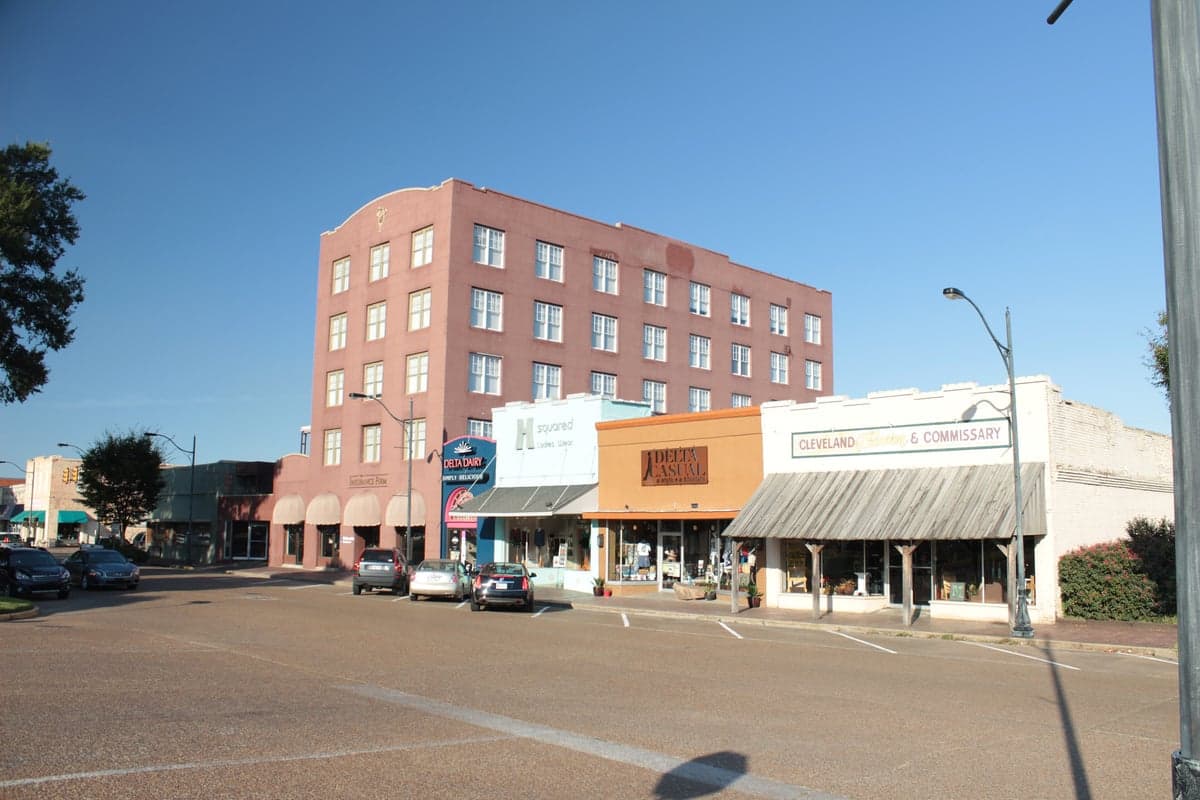
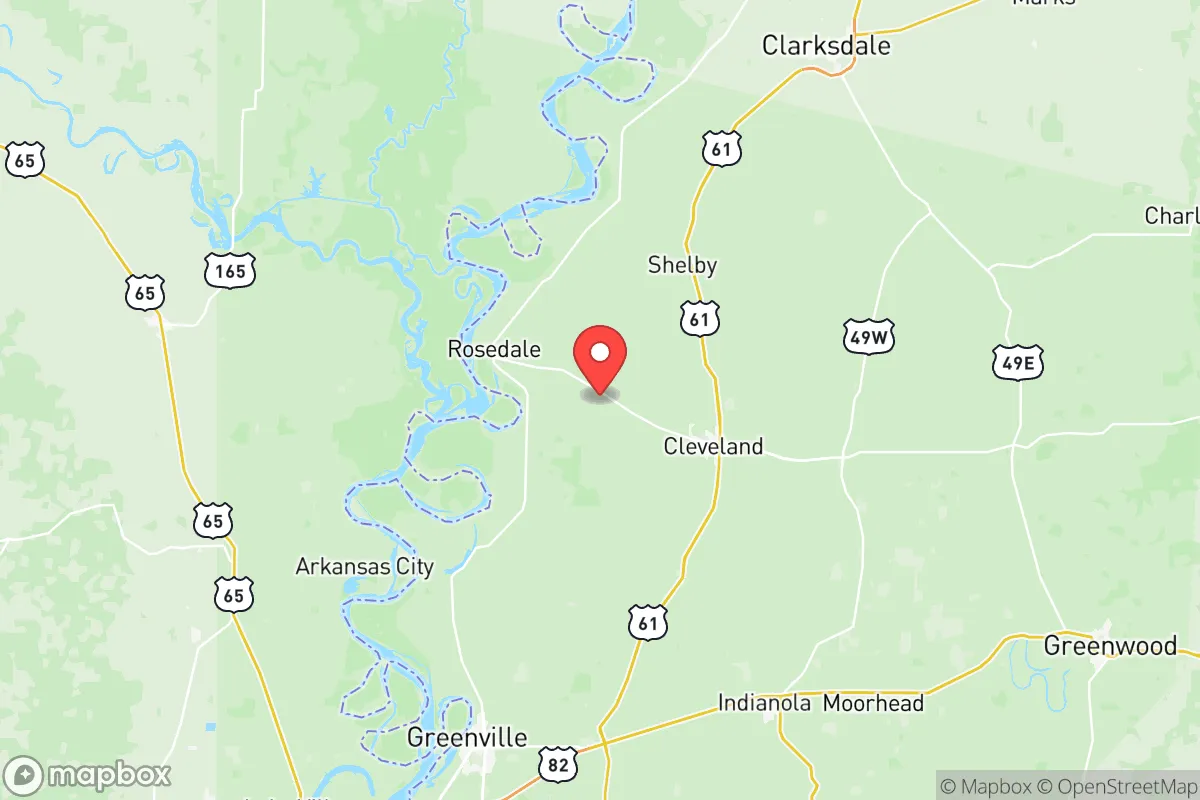
Bolivar County, Mississippi, is a predominantly rural, majority-Black Delta county of 30,163 residents defined by its deep agricultural roots and the slow demographic shifts of a region long in population decline. The county’s identity is shaped by its Mississippi River border, the legacy of plantation-era agriculture, and a population that is 63.2% Black, 30.6% White, and 2.5% Hispanic, with less than 2% foreign-born. Its largest population center is Cleveland, home to Delta State University, while smaller towns like Rosedale, Shaw, and Shelby anchor distinct communities with distinct histories. With a median age over 38 and a shrinking tax base, Bolivar County today is a place where longtime Delta families maintain deep generational roots while younger, college-educated residents often leave for opportunities elsewhere.
Settlement & growth (pre-1960)
The land now called Bolivar County was originally home to the Choctaw and Chickasaw nations, who ceded territory through a series of treaties—most notably the 1820 Treaty of Doak’s Stand and the 1830 Treaty of Dancing Rabbit Creek—that opened the Delta to American settlement. European-American settlers, primarily of Scots-Irish and English stock, arrived in the 1830s and 1840s, drawn by the promise of rich alluvial soil for cotton cultivation. The first county seat was established at Bolivar in 1836, a site now largely depopulated, before the seat moved to Rosedale in 1842, where it remained until it shifted to Cleveland in 1919. These early settlers built a plantation economy that relied almost entirely on enslaved Black labor; by 1860, enslaved people made up over 70% of the county’s population, a ratio that would persist into the postbellum era.
After the Civil War, freedmen and their descendants remained on the land as sharecroppers and tenant farmers, concentrating in small rural hamlets like Benoit, Gunnison, and Pace. The Great Migration (roughly 1915–1970) saw tens of thousands of Black Bolivar Countians leave for Chicago, St. Louis, and Memphis, seeking escape from Jim Crow laws and economic exploitation. The White population, meanwhile, was largely composed of landowners, merchants, and professionals who controlled the county’s political and economic life through the 1960s. A small but notable enclave of Lebanese and Syrian immigrants—mostly Christian merchants—settled in Cleveland and Rosedale in the early 1900s, establishing dry goods stores and later becoming an entrenched part of the local business elite. This group, though numerically tiny, marked the county’s most significant pre-1965 foreign-born influx outside of a few Italian families who worked as sharecroppers and small farmers in the 1910s.
Agriculture dominated through mid-century: cotton, soybeans, and rice were the economic mainstays, and the county’s population peaked at over 50,000 in the 1930s. The mechanization of farming after World War II triggered a second, quieter wave of out-migration, as tractors and chemical herbicides replaced hand labor and drove both Black and poor White tenants off the land. By 1960, the county’s population had fallen to around 37,000, a decline that has never reversed.
Modern era (post-1965)
The 1965 Hart-Cellar Act had almost no direct effect on Bolivar County, as the region attracted virtually no international immigration. The county’s foreign-born share remains just 1.7% today, among the lowest in Mississippi, and the small 0.6% East/Southeast Asian population is almost exclusively linked to faculty and staff at Delta State University in Cleveland. The 0.4% Indian-subcontinent population is similarly concentrated among university-affiliated professionals—engineers, doctors, and professors—who live mainly in Cleveland’s newer subdivisions near the campus.
The most consequential post-1965 demographic shift has been domestic: the continuation of Black out-migration to Southern cities. After the Civil Rights Act of 1964 ended legal segregation, many Black residents who had the means left for Memphis, Jackson, and Atlanta, seeking better schools, jobs, and housing. This “Second Great Migration” (often called the Reverse Great Migration when looking at national patterns) has steadily drained the county’s Black population from roughly 40,000 in 1970 to under 19,000 today. The White population, meanwhile, has also declined but at a slower rate, dropping from about 12,000 in 1970 to roughly 9,200 today, as manufacturing jobs in Cleveland—including the now-closed Baxter Healthcare plant and a Viking Range facility—provided some white-collar and skilled-labor anchors. Hispanic growth, primarily Mexican-American families working in catfish processing and poultry plants in places like Rosedale and Shaw, has been slow but steady, rising from less than 1% in 2000 to 2.5% today.
Suburbanization within the county has been minimal, but Cleveland has consolidated its role as the county’s hub. Newer subdivisions like Lake Hills and University Park draw university faculty and medical professionals to the eastern side of town, while the county’s smaller towns—Gunnison, Shelby, Renova—continue to lose population. Rosedale, the county’s former seat, has seen its population drop from over 3,000 in 1960 to under 1,000 today, a stark symbol of the county’s rural hollowing-out.
The future
Bolivar County’s population is projected to continue its long decline, falling below 25,000 by 2040 if current trends hold, according to the Mississippi Population Group. The county’s racial composition will likely become slightly more diverse at the margins: the Hispanic population is expected to grow slowly, potentially reaching 5–7% by 2040, as younger Mexican-American families settle in the catfish-processing towns of Shaw and Boyle. The East/Southeast Asian and Indian populations will likely remain small and university-tied, dependent on Delta State’s ability to attract international faculty and graduate students.
The Black share of the population may edge slightly higher as White out-migration continues faster than Black out-migration among older cohorts, but the difference is marginal. The most important trend is not racial change but overall shrinkage: the county is losing its young adults, especially the college-educated Black residents who graduate from Delta State and leave for larger labor markets. The remaining population is aging, with a growing share of residents over 60. This demographic pattern—decline, aging, and modest Hispanic in-fill—is common across the Mississippi Delta, and Bolivar County is unlikely to deviate from it without major new economic development.
Bolivar County in 2026 is a place of deep historical continuity and gradual demographic stagnation, where the echoes of the plantation era and the Great Migration still shape every community from Cleveland to Rosedale. For someone moving in now, the county offers affordability, a strong sense of place, and access to the natural beauty of the Mississippi River, but requires accepting a shrinking population base, limited economic diversification, and a social fabric that is still navigating the legacies of its segregated past.

* Values derived from national, state, county, city and local statistics and may differ in a specific area. Last updated: 2026-06-22T10:46:25.000Z
Narrative content on this page is AI-generated and may contain mistakes. Verify any details that matter before acting on them.
ReloMaps may earn a commission from affiliate links at no extra cost to you.

